Broadcom Stock Soars 10% as OpenAI Partners on Custom AI Chips in Multi-Billion Dollar Deal
Date: October 14, 2025
ChatGPT maker teams with chip giant to design 10 gigawatts of custom processors, marking major infrastructure expansion.
OpenAI dropped some major news: they're teaming up with chip giant Broadcom to design their own custom AI processors. It's a big move for the ChatGPT creator as demand for AI computing power continues to explode.
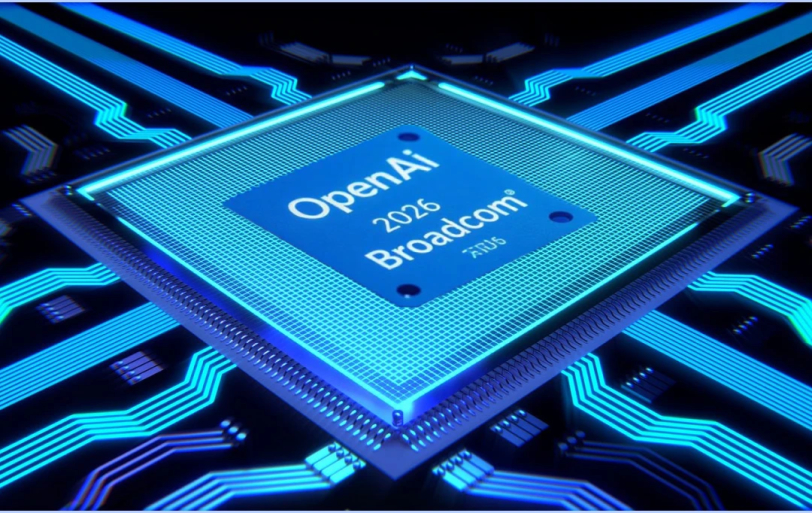
The multi-billion dollar agreement will see the two companies jointly develop and deploy 10 gigawatts of custom AI accelerators over the next four years, with rack deployments beginning in the second half of 2026 and continuing through 2029. Under the partnership, OpenAI will design the specialized chips while Broadcom handles development, fabrication, and deployment.
OpenAI CEO Sam Altman made it clear why this matters. "Partnering with Broadcom is a critical step in building the infrastructure needed to unlock AI's potential and deliver real benefits for people and businesses," he said.
Wall Street certainly took notice. The announcement sent Broadcom shares soaring nearly 10% on Monday, adding more than $150 billion to the chipmaker's market value and pushing its market capitalization past $1.5 trillion.
Massive Computing Power Play
The 10-gigawatt capacity represents a massive expansion of computing infrastructure, with power consumption roughly equivalent to the needs of more than 8 million U.S. households or five times the electricity produced by the Hoover Dam.
To put this in perspective, OpenAI currently operates on just over 2 gigawatts of compute capacity, which Altman said has been sufficient to scale ChatGPT to its current reach of over 800 million weekly active users.
"Even though it's vastly more than the world has today, we expect that very high-quality intelligence delivered very fast and at a very low price — the world will absorb it super fast and just find incredible new things to use it for," Altman said in a podcast released alongside the announcement.
The CEO revealed that OpenAI and Broadcom have been collaborating for approximately 18 months before making the partnership public.
Strategic Shift Toward Custom Silicon
The Broadcom deal places OpenAI among tech giants like Google, Amazon, and Meta that have moved to develop custom chips tailored to their specific AI workloads. By designing its own accelerators, OpenAI can embed insights from developing frontier models directly into the hardware, potentially achieving significant cost reductions and performance improvements.
"By building our own chip, we can embed what we've learned from creating frontier models and products directly into the hardware, unlocking new levels of capability and intelligence," said Greg Brockman, OpenAI's co-founder and president.
Brockman added that OpenAI used its own AI models to accelerate chip design, achieving substantial efficiency gains. "You take components that humans have already optimized and just pour compute into it, and the model comes out with its own optimizations," he explained in the podcast.
The systems will include Broadcom's end-to-end portfolio of Ethernet, PCIe, and optical connectivity solutions, with all networking scaled on Broadcom's Ethernet stack. According to Charlie Kawwas, president of Broadcom's Semiconductor Solutions Group, the collaboration "continues to set new industry benchmarks for the design and deployment of open, scalable and power-efficient AI clusters."
Part of Broader Infrastructure Push
The Broadcom partnership is the latest in a flurry of massive deals OpenAI has announced in recent weeks to secure computing capacity. The company has committed to roughly 33 gigawatts of compute across multiple partnerships, including a $100 billion agreement with Nvidia for 10 gigawatts of systems, a 6-gigawatt deal with AMD, and agreements with Oracle and other data center providers.
However, Kawwas clarified Monday that OpenAI is not the mysterious $10 billion customer Broadcom disclosed during its September earnings call, dispelling analyst speculation that had linked the two deals.
Questions About Sustainability
All this dealmaking raises an obvious question: how sustainable is this? OpenAI is pouring billions into infrastructure while still not turning a profit, despite impressive growth. Many of these partnerships involve circular financing arrangements, where companies simultaneously invest in OpenAI while supplying it with technology. This further fuels worries about a potential AI bubble.
Amazon founder Jeff Bezos touched on this at Italian Tech Week earlier this month, acknowledging we're probably in an AI bubble. But he added that some of these investments will likely pay off in the long run.
For Broadcom, the partnership represents a major validation of its position in the custom AI chip market. The company has been one of the biggest beneficiaries of the generative AI boom, with shares rising over 50% this year after more than doubling in 2024.
"OpenAI has been in the forefront of the AI revolution since the ChatGPT moment, and we are thrilled to co-develop and deploy 10 gigawatts of next-generation accelerators and network systems to pave the way for the future of AI," said Broadcom CEO Hock Tan.
What's becoming clear is that the race for AI dominance isn't just about better algorithms anymore. It's about who can secure the computing power to run them, and increasingly, that means building your own chips from the ground up.

By Arpit Dubey
Arpit is a dreamer, wanderer, and tech nerd who loves to jot down tech musings and updates. With a knack for crafting compelling narratives, Arpit has a sharp specialization in everything: from Predictive Analytics to Game Development, along with artificial intelligence (AI), Cloud Computing, IoT, and let’s not forget SaaS, healthcare, and more. Arpit crafts content that’s as strategic as it is compelling. With a Logician's mind, he is always chasing sunrises and tech advancements while secretly preparing for the robot uprising.
// Recommended
Pinterest Follows Amazon in Layoffs Trend, Shares Fall by 9%
AI-driven restructuring fuels Pinterest layoffs, mirroring Amazon’s strategy, as investors react sharply and question short-term growth and advertising momentum.

Clawdbot Rebrands to "Moltbot" After Anthropic Trademark Pressure: The Viral AI Agent That’s Selling Mac Minis
Clawdbot is now Moltbot. The open-source AI agent was renamed after Anthropic cited trademark concerns regarding its similarity to their Claude models.

Amazon Bungles 'Project Dawn' Layoff Launch With Premature Internal Email Leak
"Project Dawn" leaks trigger widespread panic as an accidental email leaves thousands of Amazon employees bracing for a corporate cull.

OpenAI Launches Prism, an AI-Native Workspace to Shake Up Scientific Research
Prism transforms the scientific workflow by automating LaTeX, citing literature, and turning raw research into publication-ready papers with GPT-5.2 precision.

Have newsworthy information in tech we can share with our community?

Related Content