Share It On:
 As cloud migration becomes the backbone of modern enterprises, the shift is no longer about infrastructure—it’s about competitive survival. Companies that embrace it gain the power to launch faster, adapt instantly, and outmaneuver rivals trapped in
 The year 2006 didn’t just change the rules of the game; it rewrote the entire rulebook. Amazon Web Services launched its public cloud platform, marking a tectonic shift in technology. It started as an internal infrastructure experiment for an online bookstore. Then, a spark of genius: 'Why not sell this excess computing power?' That decision birthed the modern public cloud era.
Fast forward to 2026. We are no longer debating if the cloud is necessary. We are debating how to survive without it.
- Remote work is no longer a perk; it is the operating standard for millions.
- Operational flexibility is the difference between market dominance and bankruptcy.
- Data security is a boardroom nightmare.
If your business is still clinging to physical servers in a basement, you aren't just behind the curve—you are anchoring yourself to a sinking ship. Customers demand millisecond latency. Competitors deploy features in hours. The legacy infrastructure model is dead. And to catch up, it’s time you include cloud migration cost in your budget.
What is Cloud Migration?
At its core, cloud migration is the process of moving digital business operations into the cloud. Think of it as a physical move, but instead of packing boxes, you are moving data, applications, and IT processes from on-premise data centers to a cloud computing environment.
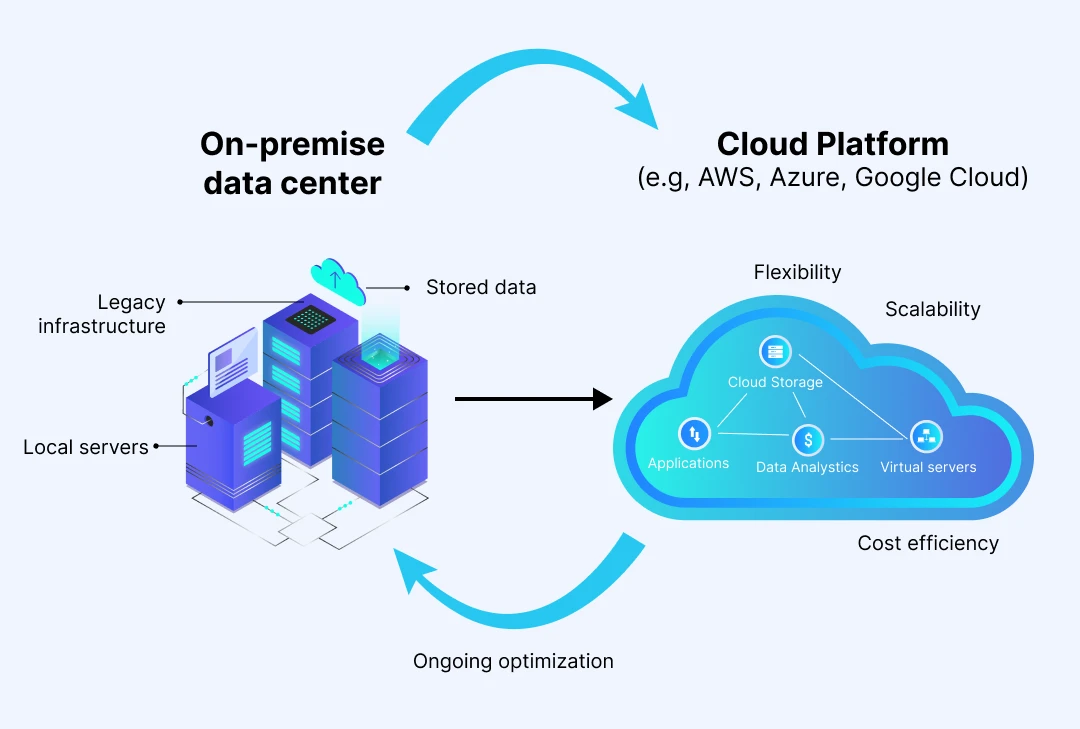
But don't be fooled by the simplicity of the definition. This isn't just a 'change of address' for your data. It is a fundamental re-engineering of how your business creates value. It often requires partnering with specialized cloud consulting firms to navigate the labyrinth of compliance and architecture.
Challenges in Cloud Migration: The Netflix Lesson
The Netflix story is the holy grail of cloud case studies, but few tell it correctly. In 2008, a massive database corruption halted their DVD shipping operations. It was a catastrophe. Management realized that relying on monolithic, on-premise hardware was a ticking time bomb. They chose to migrate to AWS.
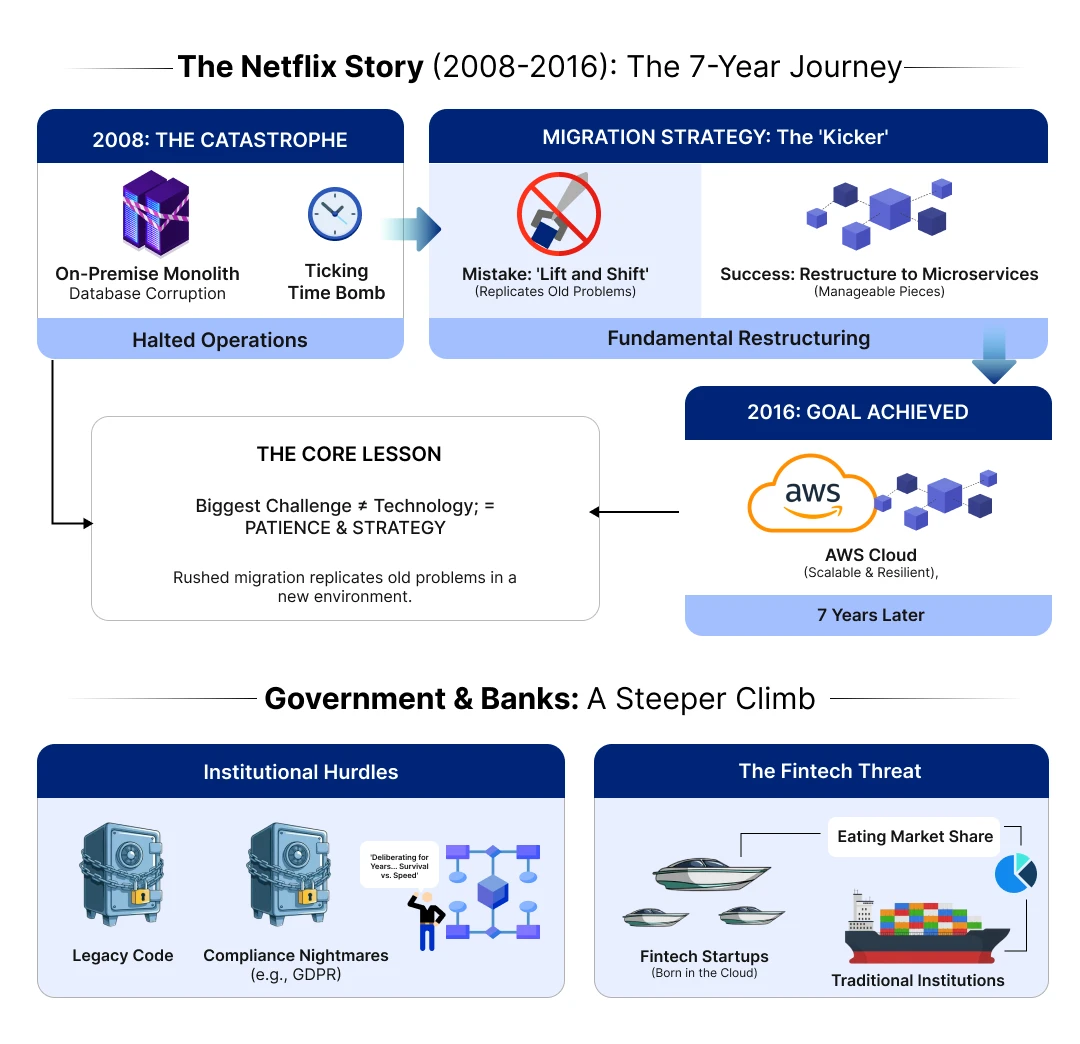
Here is the kicker: It took them seven years.
They finished in 2016. Why? Because they didn't just 'lift and shift.' They fundamentally restructured their application from a brittle monolithic to a microservices architecture. They broke their massive application into hundreds of smaller, manageable pieces.
The lesson? The biggest challenge in cloud migration is not technology; it is patience and strategy. A rushed migration replicates old problems in a new environment.
Government bodies and banks face an even steeper climb. When a financial institution moves to the cloud, the conversation isn't about speed; it's about survival amidst regulations like GDPR. They battle legacy code and compliance nightmares. While they deliberate for years, fintech startups born in the cloud eat their market share.
The Main Risks of Cloud Migration
Let’s be brutally honest. Cloud migration isn't a walk in the park; it’s a minefield. If you approach this as a simple 'server relocation,' you aren't just risking failure—you are architecting a disaster.
1. The Silent Killer: Unmapped App Dependencies
Outages rarely happen because a server explodes. They happen because of what you didn't see. Legacy systems are often a tangled mess of hard-coded IP addresses and forgotten connections.
Move a database but forget the obscure reporting script that queries it every Tuesday? You just broke the business. Failing to map app dependencies is the number one cause of prolonged blackouts. You cannot just flip a switch. You need rigorous functional testing to ensure the patient survives the transplant.
2. The 'Zombie' Invoice (Cost Shock)
The cloud runs on an operational expenditure model. That sounds great until you leave the meter running. The cloud loves to spend your money if you let it. According to the Flexera 2026 State of the Cloud Report, organizations estimate they waste 24% of their cloud spend.
This is almost always due to 'over-provisioning'—taking a server built for peak loads and running it 24/7 in the cloud. Without aggressive cost management, you are paying for capacity nobody uses. It is exactly like leaving the stadium lights on when the game is over.
3. The Skills Gap Crisis
Your IT team might be world-class at patching physical racks. That expertise does not translate to cloud-native apps. Cloud engineering is a different sport; it shifts from hardware maintenance to Infrastructure as Code.
A recent report by Pluralsight highlights the severity: 65% of organizations have had to abandon or pause projects purely because they lacked the skills. If you don't invest in training, you are handing the keys of a Formula 1 car to a driver who only knows how to ride a bicycle.
4. Vendor Lock-in: The Golden Handcuffs
Migrating to a specific cloud provider often tempts you to use their proprietary tools (like AWS Lambda). It boosts performance, sure. But it also handcuffs your business to their ecosystem. If that provider raises prices next year, leaving becomes a technical nightmare.
Smart architects hedge their bets by using containers and open standards, ensuring the target cloud architecture remains portable.
5. The 'Shared Responsibility' Trap
In your data center, you control the locks. In the cloud, the perimeter is gone. Many leaders fail to grasp the 'Shared Responsibility Model.' The provider secures the cloud, but you must secure what is in the cloud.
A misconfigured S3 bucket or weak identity and access management policy is the digital equivalent of leaving your front door wide open. Meeting security and compliance requirements (like HIPAA) requires a completely new toolkit and strict data governance.
6. Legacy Incompatibility
Not everything belongs in the cloud. Some legacy applications, especially those clinging to mainframes, simply cannot function in a modern environment without a complete rewrite. Trying to force-fit these into a hybrid cloud environment without refactoring is a recipe for latency issues that frustrate users and kill productivity.
Why Do It? The Real Business Benefits of Cloud Migration
If the risks are high, the rewards are existential.
1. Elasticity, Not Just Scalability
Scalability is growing; elasticity is breathing. In the cloud, resources expand and contract like lungs. During Black Friday, a retailer’s infrastructure can triple in size automatically and shrink back on Monday. You pay only for the spike. This level of agility accelerates AI in software development, allowing teams to spin up massive compute clusters for testing without purchasing hardware.
2. Financial Fluidity
CFOs love the shift from CapEx (Capital Expenditure) to OpEx (Operational Expenditure). You stop guessing how many servers you need for the next five years. You stop paying for electricity, cooling, and security guards. The cloud provider absorbs the overhead.
3. Innovation Velocity
This is the hidden killer app. On-premise, trying a new machine learning model requires a purchase order and weeks of setup. In the cloud, you click a button. This democratizes access to high-end AI development, letting a ten-person startup compete with a Fortune 500 R&D lab.
4. Security as a Moat, Not a Gate
There is a myth that the cloud is less secure than a locked server room. The opposite is true. Cloud providers like AWS and Azure invest billions annually into security research—a budget no single enterprise can match.
By leveraging identity and access management tools and enforcing a zero-trust architecture, you move from 'perimeter defense' (firewalls) to "identity defense" (verifying every user, every time). According to Check Point Software, AI-driven threat detection is the #1 cloud security trend for 2026, enabling automated responses to attacks that human teams would miss.
5. The 'Phoenix' Effect: Disaster Recovery
In the old world, disaster recovery meant renting a secondary data center that sat idle 99% of the time—a massive financial drain. In the cloud, you don't pay for the 'insurance' infrastructure until you actually need it.
If a hurricane takes out your HQ, your entire universal data platform can be spun up in a different region in minutes. With downtime costing enterprises up to $9,000 per minute (according to Ponemon Institute), this isn't just an IT strategy; it's business insurance.
6. Sustainability and ESG Goals
Green computing is no longer a buzzword; it's a procurement requirement. On-premise data centers are notoriously inefficient, often wasting electricity on cooling and idle servers. Migrating to the cloud allows you to piggyback on the provider's efficiency. A study by Microsoft and WSP found that cloud solutions can reduce carbon emissions by up to 90% for small businesses and 30% for large enterprises compared to on-premise equivalents.

Types of Cloud Migration
While cloud migration strategies define how you move, the 'type' defines what you are moving.
- Data Center Exit: The complete decommissioning of on-premise facilities. It involves moving everything—apps, data, and networking—to a universal data platform.
- Cloud-to-Cloud Migration: As the market matures, companies move from one provider to another (e.g., AWS to Azure) to leverage specific AI APIs or better pricing. This prevents vendor lock-in.
- Hybrid Cloud Migration: You move scalable workloads (like web front-ends) to the public cloud while keeping sensitive ledgers on-premise.
- Application-Specific: Moving a single critical workload, often to modernize it.
Cloud Migration Strategies: The "R" Frameworks
How do you actually move? We rely on the '6 Rs' of migration.
- Rehosting (Lift-and-Shift): The quickest method. You move the app 'as is.' It’s fast but inefficient. You don't gain cloud computing uses like auto-scaling, but you get out of the data center quickly.
- Replatforming: You tinker with the edges. You might swap a self-hosted database for Amazon RDS. It’s the 'lift, tinker, and shift' approach.
- Refactoring: The Netflix way. You rewrite the code to be cloud-native. This leverages the full power of cloud computing services but requires the most time and talent.
- Repurchasing: Drop the legacy software and buy SaaS (e.g., moving to Salesforce).
- Retiring: Turn off what you don't need.
- Retaining: Keep it where it is for now.
Steps in Cloud Migration: A 7-Step Model
According to industry-leading forecasts (Grand View Research), global cloud computing — led by public-cloud services — is set to expand from ~$750 billion in 2024 to well over $1.6–2.4 trillion by 2030, representing a steady CAGR of ~25% between 2026 and 2030.
The cloud market’s explosive growth will be driven by accelerating AI/ML adoption, digital-transformation programmes, and enterprises shifting workloads to cloud-native environments.
A well-structured cloud migration roadmap typically follows these key phases to ensure a smooth and low-risk transition:
- Discovery: You cannot migrate what you don't know. Audit your IT estate to map dependencies.
- Planning: Decide on the "R" strategy for every single app.
- Design: Architect the new environment. Ensure cloud tech in app development is aligned with security standards.
- Migration: Move the data. Start with low-priority apps to test how cloud mobile apps work in the new environment.
- Testing: Functional testing, security scanning, and load testing are mandatory.
- Cutover: The moment of truth where you switch traffic to the cloud.
- Optimization: Post-migration, you refine. This is where you implement cloud computing trends like FinOps to control costs.
Automation: The Engine of Speed
Manual migration is a recipe for disaster. Automation is non-negotiable.
"The last 12 years of cloud migration have primarily been about lift and shift, rehosting virtual infrastructure into the cloud for perceived quick wins. However, this approach hasn't adequately addressed technical debt in many cases. It has shifted it without optimizing for more mature cloud services and abstractions.”
— Keith Neilson, CEO and Founder of AppFactor
Tools like Terraform or Ansible allow for Infrastructure as Code (IaC). You define your environment in script files. This is critical for deploying complex cloud solutions for web app development, where consistency is key. Automation also facilitates the heavy lifting of data transfer, ensuring cloud storage services are synchronized without human error.
Business Cloud Migration Use Cases: Proof it Works
The theory is fine, but let's look at the reality.
- Airbnb: They handle millions of bookings daily. During peak seasons, their traffic spikes unpredictably. By leveraging the advantages of cloud backup and auto-scaling, they handle massive loads without owning a single server.
- General Electric (GE): The industrial giant moved to the cloud to integrate IoT across factories. They process massive streams of sensor data to predict equipment failure.
- Ukraine's Digital Infrastructure: In a dramatic example of resilience, Ukrainian government bodies migrated critical systems to Western clouds at the onset of the 2022 war. This wasn't about cost; it was about the physical safety of the registry. It highlights a critical use case: cloud cost optimization is secondary to survival.
Best Practices for Success
To ensure you don't become a statistic, adhere to these rules:
- Zero-Trust Architecture: The perimeter is dead. Verify every user and device.
- Bridge the Skills Gap: Train your team. They need to understand that the reason to use cloud apps isn't just for storage, but for computation.
- Focus on Governance: Use policy engines to prevent unauthorized resource creation.
The Verdict
Cloud migration has transformed from a technical option to a strategic imperative. The benefits—flexibility, speed, and innovation—outweigh the risks if managed correctly. This is especially true for organizations exploring Cloud Migration for Enterprises to modernize infrastructure, improve scalability, and accelerate digital transformation initiatives.
Companies that view this as a strategic transformation, rather than a hardware swap, will dominate the next decade. The technology is ready. The question is, is your culture ready to move?
Frequently Asked Questions
What are the 4 R's of cloud migration?
While Gartner expanded this to 6, the original 4 R's were Rehost, Refactor, Revise, and Replace. These represent the core decisions you make for any application: move it, fix it, change it, or buy a new one.
What is the 7-step model of migration?
It is a structured lifecycle: Assessment, Planning, Design, Execution, Testing, Cutover, and Optimization. Skipping the early steps (Assessment) is the #1 cause of project failure.
What are the five phases of cloud migration?
Often called the 'Migration Lifecycle,' these are: Preparation, Portfolio Discovery, Application Design, Migration/Validation, and Operating Model evolution.

Uncover executable insights, extensive research, and expert opinions in one place.
Related Content