OpenAI Broadens Access to Deep Research with New Lightweight Version for ChatGPT Users
Date: April 25, 2025
OpenAI's new lightweight Deep Research tool brings advanced AI-powered research capabilities to all ChatGPT users, enhancing accessibility and efficiency.
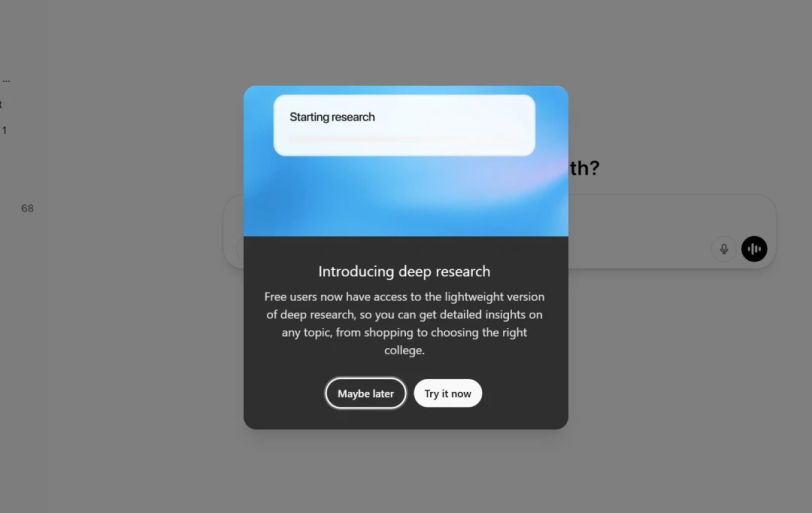
OpenAI has unveiled a streamlined version of its Deep Research tool, now accessible to all ChatGPT users, including those on the free tier. This "lightweight" variant aims to deliver comprehensive research capabilities while optimizing performance and cost-effectiveness.
Enhanced Accessibility Across User Tiers
The lightweight Deep Research tool is powered by OpenAI's o4-mini model, designed to maintain high-quality outputs with reduced computational demands. This efficiency allows OpenAI to extend the tool's availability beyond its initial Pro user base. According to OpenAI, the lightweight version "maintains much of the depth and quality of the original" while offering shorter response times.
Usage Limits Based on Subscription Levels
OpenAI has outlined specific usage limits for the Deep Research tool across different ChatGPT subscription tiers:
- Free Users: Up to 5 tasks per month using the lightweight version.
- Plus & Team Users: 10 tasks per month with the standard version, plus an additional 15 tasks with the lightweight version.
- Pro Users: 125 tasks per month with the standard version, plus an additional 125 tasks with the lightweight version.
- Enterprise Users: 10 tasks per month, with plans to match Team tier limits in the near future.
Functionality and Performance
The Deep Research tool enables ChatGPT to autonomously browse the web, analyze data, and generate detailed reports complete with citations. While the lightweight version offers slightly shorter responses, it retains the tool's core capabilities, including multi-step reasoning and real-time information synthesis. OpenAI notes that once users reach their limit for the standard Deep Research tool, queries will automatically default to the lightweight version, ensuring uninterrupted service.
Strategic Implications
The introduction of the lightweight Deep Research tool reflects OpenAI's commitment to making advanced AI tools more accessible and scalable. By optimizing resource usage without compromising on quality, OpenAI aims to broaden the adoption of its AI capabilities across a diverse user base.

By Arpit Dubey
Arpit is a dreamer, wanderer, and tech nerd who loves to jot down tech musings and updates. With a knack for crafting compelling narratives, Arpit has a sharp specialization in everything: from Predictive Analytics to Game Development, along with artificial intelligence (AI), Cloud Computing, IoT, and let’s not forget SaaS, healthcare, and more. Arpit crafts content that’s as strategic as it is compelling. With a Logician's mind, he is always chasing sunrises and tech advancements while secretly preparing for the robot uprising.
// Recommended
Pinterest Follows Amazon in Layoffs Trend, Shares Fall by 9%
AI-driven restructuring fuels Pinterest layoffs, mirroring Amazon’s strategy, as investors react sharply and question short-term growth and advertising momentum.

Clawdbot Rebrands to "Moltbot" After Anthropic Trademark Pressure: The Viral AI Agent That’s Selling Mac Minis
Clawdbot is now Moltbot. The open-source AI agent was renamed after Anthropic cited trademark concerns regarding its similarity to their Claude models.

Amazon Bungles 'Project Dawn' Layoff Launch With Premature Internal Email Leak
"Project Dawn" leaks trigger widespread panic as an accidental email leaves thousands of Amazon employees bracing for a corporate cull.

OpenAI Launches Prism, an AI-Native Workspace to Shake Up Scientific Research
Prism transforms the scientific workflow by automating LaTeX, citing literature, and turning raw research into publication-ready papers with GPT-5.2 precision.

Have newsworthy information in tech we can share with our community?

Related Content