Nvidia, AMD to Pay 15% of China Chip Revenues to US in Unprecedented Export Deal
Date: August 11, 2025
Unprecedented revenue-sharing deal requires chipmakers to pay billions from AI chip sales as a condition for securing Chinese export licenses.
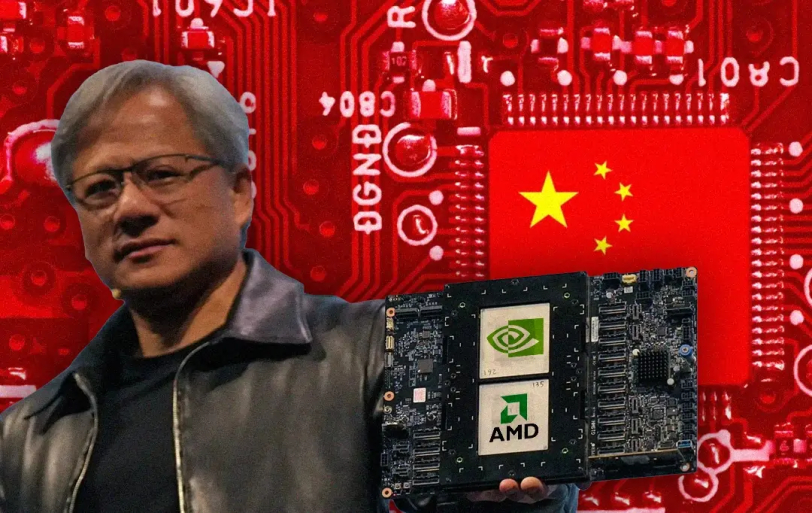
Chipmaking giants Nvidia Corp. and Advanced Micro Devices Inc. have agreed to pay the U.S. government 15% of their revenues from artificial intelligence chip sales in China, marking an unprecedented arrangement to secure export licenses from the Trump administration, according to multiple sources familiar with the matter.
The unusual revenue-sharing deal, first reported by the Financial Times on Sunday, applies specifically to Nvidia's H20 AI accelerator and AMD's MI308 chips — both crucial components for artificial intelligence applications. The agreement represents the first time U.S. companies have been required to share revenue as a condition for export approval.
Billions at Stake
The financial implications of this arrangement are substantial. Bernstein analysts estimate that Nvidia could have sold approximately 1.5 million H20 chips to China in 2025, potentially generating around $23 billion in revenue. Under the 15% agreement, this would funnel more than $3 billion directly to the U.S. government from Nvidia's sales alone.
"We follow rules the U.S. government sets for our participation in worldwide markets," an Nvidia spokesperson said in a statement to Reuters. "While we haven't shipped H20 to China for months, we hope export control rules will let America compete in China and worldwide."
The deal comes after months of disruption to both companies' China operations. In April, the Trump administration effectively halted H20 sales to China, requiring special export licenses. Nvidia CEO Jensen Huang had previously stated that the restrictions cost the company $2.5 billion in the first quarter of 2025, with an expected $8 billion loss in the second quarter.
An Unprecedented Arrangement
Export control specialists describe the revenue-sharing requirement as unprecedented in U.S. trade policy. "While export controls for sensitive products are nothing new, charging a company 15% of its revenue to sell a particular product to a particular country is unprecedented," a Trump administration official confirmed to Axios.
The arrangement emerged after a series of high-level meetings, including a session between Nvidia CEO Jensen Huang and President Trump at the White House last week. The Commerce Department began issuing H20 licenses on Friday, two days after that meeting, according to the Financial Times.
Two people familiar with the arrangement told the Financial Times that the Trump administration had not yet determined how to use the money generated from this revenue-sharing deal.
National Security Concerns
The agreement has sparked controversy among national security experts. Former deputy national security adviser Matt Pottinger and 19 other officials wrote to Commerce Secretary Howard Lutnick, urging the government not to issue H20 licenses, warning that the chip is a "potent accelerator" for China's AI development and could ultimately aid its military capabilities.
Some Bureau of Industry and Security (BIS) officials reportedly shared these concerns, fearing the decision could weaken U.S. leadership in artificial intelligence. However, Nvidia has rejected these claims as "misguided," insisting the H20 is unsuitable for military use.
With billions of dollars and strategic technology leadership at stake, this unprecedented revenue-sharing arrangement may set a new precedent for how the U.S. government manages technology exports to strategic rivals while attempting to capture economic benefits from restricted trade.

By Arpit Dubey
Arpit is a dreamer, wanderer, and tech nerd who loves to jot down tech musings and updates. With a knack for crafting compelling narratives, Arpit has a sharp specialization in everything: from Predictive Analytics to Game Development, along with artificial intelligence (AI), Cloud Computing, IoT, and let’s not forget SaaS, healthcare, and more. Arpit crafts content that’s as strategic as it is compelling. With a Logician's mind, he is always chasing sunrises and tech advancements while secretly preparing for the robot uprising.
// Recommended
Pinterest Follows Amazon in Layoffs Trend, Shares Fall by 9%
AI-driven restructuring fuels Pinterest layoffs, mirroring Amazon’s strategy, as investors react sharply and question short-term growth and advertising momentum.

Clawdbot Rebrands to "Moltbot" After Anthropic Trademark Pressure: The Viral AI Agent That’s Selling Mac Minis
Clawdbot is now Moltbot. The open-source AI agent was renamed after Anthropic cited trademark concerns regarding its similarity to their Claude models.

Amazon Bungles 'Project Dawn' Layoff Launch With Premature Internal Email Leak
"Project Dawn" leaks trigger widespread panic as an accidental email leaves thousands of Amazon employees bracing for a corporate cull.

OpenAI Launches Prism, an AI-Native Workspace to Shake Up Scientific Research
Prism transforms the scientific workflow by automating LaTeX, citing literature, and turning raw research into publication-ready papers with GPT-5.2 precision.

Have newsworthy information in tech we can share with our community?

Related Content