Huawei Takes Aim at Nvidia with New Ascend 910D AI Chip
Date: April 28, 2025
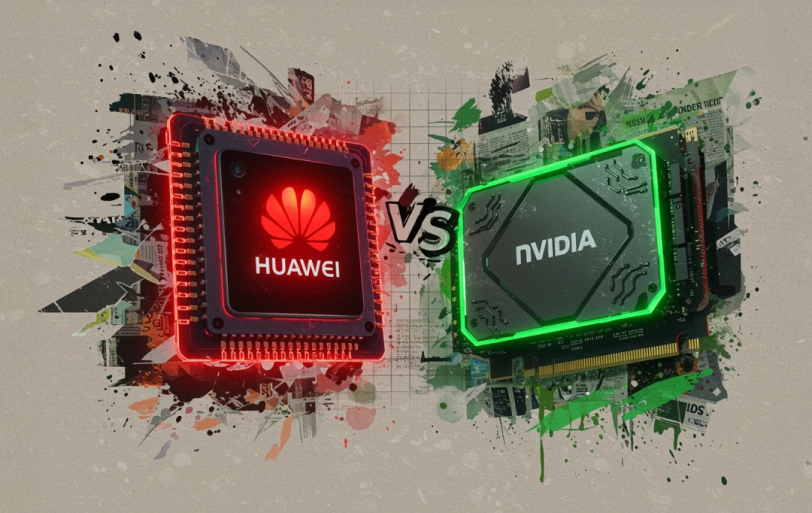
Huawei's Ascend 910D chip emerges as China's answer to Nvidia's H100, marking a pivotal shift in AI hardware competition.
Huawei is stepping deeper into the artificial intelligence race, and this time, it’s coming straight for Nvidia.
The Chinese tech giant has quietly developed its most advanced AI processor yet — the Ascend 910D — as part of its growing effort to build homegrown alternatives to U.S. technology. According to a report from The Wall Street Journal, Huawei hopes its new chip will match or even surpass Nvidia’s industry-leading H100 model, a benchmark in AI computing.
In fact, research firm SemiAnalysis stated, “Having five times as many Ascends more than offsets each GPU being only one-third the performance of an Nvidia Blackwell.” They further noted, “The deficiencies in power are relevant but not a limiting factor in China.”
Early testing is already underway. Huawei is said to be working with several domestic firms to trial the Ascend 910D’s capabilities, with wider availability expected by late May. If successful, it could be a major breakthrough for China’s tech ambitions, particularly as U.S. export controls tighten around access to Nvidia’s cutting-edge chips.
But Huawei isn't stopping there. The company is also preparing to ramp up shipments of its Ascend 910C chip — a design that stitches two 910B processors together to double performance and memory bandwidth. According to sources cited by Reuters, the 910C is already showing performance levels comparable to Nvidia’s H100, further bolstering China’s push to reduce reliance on U.S. hardware.
The timing couldn’t be more critical!
With Washington clamping down on exports of high-end semiconductors like Nvidia's H100 and the newer B200, Chinese companies have found themselves scrambling for powerful alternatives. Huawei’s new chips — if they live up to expectations — could offer a much-needed solution.
Bloomberg also pointed out that Huawei’s latest move is part of a broader strategy to reshape global tech supply chains, as geopolitical tensions between the U.S. and China continue to reshape innovation paths.
While Huawei’s past efforts in chip development have faced challenges — particularly around manufacturing under sanctions — the success of the Ascend 910D could mark a turning point, not just for the company, but for China’s broader AI ambitions.
For now, all eyes are on the May tests. If the numbers add up, Nvidia may find itself facing a serious new competitor from across the Pacific.

By Arpit Dubey
Arpit is a dreamer, wanderer, and tech nerd who loves to jot down tech musings and updates. With a knack for crafting compelling narratives, Arpit has a sharp specialization in everything: from Predictive Analytics to Game Development, along with artificial intelligence (AI), Cloud Computing, IoT, and let’s not forget SaaS, healthcare, and more. Arpit crafts content that’s as strategic as it is compelling. With a Logician's mind, he is always chasing sunrises and tech advancements while secretly preparing for the robot uprising.
// Recommended
Pinterest Follows Amazon in Layoffs Trend, Shares Fall by 9%
AI-driven restructuring fuels Pinterest layoffs, mirroring Amazon’s strategy, as investors react sharply and question short-term growth and advertising momentum.

Clawdbot Rebrands to "Moltbot" After Anthropic Trademark Pressure: The Viral AI Agent That’s Selling Mac Minis
Clawdbot is now Moltbot. The open-source AI agent was renamed after Anthropic cited trademark concerns regarding its similarity to their Claude models.

Amazon Bungles 'Project Dawn' Layoff Launch With Premature Internal Email Leak
"Project Dawn" leaks trigger widespread panic as an accidental email leaves thousands of Amazon employees bracing for a corporate cull.

OpenAI Launches Prism, an AI-Native Workspace to Shake Up Scientific Research
Prism transforms the scientific workflow by automating LaTeX, citing literature, and turning raw research into publication-ready papers with GPT-5.2 precision.

Have newsworthy information in tech we can share with our community?

Related Content