Apple's 14-inch MacBook Pro Gets M5 Chip Upgrade and Faster Storage
Date: October 16, 2025
New processor delivers 4x faster AI performance and 45% graphics boost while maintaining $1,599 starting price point.
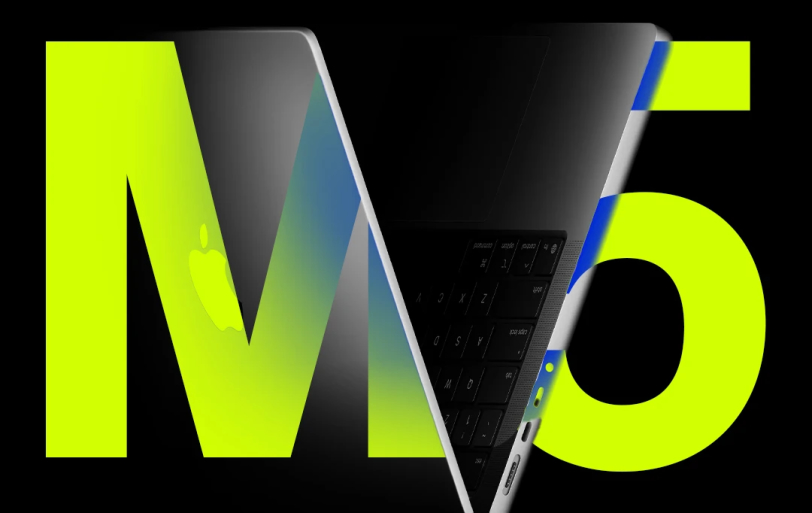
Apple unveiled its newest 14-inch MacBook Pro on Wednesday, powered by the company's M5 chip. The chip enhancement promises significant performance gains in artificial intelligence workloads while maintaining the same $1,599 starting price as its predecessor.
The announcement marks a departure from Apple's typical release strategy. Unlike last year's simultaneous launch of M4, M4 Pro, and M4 Max models, the company is releasing only the base M5 chip configuration for now, with Pro and Max variants expected in early 2026.
AI Performance Takes Center Stage
The M5 chip represents what Apple calls "the next big leap in AI performance" for its silicon lineup. Built on third-generation 3-nanometer technology, the processor features a redesigned 10-core GPU architecture with a Neural Accelerator embedded in each core.
"M5 marks the next big leap in AI for the Mac and delivers a huge boost in graphics performance, accelerating demanding workflows for everyone from students to creatives, developers to business professionals, and more," said John Ternus, Apple's senior vice president of Hardware Engineering.
According to Apple's testing, the M5 delivers over four times the peak GPU compute performance compared to M4 for AI tasks, and six times compared to the M1 chip. The company claims users will see up to 3.5 times better AI performance in real-world workflows, such as running diffusion models in applications like Draw Things or operating large language models locally.
Enhanced Graphics and Processing Power
Beyond AI capabilities, the M5 brings substantial improvements to graphics performance. Apple reports the chip achieves up to 45 percent higher graphics performance than M4, thanks to enhanced shader cores and third-generation ray tracing technology. For gaming and graphics-intensive applications, users can expect up to 1.6 times faster frame rates compared to the previous generation.
The CPU component features what Apple describes as "the world's fastest performance core," with a 10-core configuration split between four performance cores and six efficiency cores. This translates to up to 15 percent faster multithreaded performance over M4, according to Apple's benchmarks.
"M5 ushers in the next big leap in AI performance for Apple silicon," said Johny Srouji, Apple's senior vice president of Hardware Technologies. "With the introduction of Neural Accelerators in the GPU, M5 delivers a huge boost to AI workloads."
Faster Storage and Memory Upgrades
A notable improvement comes in storage performance. The new MacBook Pro features doubled SSD speeds compared to the M4 model, which should significantly benefit tasks like importing RAW image files or exporting large video projects. Storage configurations now extend up to 4TB, double the previous maximum of 2TB.
Memory bandwidth has also received a boost, with unified memory bandwidth reaching 153GB/s (nearly 30 percent higher than M4). The base model starts with 16GB of unified memory, with options for 24GB or 32GB configurations.
Familiar Design, Trustworthy Features
So, Apple’s stuck with the same look for the MacBook Pro, and the 14-inch version still has that sleek aluminum body in space black and silver. You still get that 14.2-inch Liquid Retina XDR display, which is great because it has ProMotion tech that lets it refresh up to 120Hz. And if you want, there’s also this optional nano-texture glass treatment to cut down on glare.
Everything else carries over from the M4 model. That includes the sweet 12MP Center Stage camera, six-speaker audio, and all the ports you desire with Thunderbolt support. Apple also promises up to 24 hours of battery life, and that's very impressive for laptops.
Pricing and Availability
The latest 14-inch MacBook Pro with M5 can now be pre-ordered from Wednesday, with the laptops shipping from October 22. The entry version with a $1,599 price tag sports 16GB of memory and 512GB in storage, and also sports the same M4 model replacement price tag.
So take a look: Apple's still selling the M4 Pro and M4 Max versions of the 14-inch and 16-inch MacBook Pro lines, and they begin at $1,999 and $2,499. But, proviso: Those more expensive models' prices won't go up with M5 Pro and M5 Max chips until late in the first quarter of 2026, the industry says.
The M5 chip also debuts simultaneously in Apple's 11-inch and 13-inch iPad Pro models and an updated Apple Vision Pro headset, all available for pre-order on the same timeline.

By Arpit Dubey
Arpit is a dreamer, wanderer, and tech nerd who loves to jot down tech musings and updates. With a knack for crafting compelling narratives, Arpit has a sharp specialization in everything: from Predictive Analytics to Game Development, along with artificial intelligence (AI), Cloud Computing, IoT, and let’s not forget SaaS, healthcare, and more. Arpit crafts content that’s as strategic as it is compelling. With a Logician's mind, he is always chasing sunrises and tech advancements while secretly preparing for the robot uprising.
// Recommended
Pinterest Follows Amazon in Layoffs Trend, Shares Fall by 9%
AI-driven restructuring fuels Pinterest layoffs, mirroring Amazon’s strategy, as investors react sharply and question short-term growth and advertising momentum.

Clawdbot Rebrands to "Moltbot" After Anthropic Trademark Pressure: The Viral AI Agent That’s Selling Mac Minis
Clawdbot is now Moltbot. The open-source AI agent was renamed after Anthropic cited trademark concerns regarding its similarity to their Claude models.

Amazon Bungles 'Project Dawn' Layoff Launch With Premature Internal Email Leak
"Project Dawn" leaks trigger widespread panic as an accidental email leaves thousands of Amazon employees bracing for a corporate cull.

OpenAI Launches Prism, an AI-Native Workspace to Shake Up Scientific Research
Prism transforms the scientific workflow by automating LaTeX, citing literature, and turning raw research into publication-ready papers with GPT-5.2 precision.

Have newsworthy information in tech we can share with our community?

Related Content