Apple Bets Big on Its AI: A Personal Robot, a Lifelike Siri, and a Smart Home Ecosystem
Date: August 14, 2025
What's next for Apple? A secret roadmap details the company's future in AI, including a "Pixar Lamp" style robot, a smarter Siri, and a new smart home lineup.
In a strategic bid to restore its mojo and mount a formidable comeback in the artificial intelligence race, Apple Inc. is developing an ambitious lineup of new hardware, including personal robots and a full suite of smart home devices. This has come after a recent announcement by Apple CEO Tim Cook that the company will be heavily investing in AI. He added,
“We are significantly growing our investment. We did during the June quarter. We will again in the September quarter.”
According to people with knowledge of the matter, the plans, which pushed Apple shares to a session high upon being reported, are part of a major effort to counter criticism of falling behind in generative AI and to find new sources of revenue after shelving its car project.
While Apple officially declined to comment, the internal excitement is palpable. "The product pipeline — which I can’t talk about- it’s amazing, guys. It’s amazing,” CEO Tim Cook told employees in a recent all-hands meeting. “Some of it you’ll see soon. Some of it will come later. But there’s a lot to see.”
The Next Frontier: Personal and Industrial Robotics
At the heart of Apple’s AI hardware strategy is a push into robotics, a field led in part by Kevin Lynch, who previously headed software for the Apple Watch.
The Tabletop Companion (J595)
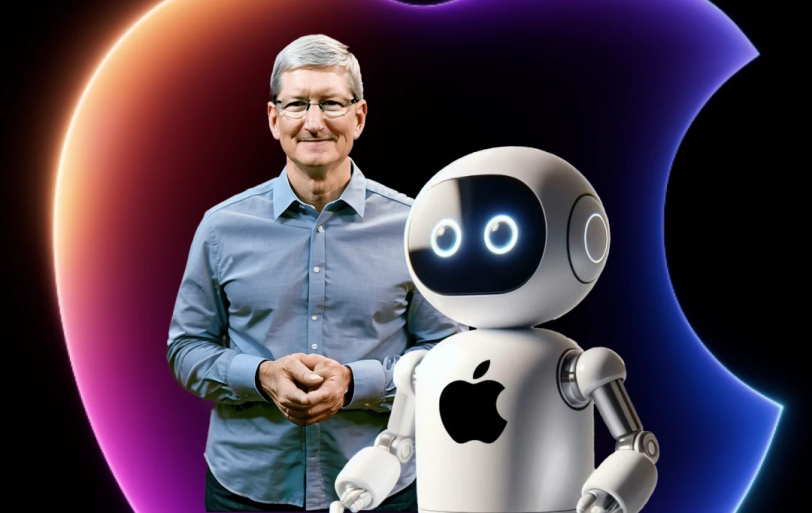
Targeted for 2027, the centerpiece is a tabletop robot designed to be a virtual companion. The device, which sources say resembles an iPad mounted on a movable limb, can follow users in a room and turn its head toward a person who is speaking. Some insiders have nicknamed it the Pixar Lamp for its animated movements. Its 7-inch display sits on an arm that can extend about half a foot in any direction.
Beyond managing a user's day, its hallmark is a new, proactive Siri that can inject itself into conversations to make suggestions. A key function will be enhanced FaceTime calls, where the display can lock onto people around a room. Apple is even testing a feature that turns an iPhone into a joystick to control the robot's view during video calls.
Broader Ambitions
Apple’s robotics exploration doesn’t end there. Teams are also developing a mobile bot with wheels, similar to Amazon's Astro, and have had discussions about humanoid models. Furthermore, a group is actively developing a large mechanical arm (code-named T1333) for use in manufacturing or retail stores, though it remains several years away.
A Full-Scale Push into the Smart Home
Before the robot arrives, Apple plans a serious entry into the smart home market, a category it has so far struggled to penetrate.
- Smart Display (J490): Slated to arrive by the middle of next year, this device is a stripped-down version of the robot without the arm. The 7-inch display, which looks like a square Google Nest Hub with rounded corners, sits on a half-dome-shaped base and can also be wall-mounted.
- Home Security (J450): To compete with Amazon Ring, Apple is working on battery-powered cameras that can last from several months to a year on a single charge. Using facial recognition and infrared sensors, the cameras will enable home automation, like turning off lights when a room is empty. The company has also tested a doorbell that uses facial recognition to unlock a door.
The Software Powering the Vision
This new hardware will be driven by fundamentally new software, representing a massive internal effort.
Charismatic Operating System
The home devices will run on a new multi-user operating system dubbed Charismatic, formerly known as Pebble and Rock. Blending the approach of the Apple TV and Apple Watch operating systems, it uses a front-facing camera to recognize individuals and instantly personalize the layout, which is centered on widgets and clock faces (including a Snoopy theme). Voice interaction via an upgraded App Intent feature will be the primary input method.
Siri's Rebirth
Core to everything is a complete overhaul of Siri using large language models (LLMs). The effort is so significant that Software Engineering Chief Craig Federighi told employees during an overhaul meeting that
"The work we’ve done on this end-to-end revamp of Siri has given us the results we needed,” he said, adding that "this has put us in a position to not just deliver what we announced, but to deliver a much bigger upgrade than we envisioned.”
This revamp, overseen by former Vision Pro chief Mike Rockwell, includes two parallel efforts: Linwood, an in-house brain using Apple's own technology, and Glenwood, which explores using outside models from partners like Anthropic. To make Siri feel more lifelike, Apple is developing a visual personality dubbed Bubbles, with designers considering ideas that range from an animated version of the Mac's Finder logo to its playful Memoji characters.
This ambitious roadmap, which also includes thinner iPhones, smart glasses, foldable phones, and a revamped N100 headset, is Apple's response to a challenging landscape. The company faces pressure to innovate after the Vision Pro's slow start and growing competition from Samsung, Meta, and even a potential new AI device from OpenAI developed with former Apple design chief Jony Ive. The unannounced plans, while subject to change, signal a clear and aggressive direction for Apple's future.

By Arpit Dubey
Arpit is a dreamer, wanderer, and tech nerd who loves to jot down tech musings and updates. With a knack for crafting compelling narratives, Arpit has a sharp specialization in everything: from Predictive Analytics to Game Development, along with artificial intelligence (AI), Cloud Computing, IoT, and let’s not forget SaaS, healthcare, and more. Arpit crafts content that’s as strategic as it is compelling. With a Logician's mind, he is always chasing sunrises and tech advancements while secretly preparing for the robot uprising.
// Recommended
Pinterest Follows Amazon in Layoffs Trend, Shares Fall by 9%
AI-driven restructuring fuels Pinterest layoffs, mirroring Amazon’s strategy, as investors react sharply and question short-term growth and advertising momentum.

Clawdbot Rebrands to "Moltbot" After Anthropic Trademark Pressure: The Viral AI Agent That’s Selling Mac Minis
Clawdbot is now Moltbot. The open-source AI agent was renamed after Anthropic cited trademark concerns regarding its similarity to their Claude models.

Amazon Bungles 'Project Dawn' Layoff Launch With Premature Internal Email Leak
"Project Dawn" leaks trigger widespread panic as an accidental email leaves thousands of Amazon employees bracing for a corporate cull.

OpenAI Launches Prism, an AI-Native Workspace to Shake Up Scientific Research
Prism transforms the scientific workflow by automating LaTeX, citing literature, and turning raw research into publication-ready papers with GPT-5.2 precision.

Have newsworthy information in tech we can share with our community?

Related Content