Share It On:
 How Artificial Intelligence and IoT are merging to create smarter, self-learning systems
Imagine devices that don't just collect data, they interpret it, learn from it, and act on it intelligently. This is AIoT, or Artificial Intelligence of Things. As the term gives it away, it’s a powerful convergence of artificial intelligence and the Internet of Things.
This modern tech fusion is a combination of two of the most prominent technologies of our era. IoT links the billions of devices to collect data, and AIoT integrates intelligence into the systems. It is like a sensor that notifies of temperature and a smart thermostat that is also capable of learning your habits and optimizing the temperature to your desired preference.
AIoT and its popularity are enormous: the world AIoT market is expected to be $896.8 billion by 2030 alone (GrandViewResearch). This is an indication of how combining AI with IoT enhances the ability of devices and improves efficiency across industries.
Now, let's delve in depth and help you answer the question: What is AIoT? here.
What is Artificial Intelligence of Things (AIoT)?
AIoT allows your IoT devices to think and make decisions autonomously. These devices do not just send data to the cloud for analysis; they also locally process data and learn about activities in real time.
For example, an Internet of Things (IoT), powered coffee maker is connected with your phone, and the coffee maker begins to brew when you click the button. An AIoT coffee machine, however, gets to know that you get up at 7 AM during weekdays and 9 AM during weekends. It noticed that you like stronger coffee on Mondays, and it automatically changes. It even orders beans before it runs out in your kitchen.
The key aspect of this integration is centered around the change in technology, whereby AIoT is more proactive than reactive. The AIoT devices do not wait; they read your habits, learn with time, and get better as you continue using them without the need to use a human interface.
How does AIoT work?
AIoT operates through a cycle where smart devices collect information, AI analyzes it, and systems adapt based on what they learn. Let's break down this process into four key stages.
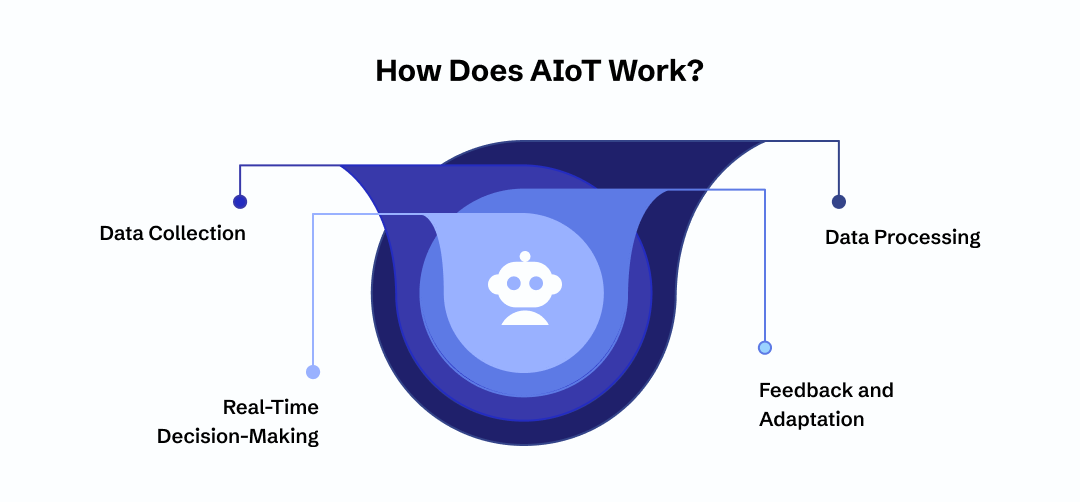
1. Data Collection by IoT Devices
It all begins with sensors and smart devices that are able to capture data from the environment they’re present in. These IoT devices track all sorts of parameters, which may include temperature, movement, noise, position, usage habits, and so on. This stream of data produces a vivid image of the actual situation that can be analyzed and responded to by AI.
2. Data Processing and Analysis by AI
After collecting data, AI algorithms will work on analyzing the collected data to discover meaningful patterns and insights. AIoT can analyze this data on the device. It identifies recent AI trends, anomalies, and correlations that humans may overlook. This smart analysis converts the raw data figures into insights.
3. Real-Time Decision-Making
With all the information, AIoT systems can make decisions immediately and do not require human approval. For instance, a robot working in an industry changes its grip strength depending on the object that it is working on. These decisions are made in a split second, so that your systems are ready to act on the evolving conditions as they face the situation.
4. Feedback Loops and System Adaptation
The AIoT systems improve their performance based on feedback loops that enable them to learn. Once a decision is made, the system follows up on the outcomes and changes its strategy in the future. In case your smart thermostat had overcooled your house yesterday, it adjusts the settings for the next day.
This is because your AIoT devices are constantly learning, becoming smarter as time goes by, and adjusting themselves to your dynamic situations without the need to manually reprogram the devices.
Key Components of AIoT
AIoT is based on four key elements that interact to form intelligent receptive systems.
1. IoT Devices and Sensors
These are the hardware that interact with the real world, such as basic temperature sensors, motion sensors, intelligent cameras, or wearable health trackers. They constantly gather information regarding the surroundings, which serves as the eyes and ears of AIoT systems. Intelligent decision-making is fueled by raw information that is collected by these devices.
2. Artificial Intelligence (AI) Algorithms
AI programs convert data gathered into actionable insights. Machine learning models identify patterns, computer vision assists the cameras to identify objects, and predictive analytics software forecasts the future.
Moreover, voice assistants can comprehend commands with the help of natural language processing. These algorithms keep improving as they learn with the passing of time.
3. On-Device Machine Learning and Edge Computing
Edge computing brings processing power directly to your devices rather than relying solely on distant cloud servers. The Edge layer performs critical functions, including data storage, data processing, and insight generation, often using on-device machine learning (ML) execution.
For example, your intelligent doorbell knows who is at the door, and self-driving vehicles make decisions in seconds, while you are driving. An on-device machine learning execution automatically compiles and executes AI models locally to provide faster response and increased privacy.
4. Connection (Networks, Cloud, Fog)
Strong connectivity through 5G networks, bluetooth, and Wi-Fi allows quick communication between devices. Cloud computing offers storage and power-intensive computing. Next, Fog computing establishes a middle ground between the devices and the cloud to process data quickly. This multi-layered structure makes sure that your AIoT systems are responsive and can process huge data streams effectively.
The API allows different components to communicate and interact seamlessly. APIs enable the IoT devices to send raw data to the Cloud/Edge, allow the AI model to access that data for processing, and permit external applications to request and receive the final actionable insights.
Benefits of AIoT Application
The benefits, or Importance of AIoT, can be a vast discussion spanning across industries and applications. From making the world a safer place to improving the quality of healthcare, there’s a role for this tech in every ecosystem. However, its abilities are entirely dependent on how well the technology has been planned and integrated into an operational process.
Here are a few benefits to demonstrate what can be achieved by just planning right!
1. Increased Efficiency and Automation
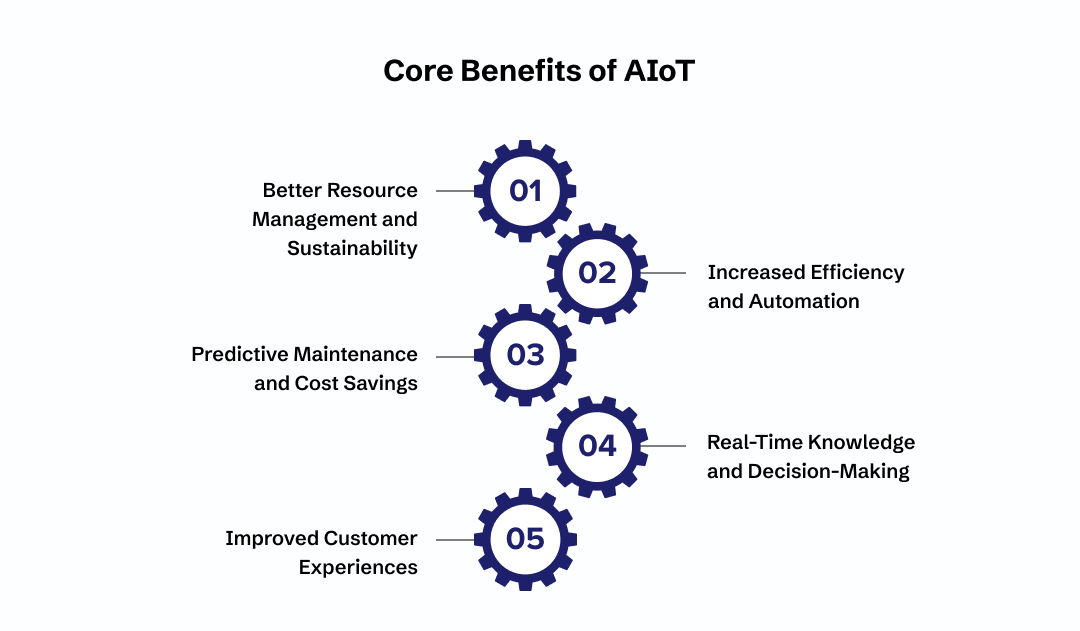
AIoT applies AI algorithms to interpret sensor data and processes complicated tasks without involving humans. This results in quicker decision-making, increased productivity, and efficiency of operations.
2.Predictive Maintenance and Cost Savings

Monitoring equipment’s health in real time allows AI to make correct predictions regarding when the equipment is in need of maintenance. This prevents failure in the future. Predictive maintenance will eliminate unexpected downtime, extend asset lifespans, and rationalize maintenance scheduling, leading to a significant decrease in operational costs.
3. Real-Time Knowledge and Decision-Making.
AI processes streams of data sent across devices in real time and converts raw data into actionable insights. It is the fast intelligence that helps in making smarter and faster decisions. Overall, this shall help organizations to act instantly to changes in the market, security threats, or business needs.
4. Improved Customer Experiences.
AIoT allows companies to collect and interpret extensive information about the user behavior of a particular user and create highly personalized products and services. Intelligent systems are able to predict needs and provide proactive services. Eventually, this will lead to increased customer satisfaction and brand loyalty.
5. Better Resource Management and Sustainability
The AIoT systems allow managing resources such as energy, water, and materials. It tracks the usage of resources and the state of the environment, which enables the use of AI to minimize waste and optimize the efficiency of the operations. This is among the main methods of fulfilling the most important sustainability goals and mitigating the overall impact on the environment.
6. Innovation in Product and Service Development
The vast amount of operational data collected from deployed IoT devices feeds directly back into the development cycle. AI analyzes this real-world usage data to identify unmet needs, common pain points, or unexpected product uses. This data-driven approach accelerates R&D, leading to the creation of next-generation products that are precisely tailored to customer requirements.
AIoT Applications and Use Cases
AIoT is driving transformative applications across virtually every major industry. Similar to other rapidly expanding AI use cases, AIoT is helping organizations automate processes, improve decision-making, and create intelligent customer experiences. Here are verified, real-life examples of AIoT applications across different sectors.
1. Intelligent Traffic Flow Management

Bosch's INTEOX networked camera platform uses video analysis functions based on neural networks (AI) to detect and locate vehicles in real-time. This data is evaluated by AI in the cloud to manage traffic flow, helping reduce congestion in urban areas.
2. Remote Patient Monitoring
Teladoc Health uses AIoT by integrating AI algorithms with home-based IoT devices and wearables to provide virtual consultations and continuous remote patient monitoring. This allows for real-time tracking of vital signs and personalized care plans. For example, the expanded solution can visually detect patient movement that could lead to falls. It then alerts for a faster intervention by bedside staff.
3. Smart Home Devices

The Bosch Series 8 oven uses sensors to collect data on baking/roasting processes (temperature, humidity, settings) and sends it to the cloud, where AI calculates the optimal cooking time for different dishes. It even sends a push notification when food is ready.
4. Precision Agriculture
John Deere's See & Spray technology uses cameras and sensors mounted on a tractor's boom, scanning the field in real-time. An onboard AI processor instantly analyzes the video feed to differentiate crops from weeds. It then actuates individual spray nozzles to spray herbicide only on the weeds, reducing herbicide use by over two-thirds.
5. Autonomous Vehicles
Every Tesla vehicle functions as an advanced AIoT device. Its suite of IoT sensors (cameras, radar, ultrasonic sensors) collects vast amounts of data about its surroundings. The onboard AI (Autopilot/Full Self-Driving computer) processes this data to identify lanes, pedestrians, and other cars, enabling it to steer, accelerate, and brake autonomously.
6. Autonomous Planetary Exploration (Space AIoT)
The Mars 2020 Perseverance Rover employs the latest AIoT concepts to navigate and scientifically operate on Mars using the sensors (cameras, spectrometers, radar). Its computer inside is based on AI algorithms to process landscape shots and take independent conclusions about where to move (to avoid obstacles) and which rocks to investigate. This self-driving capability optimizes mission time and reduces reliance on delayed instructions from Earth.
7. Proactive Home Energy Optimization
Google Nest Thermostat applies AIoT to energy management. The sensors (IoT) of the device monitor temperature, natural lighting, and human occupation, becoming accustomed to the thermal characteristics of the house. AI algorithms analyze this real-time data alongside external factors (weather forecasts, electricity pricing) to proactively adjust heating and cooling cycles. This saves energy and maintains user comfort without manual input, essentially automating the home's energy consumption.
Critical Problems and Issues of AIoT Implementation.
The sail for the application of the Artificial Intelligence of Things (AIoT) has multiple hurdles. Resolution of these challenges is important to the successful, large-scale implementation of intelligent and connected systems.
1. Data Privacy and Security
The sheer magnitude of information that is produced by billions of IoT devices renders AIoT systems very susceptible to intrusions, unauthorized access, and cyberattacks. Securing sensitive information, which includes industrial processes in addition to personal health data, needs strong encryption and serious consideration of the data governance to keep the users in trust and compliance.
2. Energy Consumption and Hardware Limitations
The majority of IoT devices are dependent on finite sources of power, such as batteries, which are directly opposed to the intensive levels of computation needed to execute sophisticated AI/ML algorithms. This requires the creation of extremely low-power consumption hardware and highly specialized AI models, including those of TinyML, to be able to keep the devices running smartly without the need for them to be charged so that they can operate over a long duration.
3. Interoperability and Standards
The AIoT ecosystem is extremely disintegrated with the application of proprietary protocols and different data formats by numerous vendors. This absence of universal interoperability frameworks adds individual data silos, stopping equipment and systems from varying manufacturers from communicating and learn through common data easily.
Regulations and Frameworks around AIoT
The ability of AIoT to aggregate large amounts of sensor data using self-learning algorithms poses significant new regulatory challenges. These are beyond the capabilities of traditional internet laws. Top AI development companies abide by these regulations and frameworks.
1. Regulatory Initiatives
These are the established and upcoming laws that legally mandate compliance for AIoT systems, defining penalties for non-adherence.
| Initiative / Legislation | Focus Area | Impact on AIoT Systems |
|---|---|---|
| EU AI Act | Algorithmic Risk & Transparency | Establishes a regulatory framework based on risk, imposing stringent transparency and auditability requirements on high-risk AIoT applications. |
| General Data Protection Regulation (GDPR) | Data Privacy | Requires strict user consent and transparent data handling for any personal data collected by AIoT devices. |
| EU Cyber Resilience Act | Product Cybersecurity | Addresses the implementation of cybersecurity directly on AI-based products, requiring manufacturers to secure devices. |
| Network and Information Security Directive 2 (NIS 2) | Systemic Resilience | Provides guidance on cybersecurity for numerous digital systems, including the complex IoT networks that form AIoT infrastructure. |
| U.S. IoT Cybersecurity Improvement Act | Device Security | Establishes cybersecurity standards for IoT devices sold to the US federal government, often setting a de facto industry standard. |
| California IoT Security Law | Consumer Device Security | Requires device manufacturers to provide security features, such as unique passwords, in consumer IoT devices. |
2. Standards and Frameworks
These frameworks provide best practices, technical guidelines, and methodology for managing risks and ensuring ethical development. Developers and organizations adhere to for best practices and liability protection.
| Standard / Framework | Focus Area | Purpose for AIoT Development |
|---|---|---|
| ISO/IEC 27001 | Information Security | Standard for implementing an information security management system (ISMS) across the AIoT infrastructure. |
| ISO/IEC 23894 | AI Risk Management | Guidance for managing technical and operational risks specifically associated with AI implementation in IoT devices. |
| NIST SP 800-213 | IoT Cybersecurity | Guidance on cybersecurity best practices for securing the vast network of connected IoT devices. |
| U.S. FCC Cyber Trust Mark | Consumer Confidence | Labeling for secure consumer IoT products that provides a clear indication of baseline security compliance. |
Future of AIoT
The AIoT market expansion is booming with a 31.7% CAGR (2024-2030). This growth is being led by AI and IoT integration, and the widespread adoption of Edge AI. Moreover, the number of AIoT-powered devices is already growing, and experts say that it will reach 9.1 billion by 2033.
This growing popularity of AIoT and Edge AI is also driven by the continued rollout of faster networks. Further, this also provides the necessary ultra-low latency and high bandwidth. Furthermore, with the onset of AIoT technologies, Digital Twins will merge physical and virtual worlds. Next, it will allow AI to simulate, predict, and optimize complex operations.
This is crucial for maximizing efficiency gains in sectors like manufacturing. The manufacturing sector remains the largest consumer of AIoT solutions, contributing over 28.70% of 2024 revenue through predictive maintenance, quality analytics, and adaptive robotics. Additionally, the healthcare vertical, focusing on remote patient monitoring, which is powered by AIoT, is forecasted to be the fastest-growing segment, expanding at a 36.9% CAGR.
Today, the entire ecosystem is moving toward Autonomous Intelligence, using AIoT to sense, comprehend, and react to environments without human intervention. As organizations continue exploring generative AI uses alongside AIoT, the focus is shifting toward systems that can not only analyze information but also generate recommendations, content, and autonomous actions in real time. Therefore, the near future is powered by AIoT, and it will continue to provide autonomous and data-driven operations and hyper-personalized experiences.
Frequently Asked Questions
What does AIoT technology mean?
AIoT technology is a combination of sensor-based IoT connectivity and AI algorithms to produce intelligent systems capable of learning and performing autonomous executions. It is used to provide real-time insights.
What is the distinction between cloud-based AIoT and Edge-based AIoT?
Edge-based AIoT operates directly on the device, reducing latency on real-time applications such as autonomous vehicles. Cloud-based AIoT relies on remote servers for large-scale model training and high computational power.
What are the types of AIoT appliances and AIoT tools that are typically used in a smart home?
Typical AIoT devices are smart thermostats and fridges that acquire your patterns to save energy. Artificial intelligence tools, voice assistants, and security cameras are AIoT devices used for predictive automation and security monitoring.
In what industries are AIoT tools and platforms used primarily?
Primarily, AIoT is used in manufacturing to perform predictive maintenance through the analysis of machine data to predict failure. It is also popularly used in the healthcare industry for remote patient monitoring.
What can be done to guarantee the data safety of AIoT tools in large-scale deployment?
The AIoT devices can be used to increase the level of security through Edge-based AIoT to analyze and filter sensitive data on the device. As a result, the amount of data transferred to the cloud decreases. This strategy will reduce exposure and use machine learning to detect anomalies in real-time across interconnected systems.

Uncover executable insights, extensive research, and expert opinions in one place.
Related Content