Share It On:
 Marketing Automation vs. Manual Marketing comes down to friction, not preference. Some work collapses under volume unless it is automated; other work loses value the moment it is.
 This debate is not really about tools. It is about how work gets done at scale, and where scale starts to break. Automation promises reach, consistency, and speed. Manual marketing trades all of that for control and judgment. The conversation of marketing automation vs. manual marketing is often framed as a feature comparison.
That framing misses the point. The real difference shows up in execution. Automation works well when outcomes are predictable and when brands are focused on how to scale marketing efforts efficiently. Manual effort matters when situations are not.
Many industry voices claim manual marketing is obsolete. That claim ignores how modern teams actually operate. Manual work has not disappeared. It has simply moved to fewer, higher-impact moments where mistakes cost more than time.
Key Differences Between Marketing Automation and Manual Marketing
Before all the details, here is the raw breakdown of where these strategies clash. One is built for speed; the other is built for connection—two competing forces that every growth team and marketing agency cost model must balance.
| Feature | Marketing Automation | Manual Marketing |
|---|---|---|
| Primary Driver | Data-driven decision making & logic. | Creative freedom, gut instinct, & emotion. |
| Speed | Instant. Real-time response 24/7. | Slow. Dependent on human bandwidth/sleep. |
| Scale | Unlimited operational scalability. | Limited by human interaction capacity. |
| The Big Risk | Risk of robotic communication (Alienation). | Human error and inconsistency. |
| Cost Model | High upfront technological investment. | High ongoing labor costs (Time = Money). |
| Best Used For | Volume, nurturing, & repetitive tasks. | Closing deals & handling high-value clients. |
What is Marketing Automation?
Marketing automation is what teams use when the work becomes too repetitive to manage manually. It usually starts with emails, scheduling, and basic lead tracking. Over time, ads, scoring, and follow-ups get pulled in as well, forming the backbone of AI in marketing systems.
Most automation systems work on rules. Someone sets conditions. Something happens when those conditions are met. For instance, clicks rise, visits boost, inactivity detected, time gaps identified, etc. The moment the system detects any change, it reacts. The process keeps going unless someone steps in to change it.
When clear patterns are established, and activities are done in high volume and in a predictable manner, that is where automation works best. This is the foundation of automation in digital marketing at scale. It struggles once situations stop looking the same. Automation does not think. It executes what already exists.
Advantages and Disadvantages of Automated Marketing
Automation is the adrenaline shot for modern business. It spikes performance instantly—but mess up the dosage, and you crash. One of the major cost benefits of marketing automation is that it transforms marketing from chaotic art into a predictable revenue engine, provided you don't let the machine overwrite your humanity.
Advantages of automated marketing directly influence marketing automation ROI, especially for businesses chasing efficiency across large funnels. Let’s have a look at them, along with the disadvantages!
| Advantages | Disadvantages |
|---|---|
| Operational Scalability: You can nurture 50,000 leads at once with the same effort it takes to nurture five. | Risk of Robotic Communication: One bad tag can send "Hello [First_Name]" to your whole list, killing trust instantly. |
| Data-Driven Precision: It kills guesswork, using behavioral triggers (clicks, views) to serve content exactly when it hits hardest. | High Technical Debt: Setting up beasts like HubSpot or Marketo demands serious setup, training, and constant maintenance. |
| Cost Efficiency at Scale: Software isn't free, but it is cheaper than hiring fifty people to send emails 24/7. | Creative Sterility: Algorithms love patterns, not nuance. You risk generic messaging that feels flat and fails to resonate. |
| Real-Time Responsiveness: Auto-responders hit the lead within seconds, nailing that crucial "speed-to-lead" window. | Over-Reliance on Data: You might ignore intuition or "dark social" signals just because the software can't track them. |
Market Statistics
The money is following the machines. For volume-based businesses, the financial argument is almost impossible to ignore. The market is aggressively shifting toward AI-driven hyper-personalization, reinforcing and improving ROI with automation as a core growth lever.
- Explosive Market Growth: MarketsandMarkets projects the global marketing automation sector will nearly double, rocketing from $47.02 billion in 2025 to $81.01 billion by 2030, at a CAGR of 11.5%.
- Productivity Surge: It’s not just about size; it’s about efficiency. Data from Amra & Elma (2025) shows companies using automation see a 14.5% jump in sales productivity and a 12.2% drop in operational costs.
- ROI Multiplier: The same report clocks an average return of $5.44 for every $1 spent. When the machine is oiled correctly, it prints money.
What is Manual Marketing?
Flip the coin, and you find the artisan’s workshop. Manual marketing is the sawdust and glue of the operation. It involves hand-crafted emails and creative freedom that often ignores A/B testing in favor of raw gut instinct.
It means targeted messaging written by a human who actually took the time to read a prospect's LinkedIn profile. It is slow and burns cash. But it is the only way to forge deep, unshakeable trust in high-stakes B2B relationships—an often overlooked counterpoint when discussing AI in marketing.
Advantages and Disadvantages of Manual Marketing
Manual marketing is the handcrafted Swiss watch in a world of smartwatches. It lacks the bells and whistles, but it commands a premium because it carries the weight of human intent. Design scalability stands among the most misunderstood pros and cons of manual marketing, which is precisely why it works for deals where a bot simply cannot get a signature.
| Advantages | Disadvantages |
|---|---|
| Unmatched Emotional Intelligence: A human reads the room, adjusts tone instantly, and actually feels the client’s pain. | The "Human Bottleneck": Your reach is capped by the clock. You cannot manually email 10,000 people without burning out. |
| High Trust Factor: Personal, raw outreach signals respect. It drastically bumps response rates in B2B. | Inconsistent Output: Humans have bad days. The quality of your marketing rides on the mood and energy of your team. |
| Agility in Crisis: Humans handle PR fires or angry clients with nuance. Automated "ticket closed" emails just add fuel. | Prohibitive Labor Costs: Talent is expensive. Manually executing tasks is the heaviest item on your P&L. |
| Deep Relationship Building: Critical for high-ticket deals where the buyer is investing in you, not just the product. | Slow Response Times: If your team is asleep, the lead waits. In an instant-gratification world, that silence is deadly. |
Market Statistics
Here is the paradox: as digital noise gets louder, the hunger for real human connection is growing. The data points to a widening trust gap—one that automation in digital marketing alone cannot bridge.
- Preference for Humans: A massive study by Five9 found that 75% of consumers still prefer talking to a real human for support. They are rejecting bot efficiency in favor of empathy.
- The AI Trust Deficit: That same study revealed nearly 48% of consumers do not trust info from AI bots. If you want them to believe it, a human needs to say it.
- The Cost of Slowness: But don’t get comfortable. The 2025 Zendesk Trends Report warns that 63% of consumers will defect after just one bad experience. It’s a brutal balancing act between the need for touch and the demand for speed.
When you are vetting digital marketing companies, you aren't just buying services; you are hiring a philosophy. Do you want a factory or a studio? That choice directly affects long-term marketing automation ROI and client retention.
If you are currently choosing a marketing agency, understanding this divide is your best defense against slick sales pitches. Automation scales your reach; manual effort scales your depth. You probably need a messy, specific mix of both.
|
Not Sure What Marketing Option To Go For? Connect with our pick of top digital marketing companies to unlock expert help! |
What to Pick from Automated Marketing vs. Manual Marketing for Your Goals?
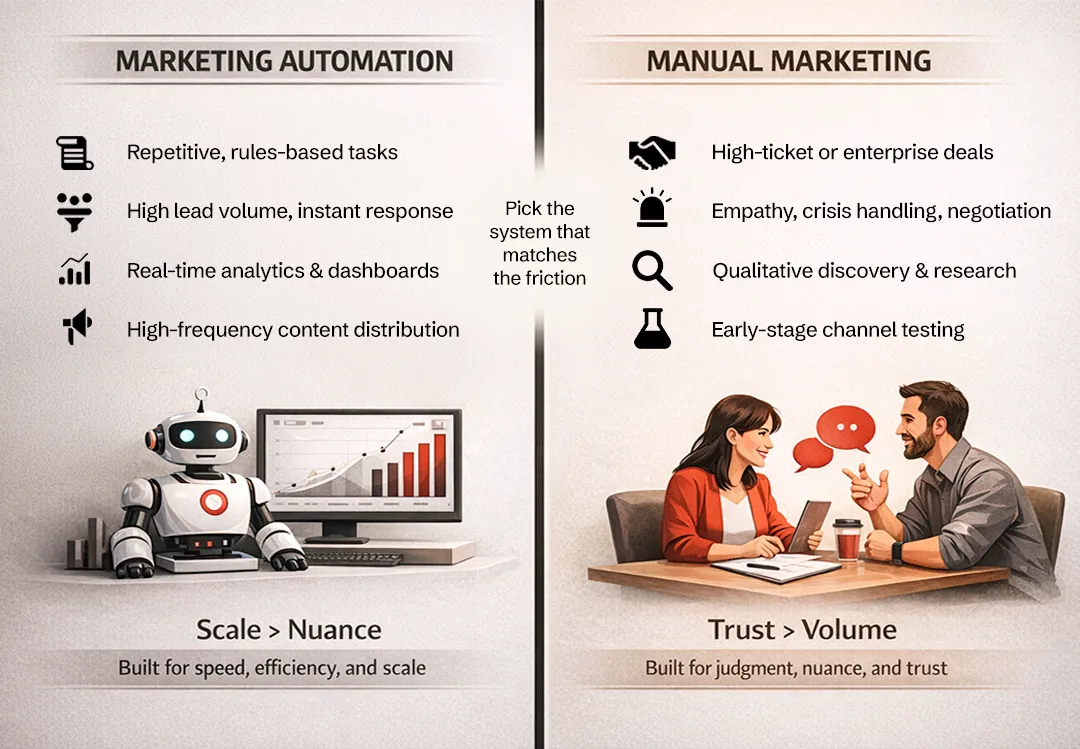
Stop guessing. Audit the workflow. A strategy built on trends is fragile. A strategy built on friction points supports scalable marketing strategies that last.
Use Marketing Automation when:
- The task is repetitive and rules-based, and efficiency impacts the marketing agency's cost directly. Burning creative energy on grunt work is a fast track to mediocrity. If the task follows a rigid "If X, then Y" pattern—like data entry or invoice generation—hand it to the code. Human talent is too expensive to waste on tasks a script can do for free.
- The volume of leads exceeds human capacity to respond quickly—this is where improving ROI with automation becomes non-negotiable. The "speed-to-lead" window is unforgiving. Wait ten minutes, and the lead is likely gone, lost to a competitor who moved faster. When inquiries hit at 2 AM, only a machine can provide the instant acknowledgement needed to keep the prospect interested.
- You need real-time analytics to adjust performance tracking: You cannot fix a problem you cannot see. Automation provides live dashboards, allowing for immediate course correction on campaign execution. Waiting until the end of the month to realize an ad spend was wasted isn't management; it's negligence.
- Your content marketing strategy demands high-frequency distribution: Algorithms are hungry beasts that demand consistency humans struggle to sustain. Automation ensures the brand stays omnipresent, keeping the feed active and the engagement ticking over, even when the marketing team is offline.
Use Manual Marketing when:
- The deal value is high enough to justify the hourly rate: Trying to close a six-figure enterprise contract with a generic drip campaign is an insult to the buyer. High-ticket deals run on trust, nuance, and relationships. If the margin covers the labor, personal outreach is the only viable path.
- The situation requires empathy, crisis management, or complex negotiation: Bots are tone-deaf. Sending an automated "ticket received" response to a furious client or during a PR crisis is gasoline on a fire. These moments demand high Emotional Intelligence (EQ) to de-escalate the tension and salvage the account.
- You are in the early stages of qualitative methods research: Understanding cannot be automated. In the early days, you need to hear the hesitation in a prospect's voice to truly grasp their pain points. Data spreadsheets can show what happened, but they will never explain why it happened.
- You are testing a new channel and don't want to engineer a system yet: Never scale an unproven concept. Validate the message by hand first. Send the emails manually to see what resonates before burning weeks engineering a complex workflow. If the manual version flops, the automated version will just fail faster and harder.
Keep a close watch on digital marketing trends. The market is fickle. Right now, the momentum is swinging hard back toward "human-verified" content as skepticism of AI-generated polish grows.

Conclusion
The choice between marketing automation and manual marketing is false. You are not choosing one; you are choosing the ratio.
Automation is the engine. Manual effort is the steering wheel. You can have the fastest engine in the world, but if you take your hands off the wheel, you will crash. The winners of the next decade won’t be the ones who automate everything. They will be the ones who understand where automation in digital marketing ends—and where humans must take over.
Frequently Asked Questions
Are manual marketing techniques dead in 2026?
Manual marketing is not dead in 2026. It just stopped being the default option. Most routine work has moved to automation, and that part is not coming back. Manual effort now appears only where risk exists. Large deals, sensitive conversations, and late-stage negotiations still depend on human judgment. Automation helps scale. Manual marketing steps in when mistakes are expensive.
Can marketing automation replace human marketers?
Marketing automation replaces execution, not responsibility. It handles scheduling, tracking, and repetition without issues. It struggles when context changes mid-stream. Client hesitation, internal politics, and brand pressure still require interpretation. Software follows rules. Marketers decide when rules no longer apply.
What is the biggest risk of marketing automation?
The biggest risk is neglect. Automated systems age quietly. Messaging stays active while assumptions change underneath. Tone drifts, and in parallel, relevance drops. Without regular review, workflows keep running even when they no longer fit the market. Errors do not stop. They simply repeat faster.
How do you measure manual marketing ROI?
Manual marketing ROI rarely shows up early. Initial engagement metrics can be misleading. The real signal appears later, through retention and account stability. Clients acquired through direct interaction tend to stay longer. Over time, they also expand more often. That long horizon is where manual effort proves its value.
What is the best way to start with marketing automation?
Automation should begin with restraint. One task is enough at the start. Teams usually choose follow-ups or basic data handling. Automating broken workflows only locks in inefficiency. Processes should be understood first. Tools work best when a structure already exists.

Uncover executable insights, extensive research, and expert opinions in one place.
Related Content