- 1. Cost and Resource Constraints
- 2. Integration with Existing Systems
- 3. Organizational Culture and Change Management
- 4. Overuse and Misapplication of AI
- 5. Scalability and Expansion of AI Initiatives
- 6. Skills and Expertise Gaps
- 7. Strategic Vision and Leadership Buy-In
- 8. Trust, Privacy, and Ethical Concerns
 Share It On:
 AI promises transformation, but AI adoption challenges often block the path. We are dissecting them in this blog along with solutions to help you speed up your AI integration strategy.
Your AI vendor promised revolutionary efficiency. Six months later, your team is drowning in integration issues, your budget is blown, and the C-suite is asking tough questions about ROI.
This scenario plays out across industries daily. Companies rush to implement artificial intelligence solutions without understanding the real barriers to AI adoption ahead. The result? Failed projects, wasted resources, and missed opportunities that competitors capitalize on.
This guide cuts through the hype to examine actual challenges in AI adoption. Drawing from recent case studies and industry data, we'll explore why AI initiatives fail and how to overcome these barriers.
Let’s have a look!
AI Adoption Challenges
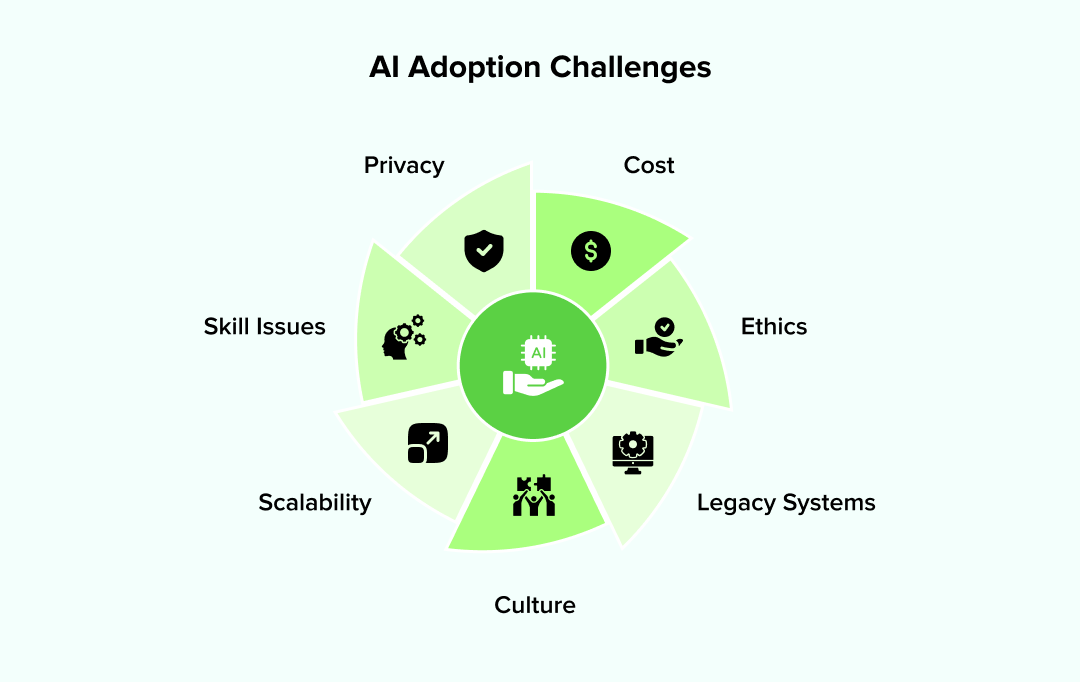
AI promises transformation, but AI deployment challenges often block the path. Recent data shows that while the global AI market is projected to reach $2,407 billion by 2032, adoption rates lag due to practical hurdles.
We see this in a McKinsey report that while 30% of businesses report leveraging AI, only 21% of executives cite integration issues for multiple business units as a top barrier.
Let's break down these AI integration issues one by one.
1. Cost and Resource Constraints
You invest in AI, expecting returns, but upfront costs can overwhelm. AI cost and ROI concerns dominate, with implementation expenses averaging $200,000 to $500,000 for mid-sized projects. Small firms especially struggle, as scalable AI solutions demand hardware, software, and ongoing maintenance.

2. Integration with Existing Systems
“While there's currently a buzz around AI, we haven't seen its full potential in these areas yet. As usual, the rapid pace of new technologies is part of the challenge because it's hard to keep up.”
This conversation we had with Keith Neilson, the CEO & Founder of AppFactor, fits quite aptly with the challenge we are discussing ahead.
AI integration with legacy systems often feels like forcing a new chapter into an old novel. Many organizations run on outdated infrastructure, making seamless AI deployment a nightmare. But the main challenge is that while top AI development companies are all geared to speed up the AI’s expansion across industries, quite a lot of businesses are still dependent on legacy systems. This echoes the poor ability of businesses to match the pace with broader AI trends.
3. Organizational Culture and Change Management
AI change management requires more than tech—it's about people. Resistance from teams unfamiliar with AI can stall progress. An AIPRM report reveals 45% of workers fear job displacement due to AI, fueling cultural pushback.
Now, the cultural resistance takes many forms:
- Middle management skepticism: The middle layer of most organizations, the managers and senior practitioners who set the cultural tone, is often the most resistant to change because of rational self-interest.
- Fear of job displacement: Common obstacles to AI adoption include resistance to change, lack of skills, and concerns about job security.
- Trust deficit: Many employees are skeptical of AI's reliability, concerned about addressing AI biases in algorithms, and unclear about how AI systems arrive at certain decisions.
- Power struggles: Around 2 out of 3 executives say generative AI adoption has led to tension and division within their company.
4. Overuse and Misapplication of AI
In our enthusiasm for transformation, we sometimes forget that not every problem requires an AI solution. One of the most pressing dangers of AI is techno-solutionism, the view that the best AI tools can be seen as a remedy when they are merely helpful resources.
The misapplication manifests in several ways:
- Automation bias: Our human tendency to reduce our vigilance and oversight when working with machines.
- Over-reliance on AI: Developers who self-reported using AI "as much as possible" experienced productivity decreases.
- Wrong use cases: Gartner report suggests that even 15% of autonomy in day-to-day tasks by agentic AI will be met by 2028.
- "AI washing": Organizations jump the gun when it comes to joining the hype, making false or exaggerated claims.
Organizations must resist the temptation to apply AI to every challenge, focusing instead on use cases where it genuinely adds value.
5. Scalability and Expansion of AI Initiatives
You start small, but scaling AI proves tough. Initial pilots work, but expanding to enterprise levels hits bottlenecks in data volume and infrastructure.
The scalability challenge includes:
- Technical barriers: Respondents still lack the knowledge of AI frameworks and APIs.
- Resource constraints: Production demands a robust, scalable architecture that pilots often lack.
- Organizational readiness: Many companies lack the processes and governance structures needed for enterprise-wide deployment.
- ROI pressure: Implementation costs, as stats of 26% of failed pilots suggest, frequently land as a surprise.
The gap between pilot success and production failure often stems from inadequate planning during the experimental phase.
6. Skills and Expertise Gaps
The talent shortage in AI represents a critical bottleneck. A report by Randstad suggests that out of 75% firms that are using AI, only 35% folks have received the needed training. While there are AI developers in the USA, India, the UK, and other corners of the world ready to assist with AI requirements, when it comes to allocating dedicated internal resources, the gap remains intact.
The talent crisis manifests across multiple dimensions:
- Gender disparity: An Economic Graph report published on LinkedIn states that in Generative-AI Augmented spaces, 95.9% workers are men, while women stand at 4.1%.
- Technical expertise shortage: There is a critical shortage of technical skills required to develop, implement, and maintain AI systems.
- Leadership capability gap: 46% of leaders identify skill gaps in their workforces as a significant barrier to AI adoption.
7. Strategic Vision and Leadership Buy-In
Leadership alignment, or lack thereof, determines AI success more than any technical factor. At companies that do not have a formal AI strategy, not all executives can confidently say they've been very successful at adopting AI.
Some leadership challenges in adopting AI include:
- Misaligned expectations: 40% of executives predict AI will deliver productivity gains of more than 30%, yet three in five believe tech is advancing faster than firms can retrain workers.
- Strategic confusion: 71% of the C-suite admit that AI applications are being developed in multiple silos.
- Governance gaps: Lack of a governance model represents one of the biggest barriers to deploying gen AI initiatives.
- Short-term thinking: Many leaders focus on immediate gains rather than transformational opportunities.
Without clear vision and committed leadership, AI initiatives fragment into disconnected experiments that never achieve critical mass.
8. Trust, Privacy, and Ethical Concerns
The ethical dimension of AI adoption cannot be ignored. 62% of respondents report data governance as a top data challenge to AI initiatives, while privacy and bias concerns grow daily.
Key ethical challenges include:
- Data privacy: Nearly half of the respondents were worried about data accuracy or bias.
- Algorithmic bias: Bias within ML models can inadvertently lead to unfair and potentially detrimental outcomes.
- Transparency issues: Many AI systems operate as black boxes, making it challenging to understand how decisions are reached.
- Regulatory compliance: Organizations must align their AI usage with global data privacy laws such as GDPR, CCPA, and industry-specific regulations.
Building trust requires more than technical solutions—it demands a fundamental commitment to ethical AI practices.
Solutions to Counter AI Adoption Challenges
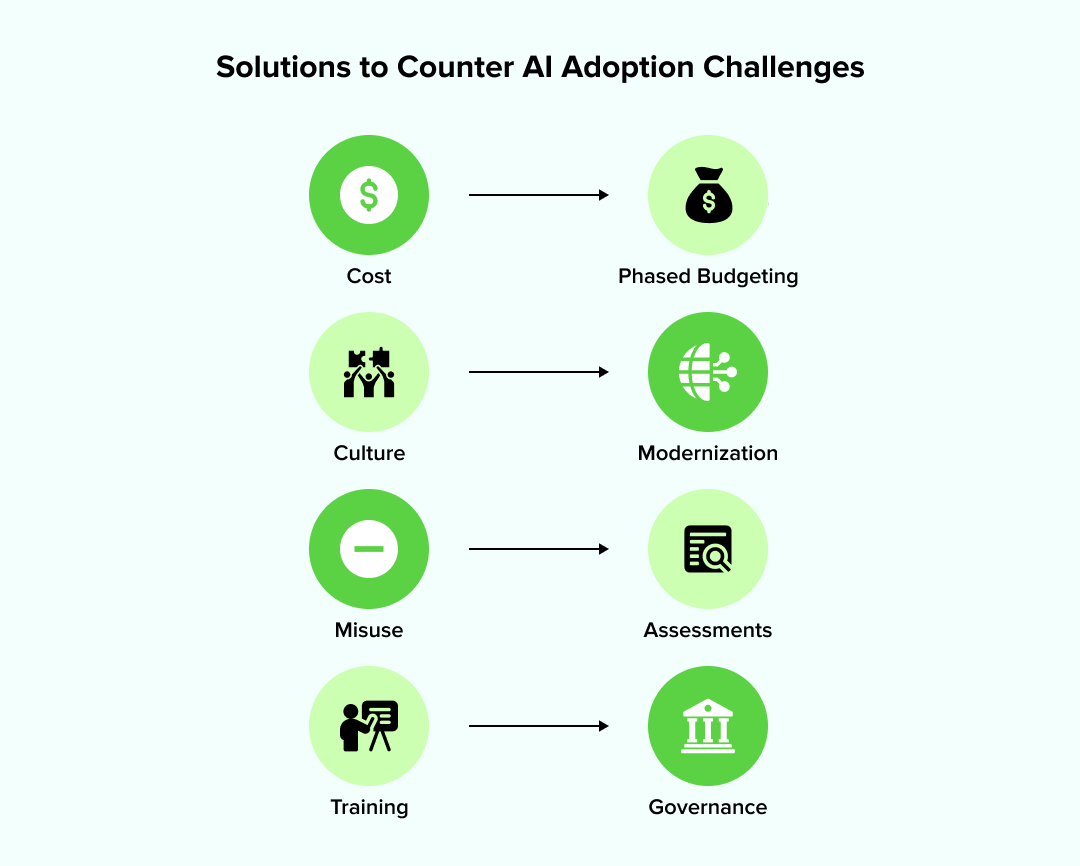
We've mapped the strategies to overcome AI barriers; now, let's chart the course forward. Overcoming AI adoption challenges requires targeted AI adoption best practices. Start with a phased approach: Assess needs, pilot small, and scale wisely.
- Tackle Costs: Prioritize open-source AI frameworks and cloud-based tools to cut expenses. Calculate ROI early using existing success stories of popular brands.
- Ease Integration: Use AI APIs for modular connections. Audit legacy systems first, as seen in successful chatbot development companies that integrate via APIs without overhauls.
- Manage Change: Implement training via platforms compliant with WCAG for accessibility. Foster culture through workshops, reducing resistance by 30%.
- Avoid Misuse: Conduct fit assessments, reserve AI for high-impact areas like predictive analytics, not routine tasks.
- Scale Effectively: Design for growth with edge computing. Implement smarter solutions to deploy performance-driven AI solutions.
- Secure Leadership: Align with business goals, using case studies from the history of AI to demonstrate value.
- Address AI ethics and Governance: Embed governance frameworks, auditing for bias, and ensuring compliance. How to implement AI successfully? Start with transparent data practices. Then, find the right talent with a history of working on ethical AIs.

Wrapping Up
The path to successful AI adoption resembles less a straight highway and more a winding mountain road—challenging, sometimes treacherous, but ultimately leading to transformative heights. A large chunk of businesses have embraced AI to some extent, yet the gap between adoption and value creation remains vast.
The challenges we've explored, from financial constraints to cultural resistance, from technical hurdles to ethical concerns, are real and substantial. But they are not insurmountable. Organizations that succeed share common traits: they plan strategically, invest in their people, modernize thoughtfully, and maintain an unwavering focus on value creation.
As you embark on or continue your AI journey, resist the siren call of technology for technology's sake. Instead, focus on solving real problems, empowering your people, and building sustainable competitive advantages. The organizations that master these elements won't just adopt AI—they'll use it to redefine what's possible in their industries.
Frequently Asked Questions
What are the main AI adoption challenges?
Primary hurdles include cost barriers, integration with legacy systems, and ethical concerns like AI bias. Collectively, these gaps make it harder for businesses to implement productive AI strategies.
How can organizations overcome AI implementation challenges?
By adopting phased pilots, skills training, and ethical governance, key to scalable AI solutions and positive ROI.
What are effective AI adoption best practices?
Focus on data quality in AI, leadership buy-in, and compliance with standards like GDPR to ensure smooth deployment.

Uncover executable insights, extensive research, and expert opinions in one place.
Related Content