Share It On:
 Multi-Agent Systems Could End the Era of Single AI — Here’s Why That Changes Everything!
The old model of AI—a single, massive brain in a digital box—is officially getting out of fashion. We're now in the era of Multi-Agent Systems (MAS), a tech that’s just not an upgrade but a whole revamp of the smart tech.
Forget the lone genius. Instead, picture a swarm of collaborating specialists. A MAS is a system composed of multiple autonomous agents, each with its own skills, that interact to solve problems.
These agents form an AI agent ecosystem. They aren't mindless drones; they have autonomy. They can make their own calls. When they connect, they create an AI mesh network capable of tackling tasks far beyond the reach of any single AI. We're not just writing code anymore; we're building digital societies, and these agent-based systems are the future.
How do Multi-agent Systems Work in AI?
Distributed problem-solving is the core idea. There’s no central command post doing all the thinking. The problem gets smashed into pieces, and the pieces get farmed out to the agents who know how to handle them.
Think of an elite military unit. The point man, the medic, the demolitions expert—they all have different jobs. The point man doesn't ask for permission to duck for cover; he just does it, and the team instantly adapts. That’s how a MAS works. Each agent is constantly running a tight loop:
- Sense: Every agent in the network grabs data from its environment. It could be watching stock tickers or reading street-level sensors.
- Think: It uses its specialized capabilities to process that data. This is the reasoning step where an agent makes a judgment call, applying its own logic and plans.
- Act: It makes a move. It buys a stock, re-routes a package, or fires off a message to another agent.
That action changes the game for everyone, creating a constant, adaptive feedback loop across the entire system.

Single Agent Versus Multi-Agent Systems
Let’s be clear: a single-agent architecture is a dinosaur. It's fundamentally brittle. You have one point of failure, and it can't scale to handle real-world complexity. It’s like trying to run a global logistics company with one person and a single spreadsheet.
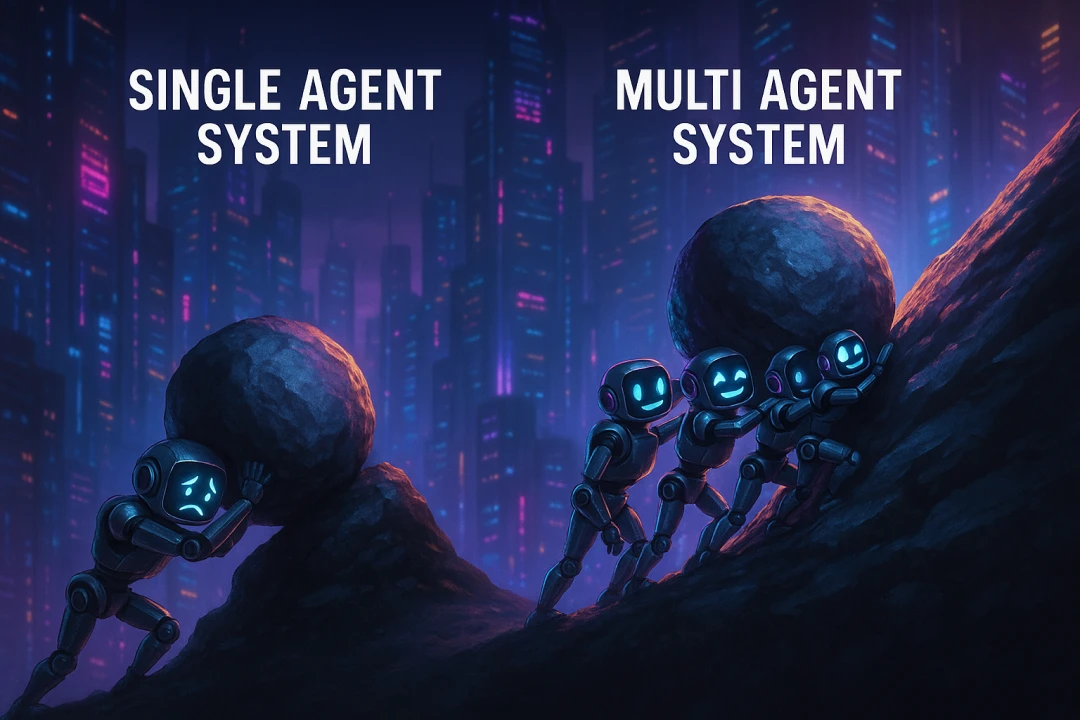
The whole multi-agent vs single-agent AI argument boils down to this: resilience. With multi-agent AI, you get a system that's tough as nails. One agent goes offline? The others can often reconfigure and keep the mission going.
You get a level of robustness that a monolithic system can't touch. Plus, you get to build a team of aces. You can have AI agents working together where one is a language wizard, another is a math genius, and a third is a master strategist.
Let’s give you a more practical example!
| Practical Scenario | Single-Agent System (In Practice) | Multi-Agent System (In Practice) |
|---|---|---|
| System Crash (Failure) | An e-commerce chatbot handles everything: inventory, orders, and FAQs. If the inventory database connection fails, the entire chatbot crashes or becomes unresponsive, unable to even answer simple FAQs. | An InventoryAgent, OrderAgent, and FAQAgent work together. If the inventory connection fails, only the InventoryAgent is affected. It can report its status while the other agents continue working perfectly. The system degrades gracefully instead of failing completely. |
| Handling a Traffic Spike (Scalability) | A central algorithm optimizes routes for 100 delivery trucks. During a holiday rush with 1,000 trucks, the algorithm chokes and becomes incredibly slow, as the complexity of the single problem grows exponentially. | Each of the 1,000 trucks has its own agent optimizing its own route while coordinating with nearby agents. The computational load is distributed, so the system scales smoothly by simply adding more agents. |
| Adding a New Feature (Maintenance) | You have a financial analysis tool that predicts stock prices. To add social media sentiment analysis, you must modify the core code, risking the introduction of bugs that could break the original, stable prediction feature. | Your system has a PricePredictionAgent. You simply build and deploy a new, separate SentimentAgent. It plugs into the ecosystem and starts providing data. The original agents are untouched, making development faster and much safer. |
| Solving a Complex Problem | A smart thermostat optimizes the temperature for a single home. It's efficient but unaware of external factors like the cost of electricity on the grid. | In a smart grid, your thermostat is an agent that negotiates with a GridAgent and your neighbor's ThermostatAgent. It might pre-cool your home when electricity is cheap, contributing to a larger, system-wide goal of preventing blackouts. |
Architectures of Multi-Agent Systems
How AI agent networks are wired together determines everything. The architecture is the system's political structure.
1. Centralized Networks
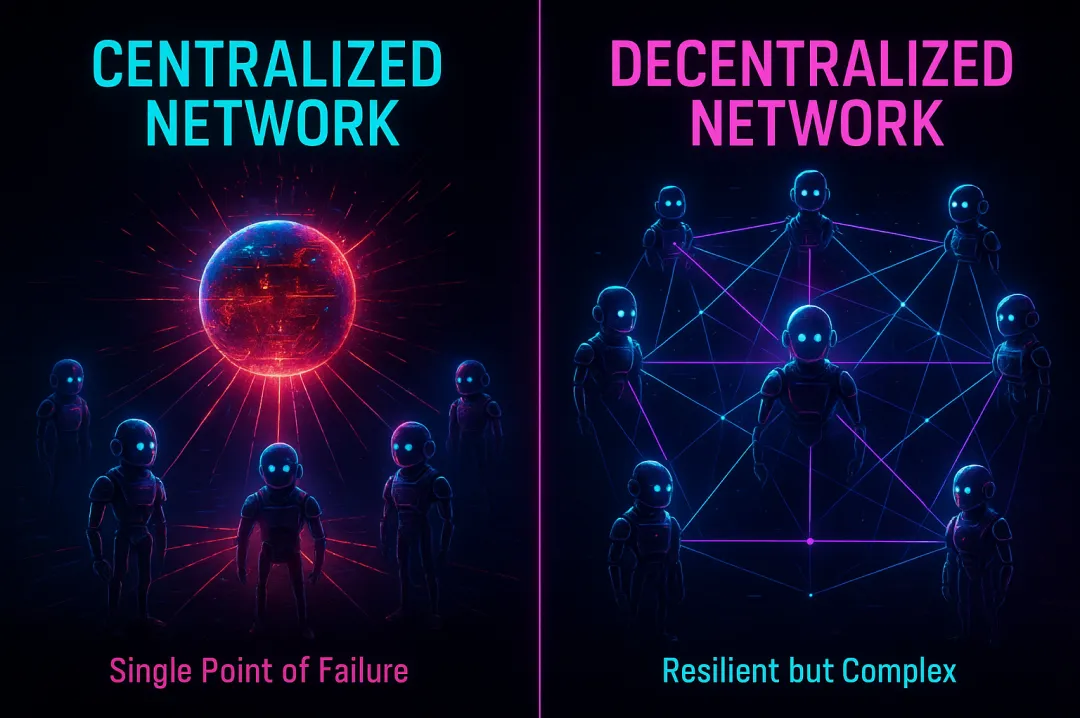
This model has a control freak in the middle. A single orchestrator agent or manager agent calls all the shots, dishing out tasks from its global knowledge base. It’s clean and easy to understand. But that central agent is a bottleneck waiting to happen and a single point of failure. If it trips, the whole network goes dark.
2. Decentralized Networks
This is organized chaos. Agents are all peers, talking directly to each other. They achieve self-organization through a shared set of rules, no boss needed. This makes the system incredibly resilient and scalable.
The downside? A massive headache when it comes to coordination complexity. Keeping everyone on the same page without a leader is a tough engineering problem to crack.
Structures of Multi-Agent Systems
Inside these networks of autonomous AI agents, agents can form different kinds of groups, creating a functioning agent society.
1. Hierarchical Structure
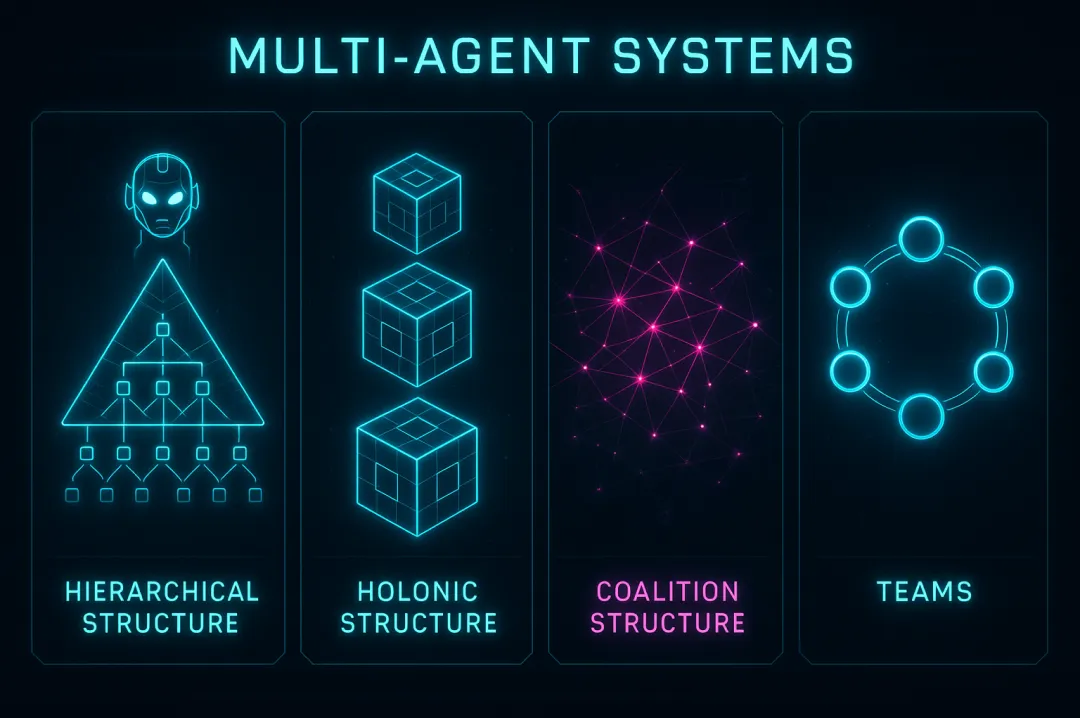
You know this one: it's the corporate pyramid. A boss agent delegates tasks to its subagents. This uniform hierarchical structure is efficient in predictable environments. But its rigidity means it can get steamrolled by a sudden change of plans.
2. Holonic Structure
Here's where it gets weird and powerful. A holon is something that's both a complete thing on its own and a part of something bigger. It’s like building with LEGOs that are themselves made of smaller LEGOs.
A holarchy is a system of these holons. An agent can be a self-contained unit and a cog in a bigger machine, which itself is a cog in an even bigger one. This is the secret to building systems that can scale almost infinitely.
3. Coalition Structure
Think of coalitions as flash mobs for AI agents. They come together for a single, specific purpose, like executing a complex financial trade, and then dissolve. This structure is all about temporary, goal-oriented flexibility.
4. Teams
Teams are built for the long haul. They're stable groups of agents with deep trust and intertwined goals. You’d use a team structure for a persistent, complex mission, like managing the national power supply grid or running a fleet of autonomous vehicles.
Behaviors of Multi-Agent Systems
When a bunch of simple agents get together, they can do incredibly smart things without being explicitly told to.
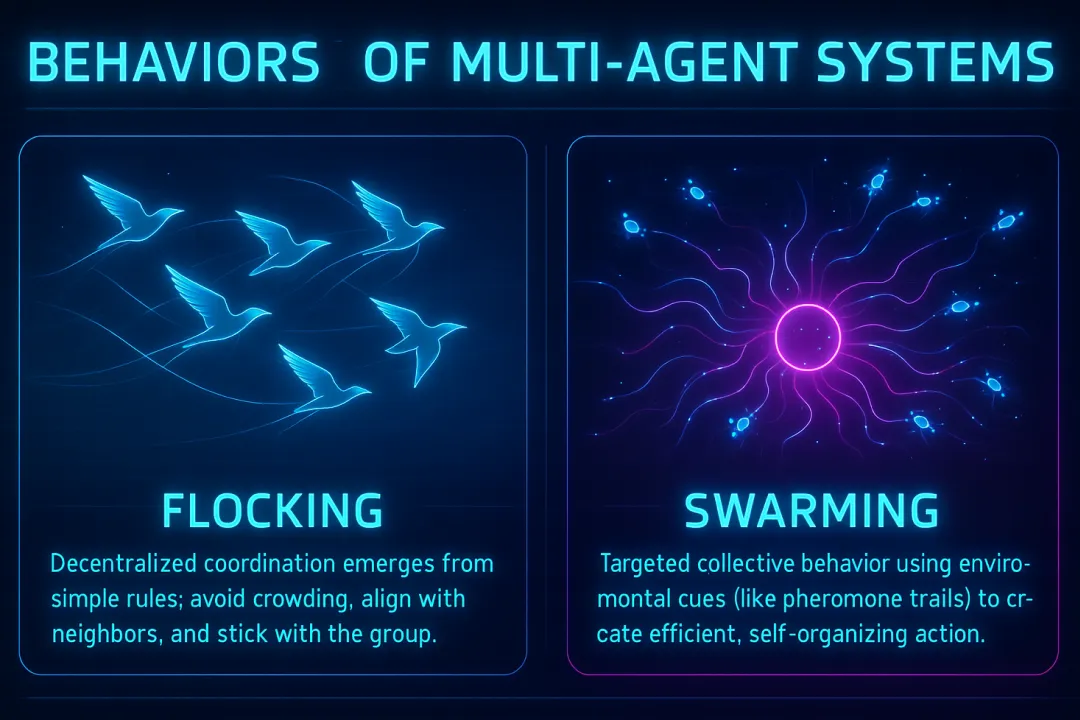
1. Flocking
You see it in birds. No single bird is in charge, yet the whole flock wheels and turns like a single organism. This flocking emerges from three simple rules each bird follows: don't crowd your neighbors, fly in their average direction, and stick with the group. That's it. It's a masterclass in decentralized coordination.
2. Swarming
Swarming is what happens when a flock gets a job. It's a targeted behavior. Think of ants stripping a carcass. They use the environment—leaving pheromone trails—to create an incredibly efficient, self-organizing workforce. It's how you get a thousand stupid robots to do one smart thing together.
Applications and Use Cases of Multi-Agent Systems
This stuff is already out in the wild.
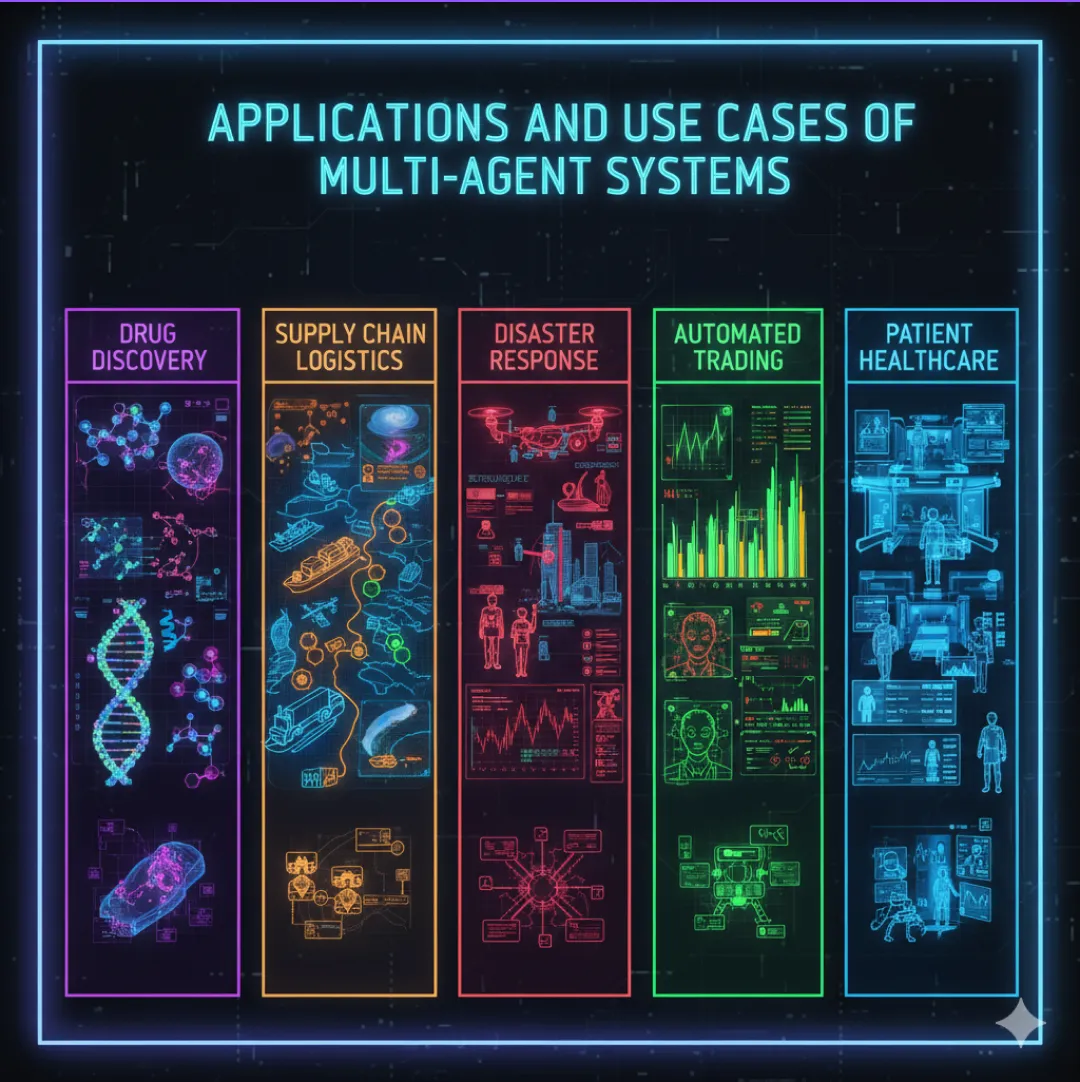
- Drug Discovery: MAS is replacing the traditional approach of using AI in drug discovery. Imagine agents representing different chemical compounds. They could autonomously explore how to bind to a target protein, searching a massive possibility space to find promising new drug candidates.
- Supply Chain Logistics: Forget static spreadsheets. In a modern transportation network, agents represent ships, trucks, and warehouses. They bid for jobs and negotiate routes in real-time to dodge storms, traffic jams, and port delays.
- Disaster Response: When an earthquake hits, a MAS can deploy. Some agents scan social media for reports of trapped people, others pilot drones with thermal cameras, and a third group coordinates with emergency services on the ground.
- Automated Trading: This is a classic battleground for agent teams. One agent watches news feeds for sentiment, another runs technical analysis, and a third manages risk, all collaborating to make split-second trading decisions. Compared to the traditional usage of AI in stock trading, this approach is faster and more foolproof.
- Patient Healthcare: Inside a smart hospital, agents manage everything. They track patient flow, schedule operating rooms, monitor pharmacy inventories, and alert doctors before a patient's condition deteriorates. These agents can be used to power almost all aspects of AI in the healthcare industry.
What Are the Benefits of Using Multi-Agent Systems?
So why bother with all this complexity? The rewards are huge. For instance:
- Flexibility: Your system becomes modular. Need a new capability? You don't have to rebuild the Death Star. You can just design a new specialist agent and let it join the team.
- Scalability: When demand explodes, a single-agent system dies. A MAS just adds more agents. This is how you handle a sudden surge in traffic or a massive new dataset without your system catching fire.
- Domain Specialization: You can build a team of PhDs. Your system can have an agent that's a world-class expert in natural language processing techniques working alongside another that's a master of geospatial math with GeoPandas and a third that’s an expert in using the NVIDIA NeMo toolkit.
- Greater Performance: Things just get done faster and more reliably. Parallel processing is baked in. And with no single point of failure, the system is naturally resilient. It has the robustness needed for jobs where you absolutely cannot fail.
What’s the Role of AI Agent Orchestration in Multi-Agent Systems?
All these multi-agent systems in artificial intelligence need rules of engagement. That's the job of AI agent orchestration. It's less about command and more about creating an environment where good teamwork can happen.
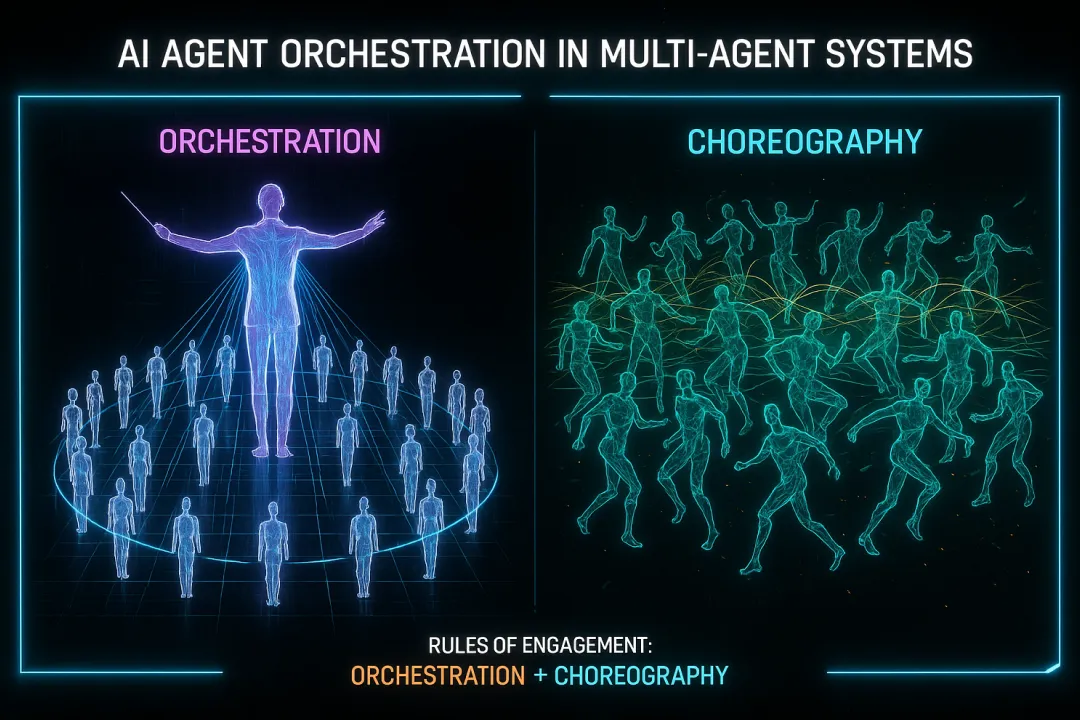
It's useful to think about orchestration vs. choreography.
1. Orchestration
- Centralized control: A single authority (like a conductor) directs the flow of tasks and ensures each part executes in the right sequence.
- Defined workflow: The system assigns roles and responsibilities, enforcing order and structure across all agents.
- Predictability: Outcomes are more consistent since the workflow follows a controlled design.
- Efficiency: Resources can be optimized and conflicts resolved quickly through central decision-making.
- Limitation: The system depends on the central controller, which can create bottlenecks or points of failure.
2. Choreography
- Decentralized coordination: Agents operate more like dancers in a flash mob, following shared rules without a central leader.
- Autonomous interaction: Each agent makes decisions based on local context and communication with its peers.
- Scalability: Works well in large, distributed environments since no single entity is overloaded.
- Flexibility: The system adapts dynamically as agents respond to real-time conditions.
- Limitation: Behavior can become unpredictable, and emergent patterns may be difficult to control or anticipate.
A good agent management system will use both. Orchestration sets the high-level plan, while choreography lets agents handle the fine-grained details themselves. This includes managing task delegation and complex agentic workflows.
Challenges of Multi-Agent Systems
This isn't a silver bullet. The problems are just as big as the opportunities.
1. Agent Malfunctions
One bad agent can spoil the bunch. If an agent starts sending out bad information, it can cause a chain reaction that leads to system-wide failure. Figuring out which agent is the source of the problem in a network of hundreds is a nightmare. Therefore, you need a counter to tackle this challenge in your initial multi-agent planning in AI.
2. Coordination Complexity
Getting self-interested agents to cooperate for the greater good is a classic problem in game theory, known as a "social dilemma." What's best for one agent might be terrible for the group. Multi-agent collaborations require sophisticated communication protocols, like FIPA-ACL (Agent Communication Language), which defines a standard for messages like request and inform. But even with a shared language, ensuring truthful and effective cooperation is a massive hurdle.
3. Unpredictable Behavior
The emergent behavior of a multi-agent system application can be terrifying. You can get brilliant, unforeseen solutions, but you can also get catastrophic, unforeseen failures. The system might discover a loophole in its rules to achieve a goal in a destructive way. Ensuring the alignment of a decentralized agent society with human values is one of the hardest problems in all of AI.

How Does Agentic RAG Enhance Your Multi-Agent System?
Standard Retrieval-Augmented Generation (RAG) is a clerk. It finds the document you ask for. Agentic RAG is a detective. It doesn't just fetch; it investigates. An agent with this skill follows leads. It might start with a broad query, analyze the results, and realize it needs a more specific piece of information.
It then forms a new query, gets that info, and synthesizes it all. It’s an active, reasoning-driven process of inquiry, turning a simple data retrieval tool into a powerful research partner for each agent.
How Can You Get Started With Agentic AI?
Jumping in is easier than you think.
- Use the Frameworks: Tools like AutoGen and CrewAI provide the scaffolding for building MAS in AI. You can also look at older, foundational frameworks like JADE (Java Agent DEvelopment Framework) to understand the history. Your core focus should be building cooperative AI systems that are useful in the long term.
- Simulate Everything: Don't test your agents in the real world first. Use simulation environments like PettingZoo for multi-agent reinforcement learning. These sandboxes are essential for finding and fixing bad behaviors before they can do real damage.
- Nail Down Your Protocol: Your agents must speak the same language. A well-defined communication protocol and a shared ontology (a formal dictionary of concepts) are not optional. It’s the foundation of everything. Explore Next-generation AI frameworks if you’re planning to go for the development internally.
- Get Involved: The multi-agent systems interest group and other online communities are where the real action is. The field is moving at lightning speed, and collaboration is the only way to keep up.
- Outsource: If you’re not familiar with the tech yet, the best bet is to collaborate with the AI agent development companies. These folks can build and deploy AI mesh networks that smoothly streamline your AI agents.
The future of AI is a team sport. It’s time to start thinking less about building a single, monolithic intelligence and more about fostering a community of them.
MAS Examples: Three Real Case Studies in Existence
Case Study 1: DeepMind’s AlphaStar – Multi-Agent Learning in StarCraft II
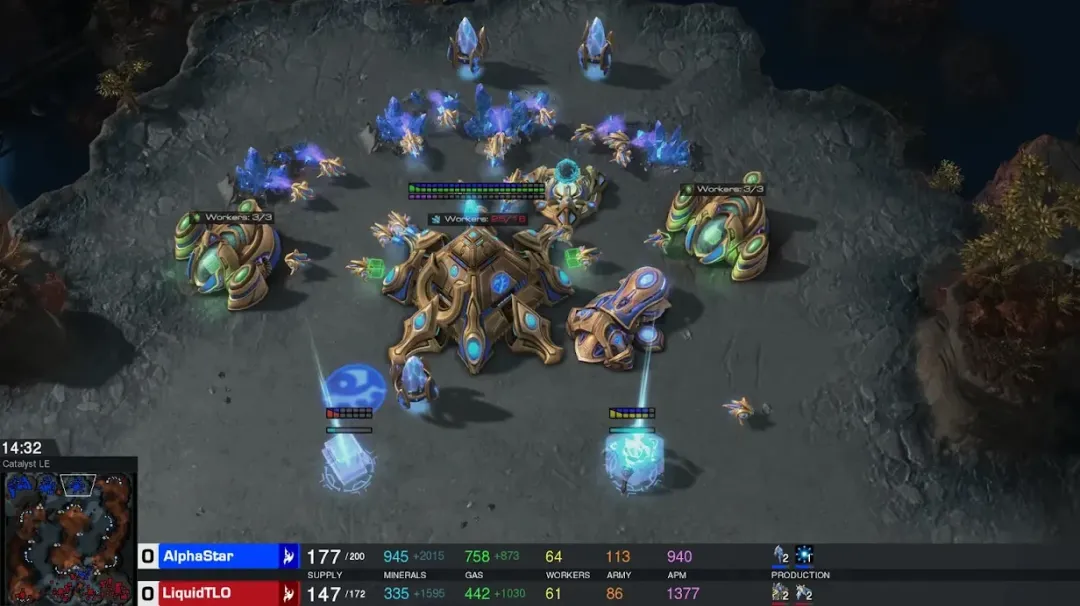
| Aspect | Details |
|---|---|
| Domain | Real-time strategy gaming (StarCraft II) |
| What the system does | Multiple agents learn via self-play, reinforcement learning, and imitation learning to play at a Grandmaster level across all three races (Protoss, Terran, Zerg). |
| MAS elements | Agents with different specializations; competing/cooperating via game dynamics; emergent coordination as agents adapt to other agents’ strategies. |
| Outcomes | Achieved Grandmaster status, exceeding 99.8% of human players in ranking. Demonstrated that MAS + self-play can scale to high strategic complexity. |
| Key lesson | Complex, adversarial/cooperative environments force agents to handle unpredictability, requiring robustness and flexibility. Also shows the importance of simulation and large-scale training before deployment. |
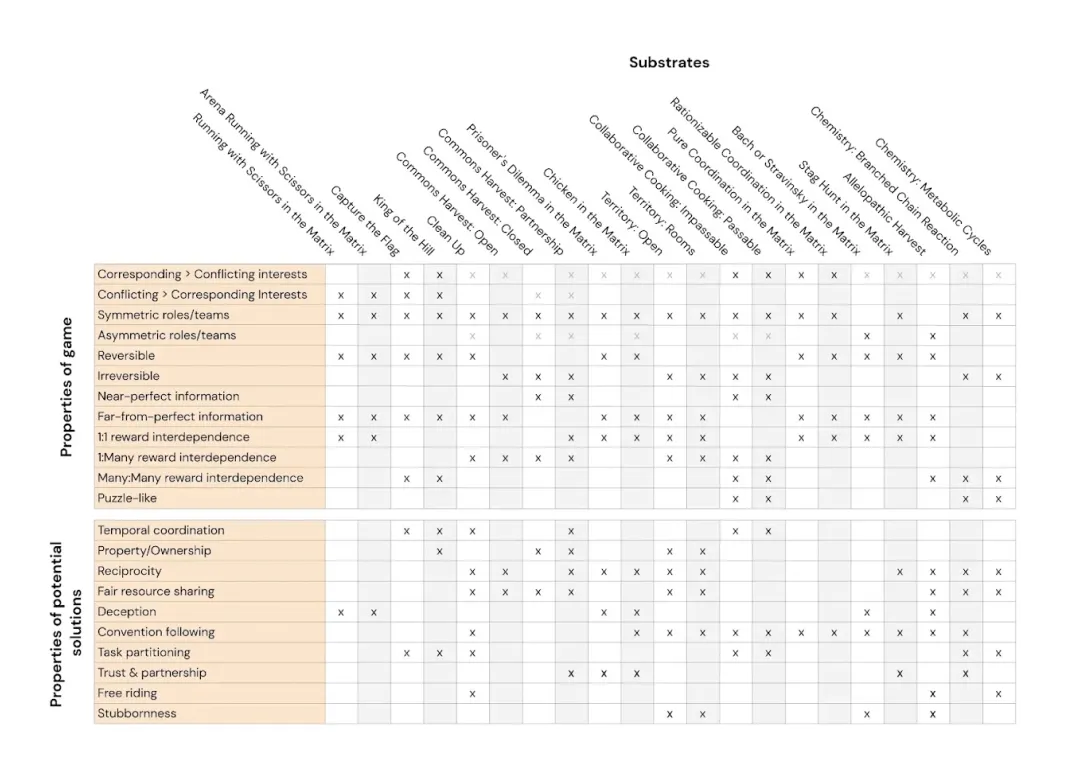
Case Study 2: Melting Pot by DeepMind – Generalization in Multi-Agent Social Environments
| Aspect | Details |
|---|---|
| Domain | Social interaction simulations: evaluating generalization across novel multi-agent settings. |
| What the system does | An evaluation suite that tests multi-agent RL algorithms across many social scenarios (cooperation, competition, trust, deception, etc.). Agents face both known and novel situations with agents they did not train with. |
| MAS elements | Multiple interacting agents; rules of engagement; coordination vs competition; emergent behavior depending on environment. |
| Outcomes | Provides benchmark metrics that show which algorithms generalize better to new social situations; helps researchers see where MAS methods fail or succeed in transfer to unfamiliar contexts. |
| Key lesson | It’s not enough to perform well in narrow, fixed environments. True MAS systems need to handle novelty: new agents, new interaction norms. This case study underscores the importance of designing for generalization, not just performance. |
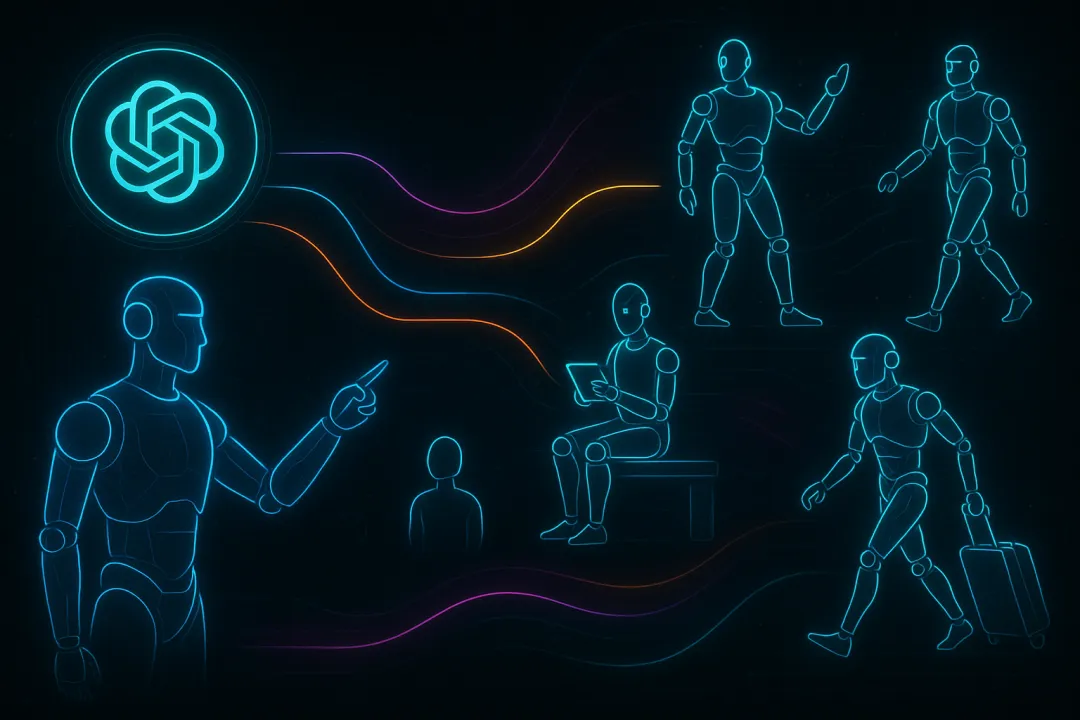
Case Study 3: Automated Customer Support Workflow (Airline) using OpenAI Swarm
| Aspect | Details |
|---|---|
| Domain | Airline customer support operations |
| What the system does | Uses a multi-agent system (via OpenAI Swarm) to divide up support tasks: agents such as Triage Agent, Flight Modification Agent, Cancel/Change Agent, Lost Baggage Agent, etc. Each handles specialized types of queries. |
| MAS elements | Modular agents dedicated to specific subdomains; agent handoffs; coordinated workflow; some orchestration to decide which agent handles what. |
| Outcomes | Faster resolution of customer issues; clearer delineation of responsibilities among agents; improved scalability of support during peak demand (e.g., delays, cancellations). The case study is more illustrative than giving exact numbers, but it shows how MAS can make customer support more robust. |
| Key lesson | MAS helps in loosely structured workflow domains by letting specialists handle subsets of tasks, improving efficiency and preventing overload. Also, helps fault-tolerance: when one agent is overloaded or fails, others can still handle other categories. |
Frequently Asked Questions
Is ChatGPT one of the Multi-agent LLMs?
No, ChatGPT itself is not a multi-agent LLM. It is a single large language model designed to generate text and follow instructions. Multi-agent systems, by contrast, involve multiple specialized agents that collaborate, each handling different parts of a task. While ChatGPT can be integrated into multi-agent frameworks, on its own, it works as a single agent.
What are Multi-agent in LLMs?
Multi-agent in LLMs refers to setups where several AI agents, often powered by large language models, work together in a coordinated way. Each agent can be assigned a role — such as research, reasoning, planning, or execution — and they communicate to solve complex problems. Instead of one model trying to do everything, multi-agent LLMs distribute the workload across a network of cooperating agents.
What does agentic mesh mean?
Agentic mesh describes a web-like structure of AI agents connected in a network. In this setup, agents don’t just operate in isolation — they exchange information, adapt to their environment, and respond to each other’s actions. Think of it as a digital ecosystem where multiple intelligent agents form a mesh, enabling resilience, flexibility, and scalability that a single model can’t achieve.
How are AI agent collaborations beneficial compared to single AI agents?
AI agent collaborations bring several advantages over a single-agent setup:
- Resilience: If one agent fails, others can continue the task.
- Scalability: More agents can be added to handle higher demand.
- Specialization: Each agent can focus on a particular skill or domain.
- Efficiency: Tasks are divided and executed in parallel, speeding up outcomes.
This collective intelligence makes multi-agent systems more adaptable and robust than single-agent AI.
What are some examples of next-gen AI systems?
Examples of next-gen AI systems that use multi-agent principles include:
- DeepMind’s AlphaStar: Multi-agent reinforcement learning applied to StarCraft II.
- OpenAI Swarm: A framework where specialized agents collaborate to handle workflows like customer support.
- DeepMind’s Melting Pot: A testing environment for multi-agent social interactions such as cooperation and competition.
- AutoGen and CrewAI frameworks: Tools that let developers build multi-agent systems for real-world applications.

Uncover executable insights, extensive research, and expert opinions in one place.
Related Content