Share It On:
 Nearshore software development means normal hours. So the office vampires lose their excuse to burn the midnight oil. Their major enemy, but your closest friend.
|
TL;DR What is Nearshore Software Development? Nearshore software development means outsourcing to nearby countries with minimal time zone differences. For U.S. companies, that often means Latin America (Mexico, Colombia, Costa Rica); for European firms, Eastern Europe (Poland, etc.). The advantage isn’t just proximity—it’s real-time collaboration. That’s why nearshoring has shifted from a cost-saving move to a strategic growth driver for C-suite leaders. |
Nearshore software development sounds fancy, but the idea is pretty down-to-earth. It’s outsourcing, only closer—close enough that your working hours actually overlap. Instead of waiting half a day for a reply or juggling calls at odd hours, you’re talking to people who are more or less on the same clock. This proximity changes the pace of work and makes collaboration feel smoother from day one.
This outsourcing model doesn’t just trim costs; it trims the lag. Feedback comes through quickly, projects keep momentum, and collaboration feels more natural. You’re not shouting into the void and hoping for an answer tomorrow. You’re swapping notes, solving problems, and moving ahead at a pace that makes sense.
By partnering with development teams nearby, businesses stop treating outsourcing like a distant hand-off. It becomes something closer to an extra wing of the company—connected, responsive, and far easier to manage.

Features of the Nearshore Software Development Model
So what does "nearshore" actually feel like in the trenches? It’s a collection of pragmatic features that combine to solve the biggest headaches of global outsourcing.
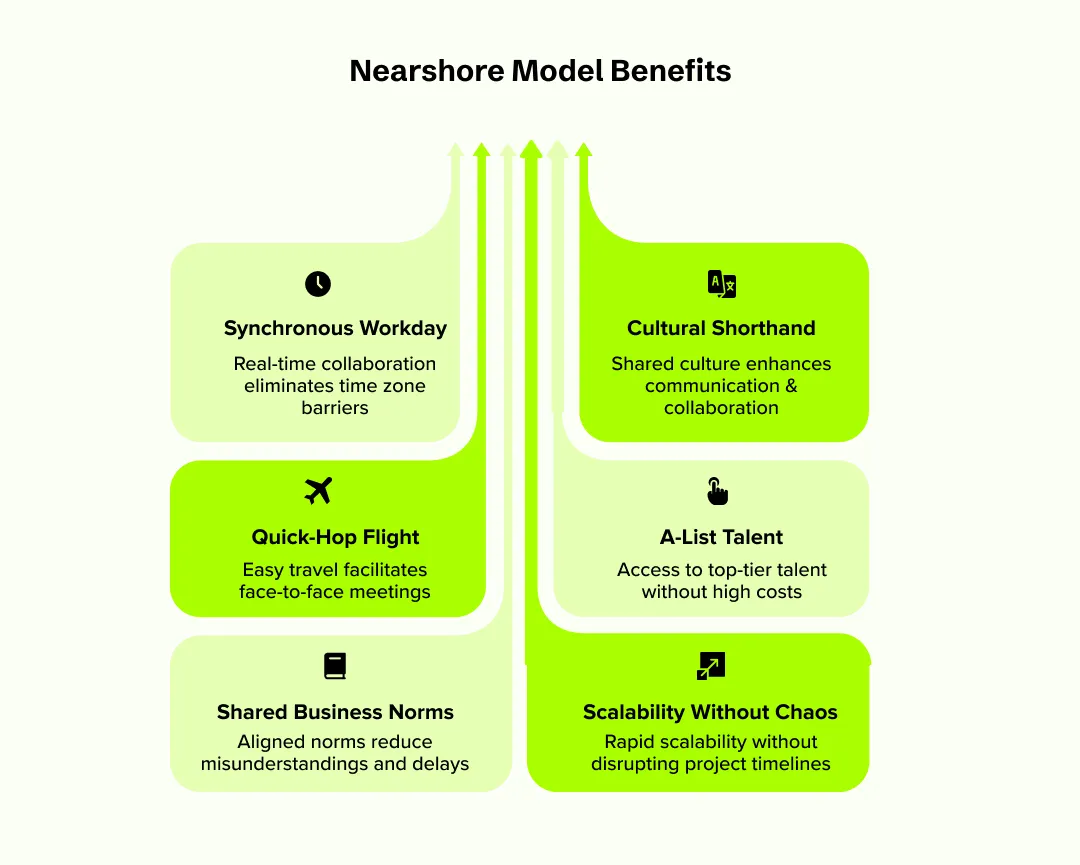
- The Synchronous Workday. This is the killer application of nearshoring. Your 9 AM is their 8 AM. When a crisis hits, you jump on a call now, not tomorrow. Problems that would fester for 24 hours in an offshore model get diagnosed and solved before lunch.
- Cultural Shorthand. Don’t dismiss this as a soft skill. When your partners understand your business idioms, laugh at the same jokes, and share a similar professional etiquette, the friction just melts away. It’s the invisible oil in the engine of collaboration.
- The Quick-Hop Flight. Need a war room for a critical launch? Getting your core people in the same physical space is a 3-hour flight, not a 20-hour, jet-lag-fueled odyssey. This makes true face-to-face meetings a powerful, practical tool in your arsenal.
- Access to A-List Talent. The narrative that all the best engineers are in Silicon Valley is dead wrong. Nearshore regions are producing elite, hungry, and highly educated tech talent. You get to tap this rich vein of skill without paying the crippling "tech hub tax"—a big plus when companies weigh overall software development cost.
- Shared Business Norms. Deadlines, reporting standards, even the rhythm of the workweek—nearshore teams often mirror the same professional culture as their clients. This cuts down on mismatched expectations and endless clarification cycles.
- Scalability Without Chaos. Adding new developers or scaling a project doesn’t mean waiting weeks for onboarding across time zones. Nearshore teams can plug into your processes quickly, making it easier to expand without derailing schedules or losing momentum.
How Nearshore Software Development Works
The way a nearshore software development model works is all about deliberate integration. This isn’t about lobbing tasks over a fence; it’s about weaving a new team into the very fabric of your organization. A successful integration strategy is paramount, and it typically takes one of three shapes.
Think of it like building an extension on your house. You have options. For instance:
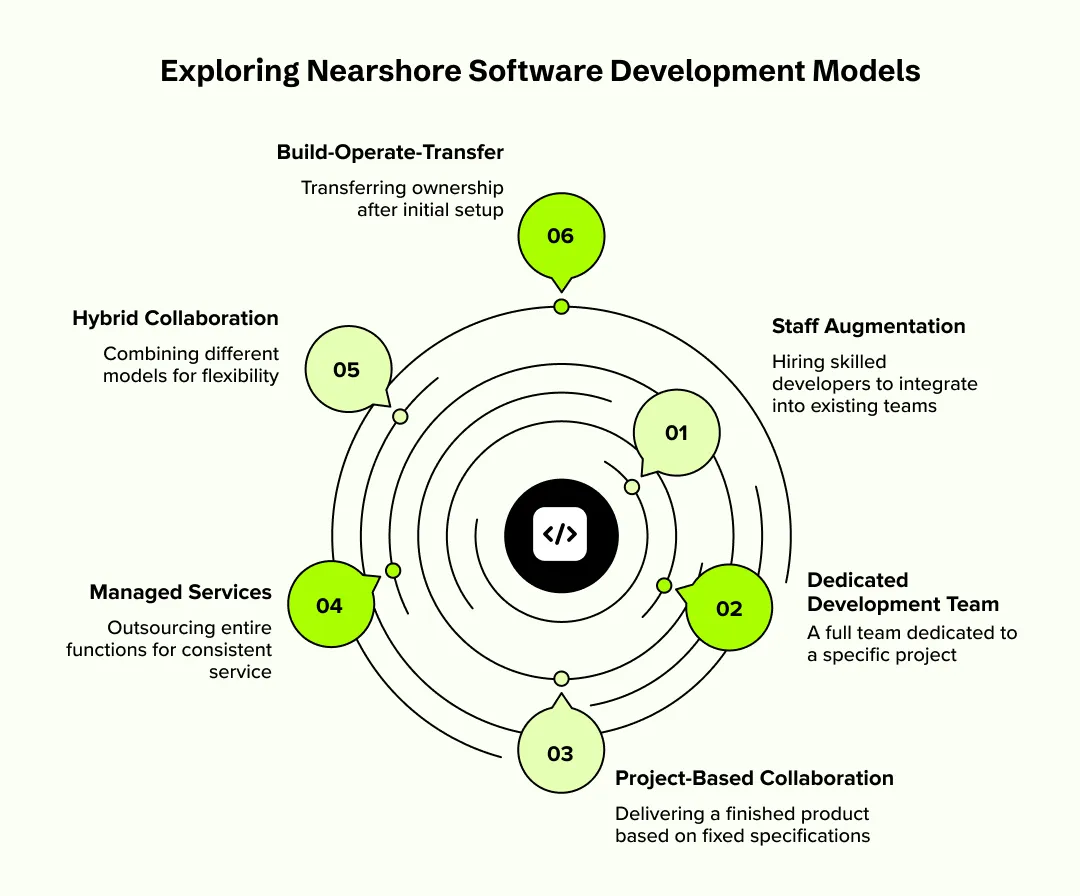
- Staff Augmentation (The Master Craftsman): Your house is built, but you need a master electrician. You hire nearshore software developers with specific, rare skills to embed directly into your existing crew. They report to your supervisors, follow your blueprints, and work under your roof. It's a surgical strike to fill a critical talent gap, demanding a deep mesh with your existing documentation of workflows and the software development life cycle.
- Dedicated Development Team (The General Contractor): You're adding a whole new wing. You hire a full, self-managed crew—the contractor, the builders, the inspectors—who work exclusively on your project. This dedicated development team handles the day-to-day execution, freeing you to focus on the architectural vision. It’s the go-to model for long-term products that require deep cultural alignment and consistent momentum.
- Project-Based Collaboration (The Turnkey Build): You know exactly what you want built, down to the last doorknob. You hand the complete blueprints to a team, and they deliver the finished product for a fixed price. This outcome-based model is a pure play on technical expertise and execution, perfect for projects with a locked-down scope.
- Managed Services (The Property Manager): Instead of owning the hassle, you outsource an entire function—like QA, maintenance, or support—to a nearshore provider. They run it end-to-end while you focus on core business. It’s about consistency, uptime, and predictable service rather than project-based delivery.
- Hybrid Collaboration (The Mix-and-Match Build): Many companies don’t fit neatly into one model. They might augment staff for niche expertise, run a dedicated team for core product development, and commission a project-based build for a side module. Hybrid setups let businesses stay flexible without being locked into a single way of working.
- Build-Operate-Transfer (The Lease-to-Own): You start with a nearshore partner building and running a dedicated team. Once the setup matures and stabilizes, ownership transfers to you. This gives companies the ability to test a market, validate a team, and then bring it fully in-house without the risks of building from scratch.
Underpinning all of these models is a fanatical devotion to modern development hygiene: ruthless agile approaches, sophisticated DevOps trends for CI/CD, and obsessive real-time communication.
Benefits of Nearshore Software Development
The upside of going nearshore isn’t just a list of bullet points; it's a direct assault on the biggest obstacles to growth. These nearshore outsourcing benefits translate into speed, savings, and sanity.
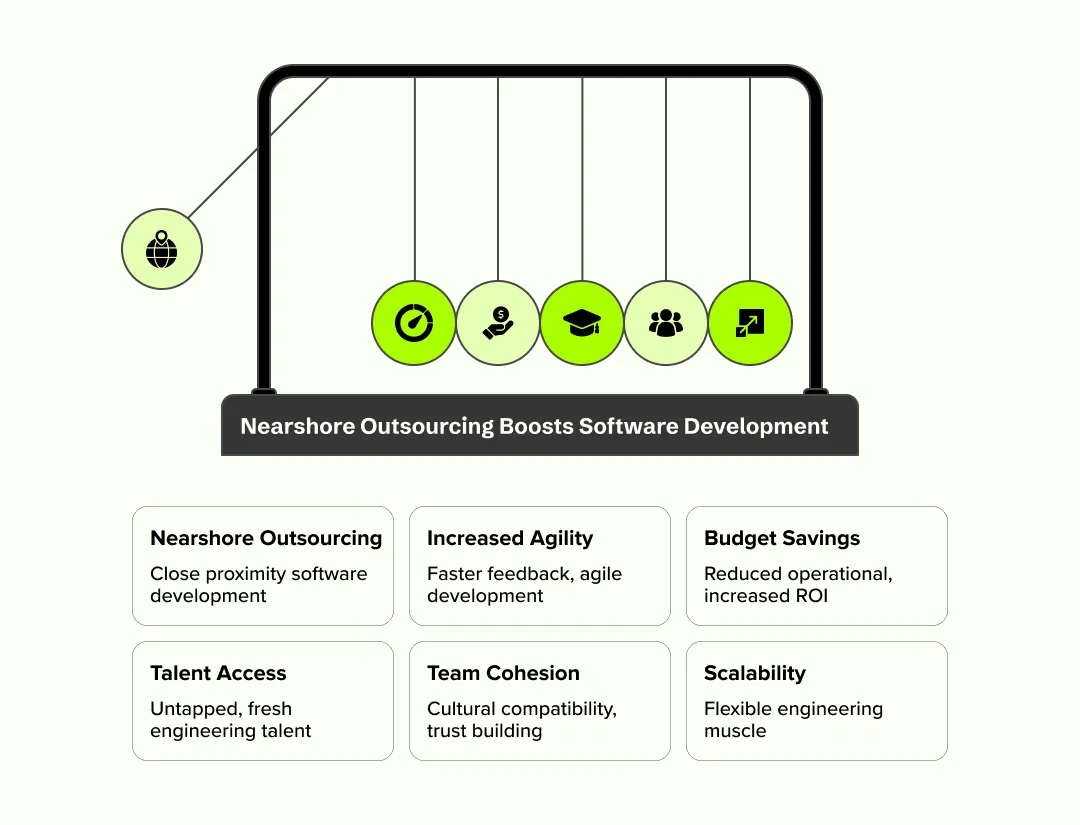
- Unlock Your Budget. The cost-effectiveness is profound. The reduced operational expenses mean the money you save isn’t just a line item; it's fuel. It’s the extra marketing campaign, the R&D for your next big thing, the ability to hire a sales leader. The debate over in-house vs. outsourced development often ends when the CFO sees the impact on the P&L and the boost to ROI.
- Achieve True Team Cohesion. With high English proficiency and deep cultural compatibility, the awkward "getting to know you" phase shrinks from months to days. This isn't just about feeling good; it's about building the trust required to do great work under pressure.
- Weaponize Your Scalability. The market changes. Fast. Nearshoring gives you the flexibility to scale your engineering muscle up or down with terrifying speed. If a product launch demands doubling your QA team or spinning up a mobile unit, the resources are already nearby and ready to integrate. It's about having an elastic workforce prepared to meet any challenge.
- Stay Compliant Without the Drama. Regulations aren’t going away, and nearshore partners often live by the same playbook—GDPR, SOC 2, HIPAA, take your pick. That saves legal back-and-forth and spares your compliance team from heartburn.
- Accelerate Onboarding. Because workdays overlap, new hires or augmented staff don’t sit around waiting. Knowledge transfer happens live, so value shows up earlier instead of weeks later.
- Tap Untapped Talent Pools. Nearshore hubs are graduating sharp engineers every year. Many of them are hungry for complex work and bring fresh approaches, not cookie-cutter solutions. That energy can be contagious for your existing team.
- Cut Travel Pain. When a whiteboard session or a war room matters, a three-hour flight is manageable. Twenty hours in transit with jet lag? Not so much. Nearshore makes in-person collaboration practical again.
- Stay Ahead of the Curve. Modern nearshore software development trends show that companies no longer look at nearshoring only for cost savings—it’s about agility, scalability, and tapping into innovative ecosystems that keep pace with shifting software development trends.
- Build Resilience. Spreading your engineering base close to home—but not entirely inside your HQ—gives you insurance against disruption. If one location stumbles, another can pick up the slack without derailing a launch.
- Kill the Lag. Time zone alignment is the ultimate productivity hack. It means faster feedback loops and genuine agile development. Teams can handle bug fixes, design reviews, and urgent changes in the same workday instead of losing a cycle. That’s how you outmaneuver the competition—something firms increasingly value when they choose to outsource software development.
Key Considerations and Challenges in Nearshore Development
Nearshoring can blow up in your face if you walk in naively. The vendors will show you a highlight reel; you need to look for the cracks.
Here’s the unvarnished intel.
| Consideration | The Unspoken Risk & The Proactive Defense |
|---|---|
| Technical & Domain Expertise |
The Risk: Their portfolio looks amazing, but it was built by a team that left two years ago. The Defense: Interrogate their technical and domain expertise. Demand to speak to the actual developers who will be on your account. Give them a small, paid coding challenge to see their raw skills. |
| Quality Control & Security |
The Risk: You get code that works on day one but is a ticking time bomb of technical debt. The Defense: Demand to see their quality control playbook. How do they review code? What’s their testing protocol? Vet their security and data protection systems as if your company’s life depends on it—because it might. |
| Communication & Cultural Fit |
The Risk: They check the box on English language proficiency, but there's no spark, no proactive problem-solving. The Defense: Cultural alignment is your job to test. Ask them how they handle disagreement. Present a hypothetical crisis and see how they react. You're hiring partners, not just typists. |
| Intellectual Property Protection |
The Risk: Your "secret sauce" gets added to their next client's project. The Defense: Your legal framework must be ironclad. Work with lawyers who understand the local laws to ensure bulletproof intellectual property protection from day one. |
| Partner & Contract Vetting |
The Risk: You’re trapped in a one-sided contract with a team that isn't delivering. The Defense: Check their market reputation with a vengeance. Prioritize flexible contract conditions. The planning and scope definition phase should feel like a partnership, not a negotiation. |
Cost Comparisons and Economic Impact
Let’s talk brass tacks. Money. The Nearshore Cost vs. Other Models isn’t a simple comparison of hourly rates. It's about Total Cost of Ownership.
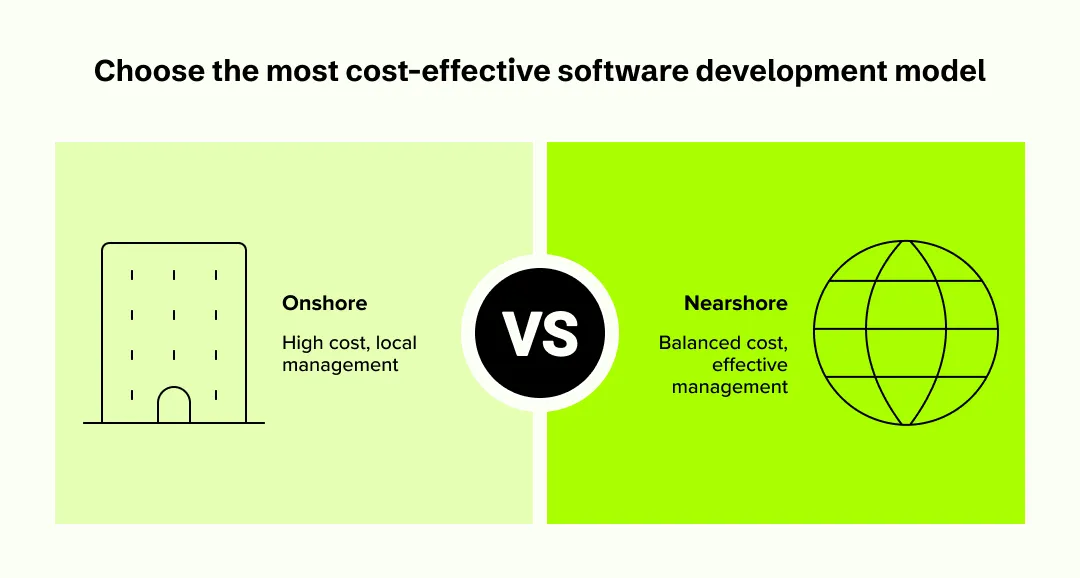
- Onshore (USA): $120 - $250+/hr. The sticker shock is real.
- Nearshore (LatAm/EE): $50 - $95/hr. The sweet spot.
- Offshore (Asia): $30 - $60/hr. The siren's call.
That offshore rate looks seductive, but it hides the "management tax." That’s the brutal cost of rework, the productivity lost to communication delays, the senior management time spent babysitting a team on the other side of the world. It’s a tax that can silently bankrupt your project. This is where software development trends clearly show a preference toward nearshoring as the middle ground.
Nearshoring offers a more honest, cost-effective solution—balancing spend with output while keeping projects on track, giving you budget control without the setbacks of distance. This is the core of its powerful value proposition.
Best Practices for the Nearshore Outsourcing Model
Success isn't accidental. It’s engineered. If you want to have a winning strategy of nearshore outsourcing for software development, you need to be disciplined.
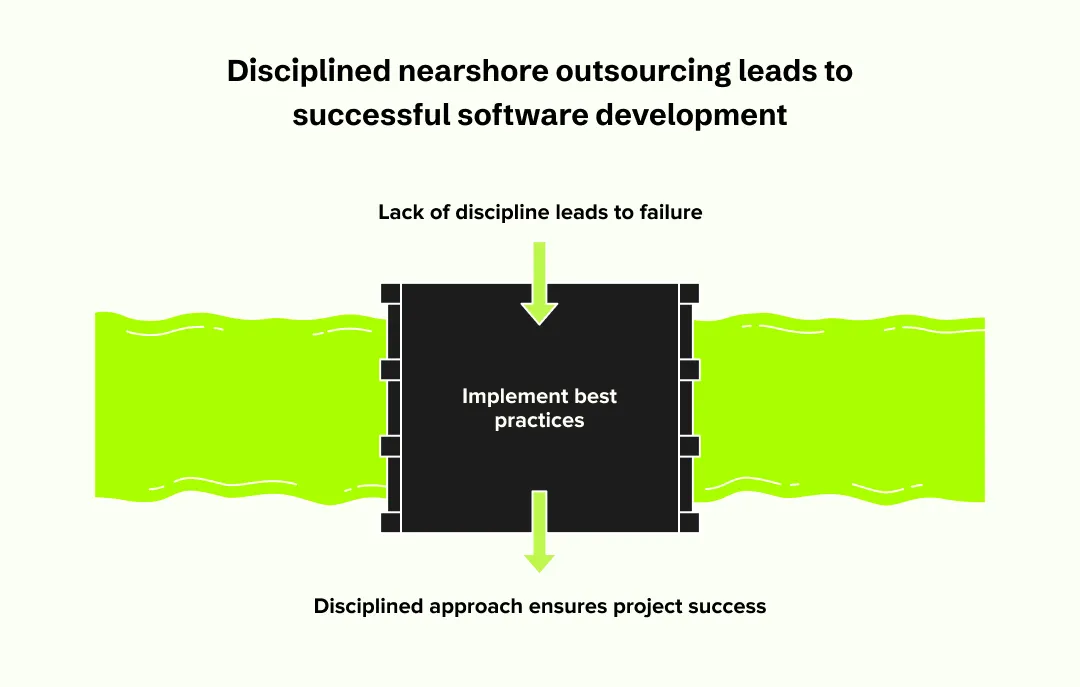
- Interrogate, Don't Interview. When vetting a partner's technical expertise, don't just ask what they've done. Ask them to deconstruct a complex problem they solved. Ask them what technologies they hate and why. You’re looking for passion and deep thinking, not just a list of skills.
- Weaponize the Pilot Project. Never go all-in on day one. Commission a small, paid sample project with a tight deadline. It’s the ultimate litmus test of their skills, communication, and ability to deliver under pressure.
- Standardize Your Communication Rhythm. From day one, establish your communication channels and rituals. Daily stand-ups are non-negotiable. So are weekly demos. This isn't micromanagement; it's creating the operational alignment needed for a high-performance remote team.
- Insist on Aligned Methodologies. If you run on agile methodologies, your partner must too—and not just in name. They need to live and breathe iterative development. This alignment on project management approaches is critical.
- Codify Your Quality Standards. Don't assume everyone's definition of "good code" is the same. Document your standards for quality control. Make sure your partner can meet any regulatory standards (like WCAG or PCI DSS) your product requires.
Popular Locations to Find the Right Nearshore Partners
Nearshore development is spreading fast. It’s not tied to one country anymore—different cities have stepped up as real options for businesses.
- New York: The city is still a magnet for tech. You’ll find plenty of software development companies in New York, especially in fintech and healthcare. It helps that the talent pool sits right next to the decision-makers.
- Noida: Over the years, Noida has become one of India’s busiest IT zones. Software development companies in Noida are valued for affordable services and quick scaling. Startups and bigger firms both rely on them.
- Gurugram: Right next to Delhi, Gurugram has turned into a tech corridor. Many software development companies in Gurugram focus on enterprise projects, with strong teams and modern offices spread across the city.
- London: Finance may define London, but its tech scene has its own weight. Software development companies in London are often tied to fintech, AI, and large enterprise systems. Global firms keep turning here for projects.
- Austin: People call it “Silicon Hills” for a reason. The city is full of startups and mid-size firms. Software development companies in Austin are common in cloud, SaaS, and early-stage product builds.

Comparisons Between Nearshore, Onshore, and Offshore Models
When comparing outsourcing approaches, the decision isn’t just about cost. It’s about velocity, control, and future-proofing. With AI trends like AI agents replacing app menus and buttons and the rise of large language models, even outsourcing strategies need to account for how teams adapt to the types of AI shaping modern workflows.
As for the comparison between these workflows, this is how it can look.
| Factor | Onshore (Your Backyard) | Nearshore (Your Neighbor) | Offshore (Across the Ocean) |
|---|---|---|---|
| Control | Maximum | High | Low |
| Speed (Velocity) | High | Highest (balanced cost) | Lowest (due to lag) |
| Cost | Highest | Balanced & Efficient | Lowest (with hidden costs) |
| Friction | Minimal | Low | Very High |
| Best For… | Sensitive, skunkworks projects needing daily physical presence. | Agile development techniques where speed, collaboration, and value are paramount. | Massive, waterfall-style projects where cost is the only variable that matters. |
The bottom line is this: The operational convenience and ease of communication of nearshoring crush the logistical nightmares of offshore. It provides the cost savings you need without forcing you to sacrifice the speed and collaboration that modern software development demands.
Frequently Asked Questions
How will the right nearshore partner guarantee my IP is safe?
You don't rely on guarantees; you rely on contracts and controls. A top-tier nearshore software development company will have ironclad legal frameworks and rigorous security protocols. You verify this through independent audits and ensure your contracts have teeth in their local jurisdiction. It's about proactive regulatory assurance.
Can a nearshore team really understand our complex business?
Yes, but you have to teach them. The best partnerships begin with a deep immersion phase where the nearshore team spends significant time with your subject matter experts. A partner's ability to demonstrate rapid learning and ask insightful questions during the vetting process is a huge green flag for their technical expertise.
What if we need to scale the nearshore team down? Are we locked in?
You shouldn't be. A core benefit is elasticity. Demand flexible engagement models in your contract that allow you to scale your team up or down with a reasonable notice period (e.g., 30 days). Rigidity is a sign of a vendor, not a partner.
How do you maintain company culture with an external team?
You don't try to just export your culture; you build a new, hybrid one. It requires deliberate effort: flying key nearshore members to your HQ for kickoffs, including them in all-hands meetings, and creating shared virtual social events. Strong cultural compatibility is built, not assumed.
We have very specific project requirements. How do we find the right niche skills?
This is where you leverage the breadth of nearshore talent pools. A great nearshore partner selection process involves finding a company that acts as a talent scout for you. They should have the network and recruiting muscle to find developers with the exact niche skills your project requires.
What is flexible nearshore software development?
It’s about adjusting your team size quickly. Nearshore partners let you add or cut resources without long delays or time zone hassles.
What are the main types of IT outsourcing models?
Outsourcing usually comes in three forms: onshore, nearshore, and offshore. Each has its own mix of cost, control, and convenience.
How does onshore vs nearshore development compare?
Onshore gives you maximum control but at a high price. Nearshore cuts costs while keeping work hours aligned and culture close.
What do nearshore software development services include?
They range from adding a few developers to hiring full teams, managed services, or project-based delivery—depending on what’s needed.
Why choose nearshore for software development?
It’s chosen for faster feedback, lower costs, and easier collaboration with skilled engineers in nearby countries.

Uncover executable insights, extensive research, and expert opinions in one place.
Related Content