Share It On:
 When was the last time your team actually aligned on one version of the truth? Anaplan’s interface forces the conversation you’ve been avoiding. Here’s how!
|
So, what is Anaplan, really? Forget the cloud software jargon for a second. Think of it as a flight simulator for your business. A living, breathing digital twin of your entire organization—every department, every process, every dollar—that lets you see the future before it happens. This isn't some flash-in-the-pan startup. |
Born in a Yorkshire, UK barn in 2006 by Guy Haddleton, Sue Haddleton, and Michael Gould, and now headquartered in San Francisco, its trajectory culminated in a massive deal valued at $10.7 billion (ultimately executed at about $10.4 billion in cash) through its acquisition by Thoma Bravo in 2022.
It’s a platform built for a concept they call Connected Planning, a philosophy designed to tear down the functional silos that hamstring large companies, forcing them into one single, cohesive, and brutally honest conversation.

Features Powering The Anaplan Engine
Anaplan’s power isn’t a feature; it’s a fundamental architectural advantage. It creates a centralized hub, an undisputed source of truth that vaporizes the soul-crushing arguments over whose spreadsheet is correct.
It has also been consistently recognized as a Leader in Gartner’s Magic Quadrant for Sales Performance Management and acknowledged by Forrester in its Financial Planning & Analysis (FP&A) evaluations—independent validation that backs up its edge.
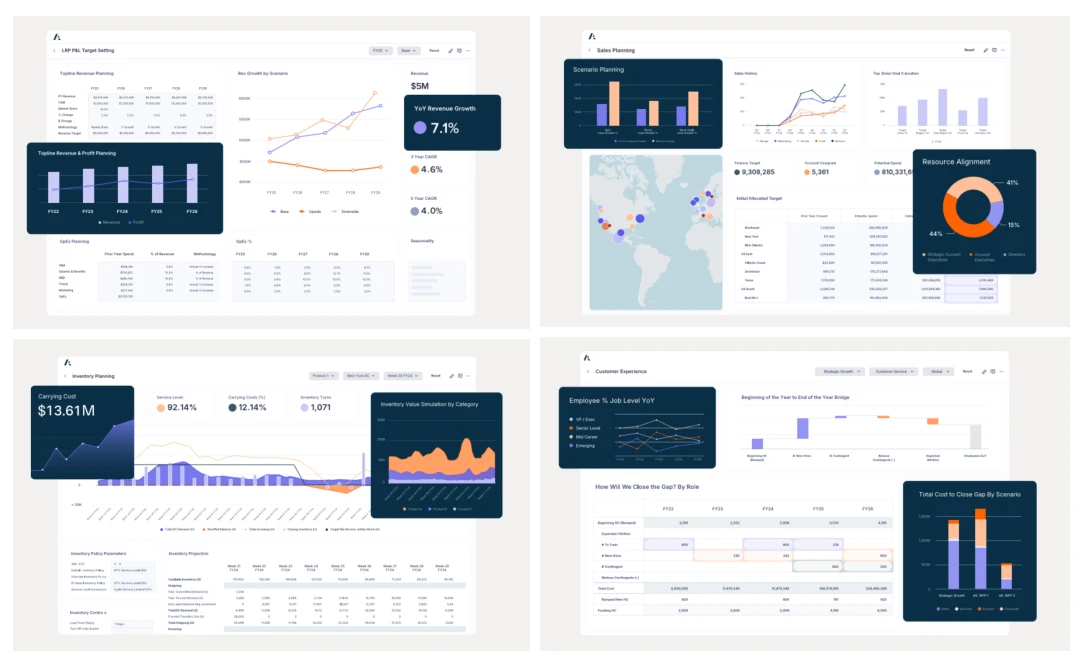
But how does it actually work?
1. Hyperblock®: The Core Engine
Forget what you know about databases. Hyperblock is Anaplan’s trademarked in-memory modeling engine. An in-memory calculation behemoth designed for speed at a ludicrous scale.
This is the tech that delivers true real-time analytics and fuels the Anaplan Intelligence suite—enabling genuine predictive forecasting based on your own history and anomaly detection that flags risks a human would miss.
2. PlanIQ: The Intelligence Layer
If Hyperblock is raw horsepower, PlanIQ is the autopilot system that makes that power intelligent. It’s Anaplan’s AI and machine learning engine, built to automate forecasting and surface insights that humans miss. PlanIQ learns from historical data, adapts as markets shift, and generates forecasts with speed and precision.
It doesn’t just crunch numbers—it ranks scenarios, highlights anomalies, and integrates with advanced ML platforms like Google Vertex AI.
Future GenAI enhancements include assisted model building, auto-generated narrative explanations for forecasts, and conversational querying of scenarios—bringing planning closer to a natural dialogue with the business.
3. A Collaborative War Room: The Experience
Real alignment doesn't happen in email chains. The UI is built around shared dashboards that become the single source of truth for decision-making. Teams engage directly within the platform via threaded commenting and notifications, ensuring context is never lost.
With full version control and mobile access, planning becomes a fluid, continuous action, not a static, desk-bound event. This also includes workflow capabilities for managing approvals, reporting capabilities for dynamic dashboards, and seamless HR planning and sales planning alignment within the same platform.
4. The Connective Tissue: Modern Integrations
A planning platform that can't talk to your core systems is a dead end. Anaplan is built to be a citizen of the modern data stack. It connects to ERP and CRM systems and integrates with BI platforms like Tableau and Power BI, as well as cloud data warehouses such as Snowflake.
Its open APIs and integration framework simplify ETL processes, ensuring data flows smoothly between enterprise resource planning (ERP), customer relationship management (CRM), and other core applications.
This integration-first design makes Anaplan a natural fit with core banking platforms and modern banking platform architecture, where agility and compliance must align.
It’s cloud-native, at home on AWS, GCP, or Azure, designed to be the intelligence hub, not another silo.
Security & Compliance: Built for the Enterprise
Planning platforms that can’t guarantee security don’t belong in the enterprise. Anaplan knows this, which is why governance isn’t an add-on—it’s baked into the steel frame of the platform.
Here’s how it ensures security.
- Role-based access + SSO: Every user is permissioned down to the cell level. A CFO, HR director, and sales rep all see the same platform—but only their slice of truth.
- Centralized identity management: Admins control everything from one place, tightening governance and eliminating shadow access.
- End-to-end encryption: Sensitive data isn’t negotiable. Everything is locked down—AES at rest, TLS in transit—so leaks and breaches don’t cripple your strategy.
- Immutable audit trails: Every action is logged automatically. If a model changes, you know who did it, when, and why. No excuses, no hiding.
- Regulatory compliance ready: SOC, ISO, GDPR, SOX—the badges that prove Anaplan is battle-tested for finance, healthcare, and public-sector scrutiny. These capabilities are especially vital in industries like financial services, where secure fintech solutions, blockchain in fintech, and digital finance trust building are critical for compliance and resilience.
- Resilient architecture: Distributed data centers, redundancy, and failover keep planning online—even when your infrastructure takes a hit.
Security here isn’t tacked on. It’s engineered into the foundation.
What is Anaplan Used For? From Function to Industry
Connected Planning sounds great on a slide. But what does it feel like? It feels like speed. It feels like seeing around corners, turning what-if scenario modeling from a quarterly exercise into a daily strategic weapon.
A quick example of some Anaplan use cases. Your head of sales wants to launch an aggressive new pricing strategy. In the old world, that's a gamble. Here, it’s a five-minute simulation. The model cascades, instantly showing the impact on supply chain, finance, and marketing.
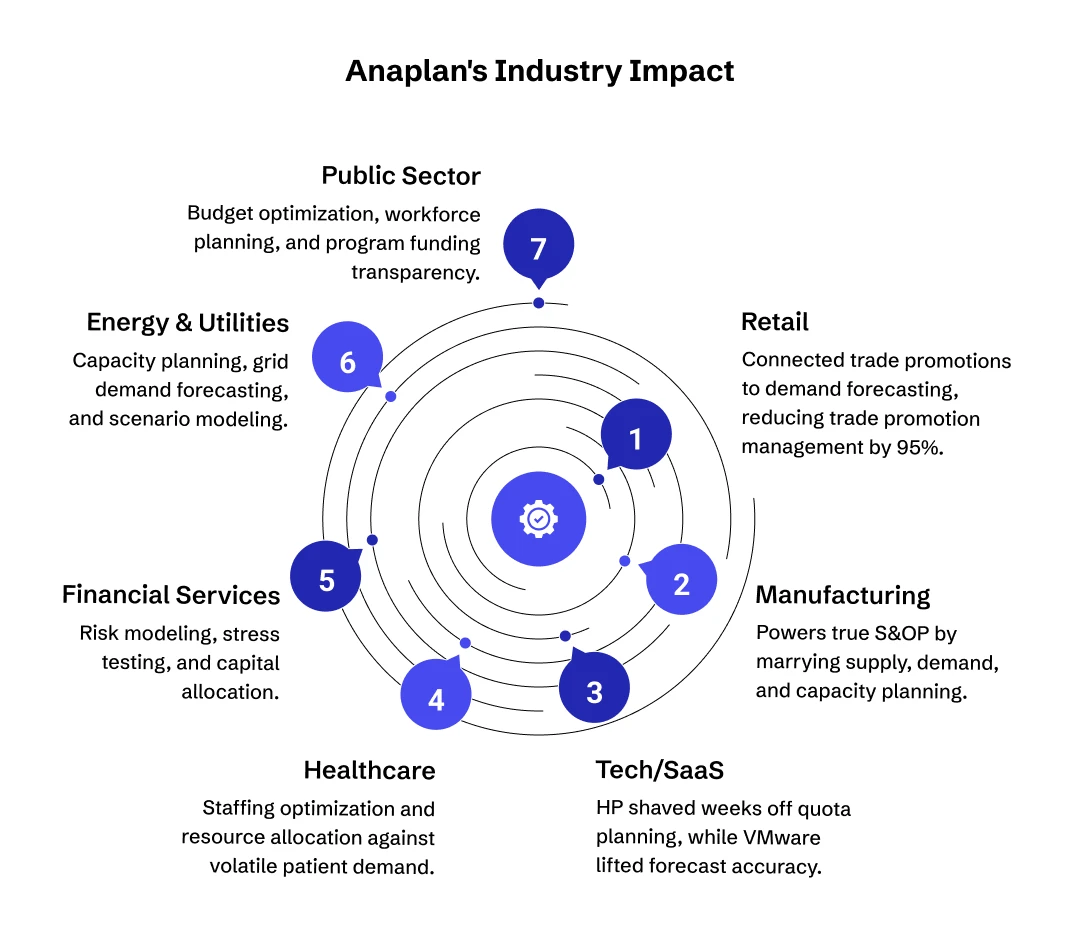
This is why Anaplan use cases span industries:
- Retail (Coca-Cola): Connected trade promotions to demand forecasting, cutting trade promotion management by 95% compared to legacy solutions.
- Manufacturing: Powers true S&OP by marrying supply, demand, and capacity planning, reducing mismatch between production and demand by measurable margins.
- Tech/SaaS (HP & VMware): HP shaved weeks off quota planning, while VMware lifted forecast accuracy significantly by unifying sales teams under one model.
- Healthcare: Staffing optimization and resource allocation against volatile patient demand.
- Financial Services: Risk modeling, stress testing, and capital allocation.
- Energy & Utilities: Capacity planning, grid demand forecasting, and scenario modeling.
- Public Sector: Budget optimization, workforce planning, and program funding transparency.
Beyond traditional industries, Anaplan is also finding traction in the AI-powered finance segment for stress-testing portfolios, the AI-powered healthcare industry for demand modeling, and even in evolving mobile banking trends.
And you don't have to start from scratch. The Anaplan App Hub hosts 250+ continuously updated, partner-built accelerators, certified for best practices across industries. They cut implementation time drastically, giving you a proven baseline before customizing.
It also powers advanced scenarios like IT investment planning, R&D portfolio optimization, and capital projects planning. These advanced models extend into intelligent financial planning, financial impact analysis, and the transformation of financial ecosystems.
This is especially true as connected systems and IoT in banking continue to reshape enterprise strategy.
Built-in constraints analysis, inventory optimization, and marketing campaign ROI analysis allow leaders to stress-test strategies before committing real capital. At the core of this is the data hub, ensuring every plan is grounded in one unified truth.
Anaplan features extend beyond software: a 70,000+ member global community, 200+ certified consulting partners, and an Academy delivering official certifications. Together, this creates the scaffolding enterprises need to not just adopt the platform, but to thrive on it.
Who is Anaplan For?
The Anaplan software is designed for enterprise organizations that need cross-functional agility. Its users span from CFOs running financial planning and analysis to sales teams managing quota and territory planning, and HR leaders driving workforce planning.
- Sales teams leverage it for account planning, quota setting, and territory optimization.
- Finance leaders use it for compliance requirements, financial planning, and integrated forecasting.
- Operations and HR leaders depend on it for decentralized workforce planning and alignment.
- IT leaders rely on its role-based access control, data encryption, and ability to host custom apps through the Anaplan App Hub.
In short, it’s built for enterprise scale, but flexible enough for decentralized employees working across global teams.
The Promise and the Peril: Anaplan Pros and Cons
Look, no platform is a panacea. Anaplan is a powerful, enterprise-grade weapon. But it demands a skilled operator and a real commitment. You need to walk into this with both eyes open.
1. The Promise (Pros)
Beyond agility, leaders gain predictive analytics, financial intelligence, and true integrated business planning. Real-time data fuels rolling forecasts, while the Hyperblock system enables deep scenario analysis without lag.
- Radical Enterprise Agility. Forget the buzzword. This is the raw ability to pivot faster than your competitors. By forging integrated business planning into your company's DNA, you shatter the operational hourglass.
- A God's-Eye View. The power of the Hyperblock system is in its scenario analysis. You can war-game recessions, supply chain shocks, and competitive launches, transforming your organization from reactive to predictive.
- The Death of "Spreadsheet Truth". With a full audit trail and rigorous data governance, Anaplan becomes the single source of truth. It forces an end to data arguments, elevating conversations from "Whose numbers are right?" to "What's the right decision?"
- Empowerment and Accountability. Through collaborative modeling, the people who are closest to the action own their numbers and their plans. Accountability becomes clear. The excuses vanish. Because Anaplan sits at the center of planning, it enhances intelligent data management and supports knowledge management with AI. This helps enterprises break traditional silos and tackle AI adoption challenges with clarity and speed.
- Fast Time-to-Value. Pre-built App Hub solutions mean you don’t spend six months reinventing wheels before seeing results.
2. The Peril (Cons)
Challenges extend beyond adoption. Early-stage rollouts may also expose enterprise AI implementation issues, overcoming adoption barriers, and limits in reporting when scaled too quickly.
Companies may also face computing capacity limits, volume constraints, and process bottlenecks if governance isn’t enforced. Formatting options and reporting flexibility can further frustrate early adopters.
And without proper training resources or skilled consultants, the implementation period exposes hidden costs that go beyond licenses.
- The Talent Tax. Let's be blunt. Anaplan model building is not a weekend hobby. It requires a specific, logical, and expensive skillset. In many cases, enterprises also evaluate top ai development companies to support complex implementations and bring in specialized expertise.
- The Cost Iceberg. The subscription fee is just the down payment. The Total Cost of Ownership—factoring in the Anaplan implementation, integration, and change management—is where the real numbers live.
- Implementation is a Grind. This is not a plug-and-play solution. A successful implementation period is a demanding, multi-month exercise in process re-engineering and data discipline.
- An Unflinching Mirror. Anaplan will hold up a mirror to every broken process, flawed approval workflow, and political bottleneck in your company. It will force you to confront your own dysfunction. Be ready for that fight.
3. The Talent
Let's be blunt. The "Talent Tax" for skilled model builders is real. But it's a manageable risk, not a roadblock. The Anaplan software has invested heavily in a support ecosystem—from the Anaplan Academy (with multiple certification levels) to a global partner network of 200+ consulting firms, and an active Community with 70k+ members. This ecosystem exists to close the skills gap and shorten ramp-up time.
Anaplan Pricing: Breaking Down the Cost Structure
Anaplan pricing isn’t public—it’s a negotiation based on scale and complexity. But most enterprises see an entry point of $50k–$250k annually for the Anaplan platform subscription.
Add to that Anaplan implementation services, which can cost 2–4x the license fee. Think of this as an investment, not just software costs: the real expense includes integration, change management, and training.
Where Anaplan is Headed
The platform isn't standing still. The roadmap is clear: more AI-augmented planning, autonomous scenario modeling, and deeper predictive intelligence. Anaplan is also experimenting with GenAI integrations to accelerate plan creation and insight surfacing. The north star: a system that doesn’t just help you plan, but helps you think.
- Autonomous workflows: No more waiting for humans to trigger plans. Anaplan will soon kick off workflows automatically when KPIs break thresholds—your planning moves at machine speed.
- Predictive intelligence everywhere: Expect AI to be embedded into every layer of the platform, from supply chain constraints to sales quota modeling.
- Data fabric integrations: Deeper hooks into Snowflake, Databricks, and other enterprise data fabrics ensure planning pulls from the freshest, cleanest datasets in real time.
- AI governance focus: As AI touches more decisions, Anaplan is investing in transparency—making sure leaders understand why an algorithm flagged a scenario, not just what it spat out. The roadmap also signals deeper support for AI agents, automation via AI agents, and intelligent automation in planning—a direction aligned with broader emerging tech in enterprise and the future technology trends shaping the digital economy.
The future isn’t faster reaction. It’s proactive control of the battlefield.
Best Practices for Implementing Anaplan
Winning with Anaplan isn’t about flipping a switch—it’s about discipline, process, and execution. The technology is powerful, but without a smart rollout strategy, it will expose every weakness in your organization. These best practices ensure you implement Anaplan in a way that delivers lasting impact, not just flashy dashboards.
- Taking a Phased, Agile Approach: Don’t attempt a “big bang.” Use a phased agile approach—start with one painful process, fix it, then scale.
- Relying on Skilled Consultants: Certified consultants and partner firms bring proven cross-functional planning methodology and scar tissue from past projects.
- Improving Processes Alongside Technology: Automating a bad process just gives you a faster bad process. Use implementation to challenge data definitions and enforce clean data entry standards.
- Prioritizing Data Integrity: Data governance is non-negotiable. Enforce API integration, monitor ETL processes, establish a master data management framework, enforce data quality, and lock down security with multi-factor authentication and regular security audits.

Best Anaplan Alternatives
Anaplan is a heavyweight champion. But the ring is crowded. When evaluating Anaplan vs. competitors, leaders weigh not only core functionality but also how well platforms support finance & tech alignment.
They also consider readiness for emerging tech in planning and the ability to integrate with innovations like blockchain and real-world AI applications.
| Platform | Key Strengths | Best For | The Bottom Line |
|---|---|---|---|
| Anaplan | Raw modeling power. Unmatched flexibility. Cross-functional to its core. | Complex, global businesses with gnarly, unique problems that other tools can't handle. | It's the F-22 of planning platforms. Immensely powerful and with the price tag and skill requirements to match. |
| Workday Adaptive Planning | Intuitive. User-friendly. Lives seamlessly within the Workday ecosystem. | Companies that have already gone all-in on Workday for their core HR and Finance. | Recognized for usability by Gartner, but limited in operational depth. |
| OneStream | The CFO's dream. A unified platform for planning, consolidation, and close. | Finance-led organizations on a mission to kill their patchwork of legacy CPM tools. | Analyst consensus: OneStream for consolidation, Anaplan for agility. |
| Planful (Host Analytics) | The pragmatic workhorse. Delivers strong FP&A power for the mid-market. | Smart, growing companies that need serious planning tools but aren't ready for the enterprise price tag. | A solid mid-market FP&A tool, but not an enterprise modeling engine. |
| Oracle Fusion Cloud EPM | The ecosystem incumbent. A vast toolset for the Oracle faithful. | Companies deeply embedded in the Oracle stack that value integration above all else. | Extremely powerful when you stay inside Oracle’s universe, but it often feels less like a single platform and more like a federation of modules. |
To conclude, Anaplan isn’t just another SaaS tool—it’s the connected guts of your enterprise. It forces departments to drop the theater, align on one truth, and plan as a single organism. If you want faster cycles, sharper forecasts, and the ability to simulate the future instead of guessing at it, Anaplan isn’t optional. It’s the war room your business has been missing.
Frequently Asked Questions
Why do companies use Anaplan?
To get faster. To get smarter. To connect the left hand to the right hand in real-time. They use it to stop guessing about the future and start simulating it.
Is Anaplan like Excel?
No. Excel is a spreadsheet tool, while Anaplan is a cloud-based planning platform. Anaplan handles complex, real-time modeling across entire organizations, not just static rows and columns.
Who competes with Anaplan?
Anaplan’s main competitors include Workday Adaptive Planning, OneStream, Oracle Fusion Cloud EPM, and Planful (formerly Host Analytics).
What's the learning curve for Anaplan?
For a user, it’s a gentle hill. For a model builder, it's a sheer cliff face. Building elegant, efficient models in Anaplan is a highly specialized craft. Don't underestimate the skill it requires.

Uncover executable insights, extensive research, and expert opinions in one place.
Related Content