Share It On:
 Unpack the concepts of narrow and general AI. Discover how these different forms of intelligence are shaping innovation and what lies ahead.
Every quarter, enterprises invest billions in artificial intelligence initiatives. The successful ones share a common trait: they know exactly which type of AI they're implementing. Understanding the difference between narrow AI and general AI separates strategic technology adoption from speculative ventures. Narrow AI currently drives enterprise value through specialized applications—intelligent automation, predictive maintenance, and advanced analytics.
These systems excel within their domains but can't transfer learning across functions. General AI promises universal problem-solving capability but remains firmly in the research phase. This distinction impacts everything from vendor selection to ROI projections. While your competitors chase artificial general intelligence myths, informed leaders deploy narrow AI solutions that deliver measurable business outcomes.
Read this article to master this critical distinction and build AI strategies grounded in current capabilities rather than future possibilities.
Understanding General AI and Narrow: An Overview
Before diving into comparisons, let's briefly define Narrow AI and General AI and explore where you encounter them.
What is Narrow AI?
Narrow AI specializes in performing specific tasks exceptionally well within defined boundaries. It's the workhorse behind today's AI, powering smartphone apps and enterprise systems, but it cannot operate beyond its programmed expertise.
Narrow AI Examples
- Spotify's Discover Weekly – Analyzes your music taste to curate personalized playlists
- Tesla's Autopilot – Navigates highways and parks cars, but can't plan your route
- DeepL Translator – Converts languages with near-human accuracy, but can't write original content
- American Express Fraud Detection – Identifies suspicious transactions in milliseconds
- Netflix Recommendation Engine – Predicts what you'll binge-watch next based on viewing patterns
- Generative AI Chatbots (Gemini, ChatGPT, Claude) – These powerful models excel at generating text, translating languages, summarizing information, and answering questions in a conversational style, but they don't possess general human-like intelligence or consciousness.
What is General AI?
General AI represents artificial intelligence that could match human cognitive abilities across all domains. This theoretical system would understand, learn, and apply knowledge to any task—from composing music to solving physics equations—without specialized programming.
General AI Examples
- Problem Solving: Solves diverse problems like humans
- Learning: Learns new skills autonomously
- Adaptability: Adjusts to novel situations and environments
- Reasoning: Thinks logically, plans, and makes decisions
- Common Sense: Possesses intuitive knowledge about the world
- Self-Awareness: (Hypothetical) Experiences consciousness and feelings
Comparison of Narrow AI and General AI: Taking a Glance
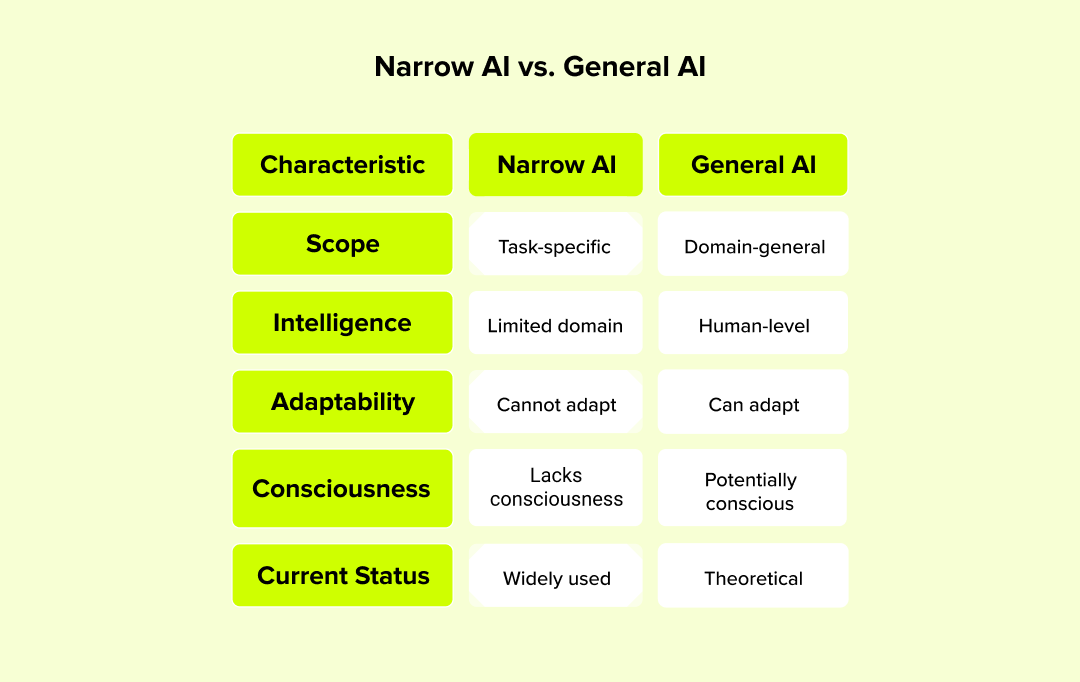
Let's examine the fundamental differences between what's powering your current systems and what might transform tomorrow's world.
| Parameter | Narrow AI (ANI) | General AI (AGI) |
|---|---|---|
| Definition | Specialized intelligence designed to excel at specific, predefined tasks within limited domains | Hypothetical intelligence capable of understanding, learning, and applying knowledge across any domain, like humans |
| Current Status | Fully operational and commercially deployed across industries worldwide | Theoretical concept under research; no working examples exist |
| Learning Capability | Learns within its specific domain only; cannot transfer knowledge to unrelated tasks | Would learn any task and transfer knowledge between completely different domains |
| Problem-Solving Scope | Solves problems within predetermined parameters and trained scenarios | Could theoretically tackle any problem, including those it wasn't specifically designed for |
| Business Applications | Powers today's AI solutions: chatbots, recommendation engines, fraud detection, predictive analytics | No current business applications; remains in research laboratories |
| Training Requirements | Requires extensive domain-specific data and clearly defined objectives | Would need minimal training to adapt to entirely new challenges |
| Flexibility | Highly rigid; cannot adapt beyond its programmed purpose | Would demonstrate human-like adaptability across all situations |
| ROI Timeline | Delivers measurable returns within months of implementation | Unknown timeline; estimates range from decades to centuries |
| Implementation Cost | Predictable costs based on data, infrastructure, and specific use case | Impossible to estimate; would likely require unprecedented investment |
| Risk Profile | Limited risk confined to a specific application area | Potential systemic risks across entire organizations and society |
| Performance Consistency | Delivers consistent, predictable results within its domain | Would vary based on context, similar to human performance |
| Scalability | Easily replicated and scaled for similar tasks across the enterprise | Each instance would potentially develop unique capabilities |
| Human Oversight | Requires continuous human supervision and parameter adjustment | Would operate with minimal human intervention once developed |
| Error Handling | Fails predictably outside its training parameters | Could potentially self-correct and learn from mistakes autonomously |
| Market Readiness | Mature technology with established vendors and proven methodologies | No commercial solutions exist; purely experimental |
What are the Differences Between Narrow AI and General AI: A Closer Look
The gap between narrow and general AI isn't just technical: it fundamentally shapes how businesses deploy artificial intelligence and what they can realistically expect from their investments. Here's what separates the AI running your operations from the AI that exists only in Silicon Valley presentations.
1. The Specialization Divide
Narrow AI operates like a world-class specialist—brilliant at one thing but lost at everything else. Your fraud detection system excels at spotting suspicious transactions, but it can't schedule a meeting. This laser focus defines its strength and limitation: mastering specific tasks through extensive dataset training, often surpassing human experts within its domain.
General AI, by contrast, would function like a Renaissance genius, equally capable of composing symphonies, solving mathematical theorems, and running a business. It would understand context, transfer knowledge between unrelated fields, and adapt to new situations without additional programming. This versatility remains purely theoretical.
2. Learning and Adaptation Capabilities
The learning process reveals another crucial distinction. Narrow AI learns through pattern recognition within strict, predefined boundaries. Netflix's recommendations or Spotify's playlists analyze specific behavior patterns within their entertainment domains. They cannot apply that learning to manage your calendar or write emails. Similarly, a chess-playing AI cannot learn checkers without complete reprogramming.
General AI, however, would theoretically learn a task like chess and extract its strategic thinking principles. It could then apply those same principles to entirely different domains like business negotiations or military tactics, much like how humans transfer knowledge across fields.
3. Real-World Application Boundaries
Today's businesses thrive on Narrow AI precisely because of its limitations. Social media apps and platforms, for instance, utilize distinct AI systems for curating feeds, targeting advertisements, and moderating content. Instagram's picture recognition cannot evaluate financial reports, nor does LinkedIn's job matching AI suggest holiday spots. This specialization allows for predictable, manageable implementations, providing companies with tools that excel within defined parameters.
General AI, conversely, would theoretically handle all these tasks with a single system, intuitively. It can understand the nuanced differences across domains like professional networking and social sharing.

4. Problem-Solving Approaches
Narrow AI attacks problems through brute-force pattern matching within its trained domain. AI in Customer service, for instance, matches queries to predetermined response patterns, escalating to humans when conversations drift beyond its training. While these algorithms identify linguistic patterns, they don't truly comprehend customer displeasure or context.
General AI, on the other hand, would recognize context, emotion, and unspoken needs to fully understand consumer messages. It could effortlessly manage billing issues, provide technical help, and offer tailored product suggestions. And this is all done while preserving conversational context across subjects.
5. Deployment and Integration Realities
The implementation gap between Narrow AI and General AI becomes stark in enterprise environments. Narrow AI slots into existing workflows like specialized tools. AI in healthcare, for example, distinct systems analyze radiology images for tumors, predict patient readmission risks, or optimize surgical scheduling.
Healthcare providers deploy Narrow AI where it delivers immediate value, improving diagnostic accuracy, reducing administrative burden, and personalizing treatment protocols. Each application operates independently, requiring careful orchestration for cohesive patient care.
6. Economic and Strategic Implications
The economic model for narrow AI follows traditional software deployment: clear costs, defined benefits, and measurable ROI. Organizations budget for specific solutions addressing particular pain points. A bank might invest in narrow AI for credit scoring, knowing exactly what performance improvements to expect and how quickly the investment pays off.
General AI would upend these calculations entirely. Its theoretical ability to handle any cognitive task makes cost-benefit analysis nearly impossible. Would you need one general AI system or thousands? How would you price something that could potentially replace entire departments? These questions remain unanswerable because general AI exists only in research papers and science fiction.
7. Risk and Control Considerations
Narrow AI's limited scope contains its risks. If your recommendation engine makes poor suggestions, customers might abandon their shopping carts. If your predictive maintenance AI misses equipment failures, production suffers. These risks remain isolated to specific business functions, making them manageable through traditional risk assessment frameworks.
General AI would introduce systemic risks impossible to compartmentalize. A system capable of learning and acting across all business functions could theoretically make coordinated decisions affecting everything from hiring to strategic planning. This interconnectedness explains why many AI researchers advocate for the careful development of general AI, if it ever becomes possible.
ALSO READ: Generative AI vs Predictive AI - Exploring Capabilities!
Summing It Up
The debate over Narrow AI vs General AI isn't about choosing one over the other. While researchers pursue the dream of human-like machines, Narrow AI is already transforming our jobs, money, and daily lives. Think of it as medicine that works immediately. General AI might someday revolutionize everything, but Narrow AI is doing so now, one specialized task at a time.
Smart businesses aren't betting on which type will 'win'; they're deploying Narrow AI to solve real problems, all while keeping an eye on future possibilities. Ultimately, the most impactful technology often isn't the most intelligent, but the one that actually ships and delivers.

Frequently Asked Questions
How is Narrow AI different from General AI?
Narrow AI, often known as "weak AI," performs well at certain activities while adhering to preset guidelines, such as making product recommendations or playing chess. On the other hand, general artificial intelligence, or "strong AI," would have cognitive capacities comparable to those of humans, such as learning, reasoning, and adapting to a variety of situations and tasks—a capability that is still only theoretical.
Is ChatGPT Narrow AI?
Yes, ChatGPT is an example of Narrow AI. It can interact with others and write prose that is remarkably comparable to that of a human, but its intelligence is restricted to language tasks. It lacks general cognition and self-awareness, and it cannot do tasks outside of its trained domain.
Is Siri an example of General AI?
No, Siri is an example of Narrow AI. While it uses AI technologies like natural language processing and speech recognition to respond to commands and inquiries, its capabilities are restricted to specific activities. Siri lacks the suppleness, wide-ranging intelligence, and conscious comprehension of a human.
Are there any current real-world examples of General AI, or is it still a theoretical concept?
General artificial intelligence is still merely a theoretical concept with no real-world uses today. Despite their extraordinary capabilities, all current AI systems fall under the category of narrow AI, which means they are designed to do specific, well-defined tasks.
How can businesses best leverage Narrow AI today, and what are its limitations?
Businesses are using chatbots to assist customers, automation, targeted advertising, and narrow artificial intelligence (AI) for data analysis. Efficiency and insights are increased. The inability to perform tasks beyond its restricted programming, generalize information, or adjust to whole new environments is among its drawbacks; human supervision is required for complex issues.
What are the long-term implications and ethical considerations of General AI?
Long-term effects include profound social changes, potential job losses, and unmatched innovation. Ethical concerns include control, safety, educational bias, autonomous decision-making responsibility, and the existential conundrum of how a self-aware, superintelligent advanced technology will impact humanity.

Uncover executable insights, extensive research, and expert opinions in one place.
Related Content