Share It On:
 Learn how to find skilled healthcare app developers who build secure, user-friendly apps that improve patient care, streamline workflow, and drive innovation in the digital health space.
So, you have a groundbreaking idea for a healthcare app. You envision a future where technology empowers patients and clinicians alike. But turning that vision into a compliant, secure, and user-friendly reality hinges on one crucial decision: how you hire healthcare app developers.
Healthcare is a sensitive industry. It demands a unique blend of technical command, industry-specific knowledge (like HIPAA, HL7, FHIR), and a deep understanding of user empathy. Feeling overwhelmed? Don't be. We're about to demystify the process and equip you with the insights to find the perfect development partners.
Let’s dive deeper!
Steps Involved in Hiring Healthcare Mobile App Developers
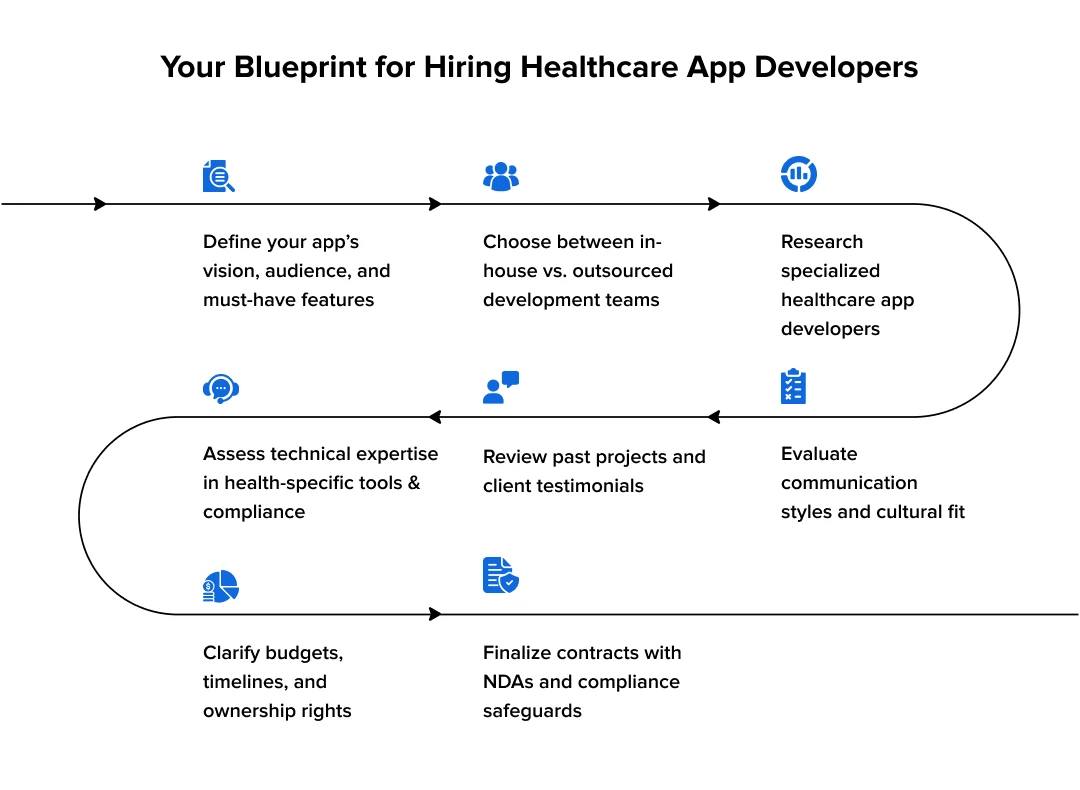
Finding the right healthcare mobile app developers is crucial for building a safe, scalable, and user-friendly digital health solution. Here’s a streamlined checklist to help you make a smart and strategic hiring decision:
1. Start with a Clear Vision: Define your app's purpose, audience, and core features. Whether it’s video consultations, EHR integration, or HIPAA compliance, clarity helps you find the top healthcare app developers who truly fit your needs.
2. Decide: In-house or Outsourced? Choose between building an internal team or partnering with a specialized agency. Outsourcing healthcare mobile app development often gives you access to wider expertise, faster delivery, and healthcare-specific experience.
3. Do the Homework: Research portfolios, reviews, and case studies. Focus on healthcare app development examples that solve real problems—not just pretty designs, but functional, secure, and regulation-compliant apps.
4. Evaluate Their Technical Muscles: Test their proficiency in relevant tech stacks or app development frameworks like Swift, Kotlin, or Flutter. Also, ensure they understand healthcare tools like FHIR, HL7, and wearables integration—a must for experienced healthcare mobile app developers.
5. Check Their Track Record: Look for proof of success. Talk to past clients to verify their delivery history, responsiveness, and real-world impact. Great healthcare mobile app development is measured by outcomes, not just output.
6. Get a Feel for Communication and Culture: Technical skills matter, but so does chemistry. Ensure the developers ask insightful questions and understand your mission. Strong collaboration leads to fewer hiccups and smoother project execution.
7. Talk Numbers and Timeline: Ask for a detailed cost and timeline breakdown. Clarify everything—from design to post-launch support. When working with mhealth app developers, transparency upfront ensures fewer surprises later.
8. Seal the Deal with a Solid Contract: Finalize the partnership with a detailed agreement covering deliverables, deadlines, IP rights, and compliance. For healthcare app development, don’t skip on NDAs or data security clauses—they’re essential.
Pitfalls and Tips for Hiring Healthcare Mobile App Developers
Hiring the right team is critical to the success of your healthcare digital solution. However, even the most promising projects can fail if you overlook some common red flags during the hiring process.
Below are key mistakes to steer clear of when looking to hire healthcare mobile app developers:
| Key Pitfall | Tip to Overcome |
|---|---|
| Ignoring Technical Versatility | Ensure healthcare mobile app developers are proficient in front-end and back-end frameworks, data encryption, API integration, cloud services, and mobile responsiveness to build scalable and secure apps. |
| Neglecting User-Centered Design Principles | Prioritize user experience (UX) and user interface (UI) skills. Choose developers who design apps that are intuitive, compliant, and accessible to a wide user base. |
| Not Reviewing Maintenance and Update Plans | Ask for a clear post-launch maintenance roadmap. In healthcare application development, compliance rules change frequently—regular updates are essential to stay compliant and relevant. |
| Disregarding Data Integration Capabilities | Hire developers experienced in integrating EHR systems, lab platforms, and wearables. Seamless data sharing ensures continuity of care and minimizes errors. |
| Failing to Align on Project Scope and Goals | Define clear project goals, compliance needs, deliverables, and timelines upfront. Ensure the team understands the full scope before development begins. |
| Lack of Knowledge and Experience | Choose developers with proven experience in healthcare application development and a strong portfolio of successful apps in the sector. |
| Weak Technical Proficiency | Verify expertise in Swift, Java, mobile frameworks, and HIPAA compliance. Technical strength ensures the app meets industry standards. |
| Skipping References and Past Work Checks | Request client references and project samples from previous healthcare app development work to assess reliability and quality. |
| Focusing Solely on Cost | Don’t just pick the cheapest option. Balance value vs. cost to find a developer offering quality, skill, and cost-effectiveness. |
| Overlooking Project Management & Timelines | Discuss the developer’s availability, workflow, and ability to meet deadlines. A structured project management approach ensures timely delivery. |
Avoiding these common mistakes and considering the right factors can significantly improve the success of your healthcare application development project. By prioritizing transparency, technical expertise, and a user-focused approach, you’re more likely to hire healthcare mobile app developers who can deliver a high-performing, compliant, and future-ready healthcare solution.
Essential Skills Every Healthcare App Developer Should Have
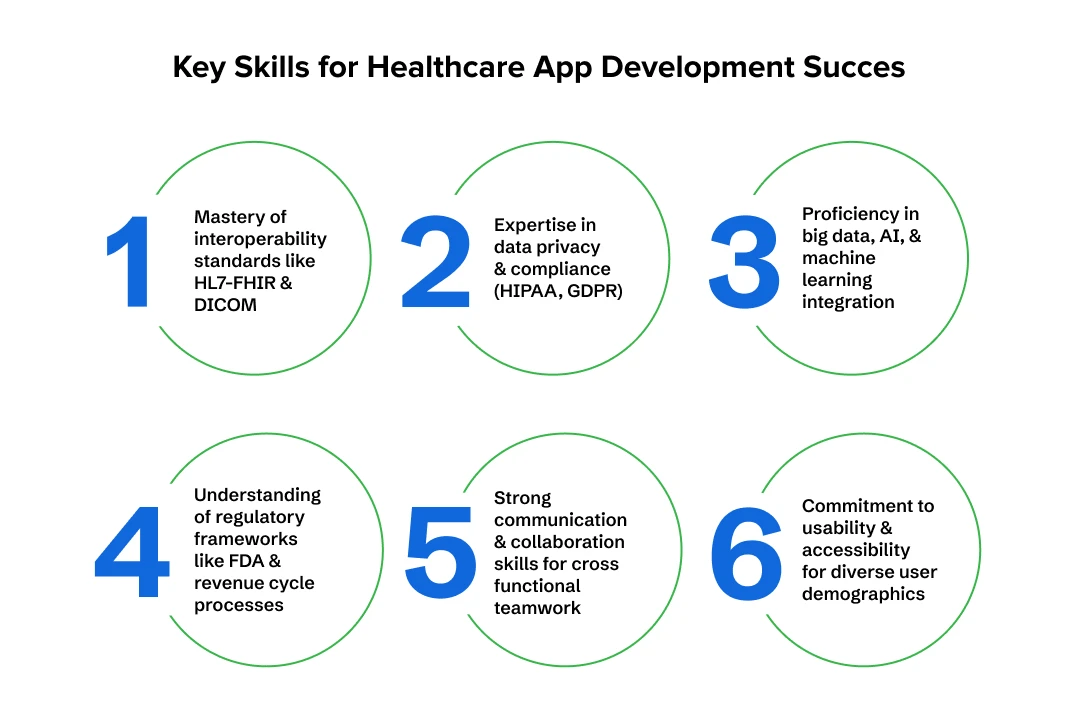
When it comes to app development for healthcare, not every developer fits the bill. The complexity of regulations, the sensitivity of patient data, and the demand for seamless user experiences mean that healthcare app developers must possess a specific blend of technical and soft skills. Below is a unique breakdown of the must-have capabilities for professionals in this field:
1. Mastery of Interoperability Standards
Successful healthcare mobile app developers must understand standards like HL7-FHIR, DICOM, and ANSI X12, ensuring seamless system communication and accurate clinical data interpretation.
2. Strong Focus on Data Privacy and Compliance
Expertise in GDPR, HIPAA, encryption, and secure coding is essential for safeguarding patient data in healthcare mobile app development.
3. Advanced Technical Proficiency
Developers should be skilled in big data and machine learning to support AI in healthcare app development and integrate APIs, EHRs, and wearable tech.
4. Understanding of Regulatory Requirements
Knowledge of FDA regulations and healthcare revenue cycles ensures compliant and functionally robust healthcare mobile app development.
5. Effective Soft Skills for Team Collaboration
Communication, adaptability, and teamwork are vital as healthcare mobile app developers often work with diverse teams, including clinicians and designers.
6. Dedication to Usability and Accessibility
Creating intuitive, inclusive, and accessible interfaces ensures healthcare mobile app development caters to all user groups—from elderly patients to medical professionals.
Looking At the Cost of Hiring Healthcare Mobile App Developers
When evaluating the cost of hiring healthcare mobile app developers, several factors come into play. These include the complexity of the app, the types of features involved (such as AI or EHR integration), and the developers’ geographical location.
Whether you're developing a telemedicine app, a fitness tracking solution, or a secure EHR platform, understanding the pricing landscape helps you budget more effectively while maximizing the benefits of mobile health apps.
Here’s a synopsis of how the cost can look!
1. Average Cost by App Type
| Type of Healthcare App | Estimated Cost Range | Remarks |
|---|---|---|
| Simple Health App | $10,000 – $50,000 | Basic features, limited integrations |
| Complex Health App | $150,000 – $500,000+ | Includes AI, analytics, and multiple user roles |
| Telehealth / Telemedicine App | $50,000 – $200,000 | Requires video calls, secure messaging, and EHR access |
| Fitness & Wellness App | $60,000 – $300,000 | Often integrates with wearables and real-time data |
| EHR Management App | $30,000 – $100,000 | Needs robust compliance and secure data handling |
2. Hourly Rate Based on Developer Location
| Region | Hourly Rate Range | Details |
|---|---|---|
| India | $20 – $30 per hour | Cost-effective, strong technical talent, ideal for MVPs and long-term scaling |
| North America | $100 – $150 per hour | High-end expertise, great for complex healthcare application development |
| Western Europe | $80 – $130 per hour | Reliable quality, good compliance knowledge, well-versed in GDPR |
| Eastern Europe | $40 – $75 per hour | Budget-friendly with solid skillsets, growing market for healthcare app development |
| Latin America | $35 – $70 per hour | Time-zone aligned with US, competitive rates, improving in healthcare mobile app development |
| Australia & New Zealand | $90 – $140 per hour | Excellent quality, smaller talent pool, high compliance and security focus |
| Southeast Asia | $25 – $45 per hour | Affordable and growing outsourcing hub, varying levels of domain expertise |
| Middle East | $40 – $80 per hour | Regional knowledge, best for localized healthcare app developers needs |
Investing in the right team of healthcare mobile app developers not only ensures technical excellence but also allows organizations to unlock the full benefits of mobile health apps, from improved patient engagement to operational efficiency. Understanding these cost variables upfront empowers stakeholders to make informed, strategic development decisions.

In-House vs Outsourcing: What’s Best for Your Healthcare App Project?
When launching innovative Healthcare Business Ideas, one of the most crucial decisions is whether to build an in-house development team or outsource your project to specialized experts.
While in-house development provides direct control, outsourcing healthcare app development offers greater flexibility, access to global talent, and faster time-to-market, especially important for startups and enterprises aiming to scale quickly.
Let’s break down the differences:
Comparison: In-House vs Outsourcing
| Criteria | In-House Development | Outsourcing Development |
|---|---|---|
| Initial Cost | High: Salaries, equipment, benefits, training | Lower: Pay per project or milestone without overhead expenses |
| Speed to Market | Slower: Recruitment and onboarding take time | Faster: Teams are ready to begin with experience in Android and iOS healthcare app development |
| Access to Expertise | Limited to local talent | Broad: Global pool of seasoned healthcare app developers |
| Scalability | Difficult: Hiring and scaling take time | Easy: Quickly scale up or down based on project requirements |
| Focus on Core Business | Diverts internal resources | Lets you focus on business strategy and Healthcare Business Ideas |
| Regulatory Knowledge | May require extra training or consultants | Many outsourcing teams specialize in healthcare mobile app development and compliance (e.g., HIPAA, GDPR) |
| Maintenance & Support | Resource-intensive for smaller teams | Ongoing support and upgrades are often included in outsourced packages |

Wrapping Up: Choosing the Right Healthcare App Development Partner
Hiring skilled healthcare app developers is more than just filling a role—it's about finding professionals who understand the sensitive nature of healthcare data and the importance of compliance.
Whether you're developing a telemedicine app or a remote patient monitoring system, the developer’s ability to blend functionality with privacy and usability is key. Prioritize those with proven experience, strong communication, and a deep understanding of industry standards like HIPAA and GDPR.
For businesses seeking efficiency and flexibility, outsourcing remains a top choice. It offers access to specialized talent, faster project delivery, and often lower costs without sacrificing quality. With the right healthcare mobile app developers, your app can drive innovation, improve patient outcomes, and become a trusted tool in care delivery. Just take your time, do your research, and build with purpose.
Frequently Asked Questions
How much does hiring an app developer cost?
The cost of hiring might differ based on the platform, project size, experience, and level of skill. A junior developer typically costs between $25 and $40. Senior developers may charge $100 to $150+ per hour, whereas mid-level developers may charge $50 to $100.
What should I look for when hiring healthcare app developers?
Look for developers with proven experience in healthcare app development, familiarity with compliance standards like HIPAA and GDPR, and strong communication skills. Technical expertise, understanding of medical workflows, and the ability to build secure and user-friendly apps are also key. Also, verify past projects delivered to verify their ability to build a product.
Is it better to outsource or hire in-house for healthcare app development?
Outsourcing is often more cost-effective and gives access to a global talent pool. It’s ideal for businesses that want faster time-to-market, flexibility, and the option to scale resources without long-term commitments.
Why is healthcare industry experience important when hiring developers?
Experience in the healthcare industry ensures that the developer understands patient privacy, data security, and regulatory compliance, crucial factors in healthcare mobile app development. It helps avoid costly mistakes and results in more effective, legally sound apps.
What are the best platforms to find medical app developers?
You can find medical app developers on platforms like Upwork, LinkedIn, GitHub, Indeed, etc. Basically, depending on your language, look for the most popular hiring platform and post your requirements.

Uncover executable insights, extensive research, and expert opinions in one place.
Related Content