Date: November 03, 2025
Listen to This Article
The U.S. President declares Nvidia’s most advanced Blackwell chips off-limits to foreign nations, tightening the U.S grip on the global AI race.
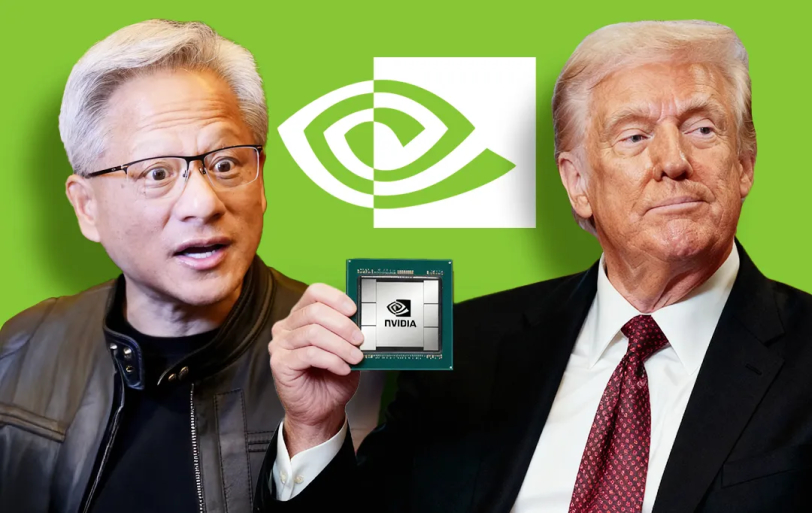
U.S. President Donald Trump said Nvidia’s most powerful Blackwell AI chips will be reserved exclusively for domestic use. During a taped CBS 60 Minutes interview and remarks aboard Air Force One, Trump stated,
“The most advanced, we will not let anybody have them other than the United States.”
He added, “We don’t give the Blackwell chip to other people.” The comments come amid rising competition between the United States and China in artificial intelligence and semiconductor technology. The Blackwell B30A series, Nvidia’s most sophisticated AI processor yet, powers large-scale data centers and training clusters that drive generative AI models like ChatGPT and Gemini.
Experts say the restriction could further tilt the AI race in America’s favor. They even warned that if the U.S. allowed export of advanced Blackwell chips, China could potentially surpass U.S. computing capacity by 2026. Trump’s decision, therefore, signals a clear intent to maintain strategic dominance in AI infrastructure.
Despite the ban, Nvidia continues to expand in other regions. Just last week, the company announced plans to deliver more than 260,000 Blackwell AI chips to South Korea, partnering with tech giants such as Samsung Electronics. However, those deals are unlikely to extend to China or nations considered sensitive under new trade policies.
When asked if China could access scaled-down versions of the chip, Trump hinted at flexibility:
“We will let them deal with Nvidia, but not in terms of the most advanced,” he said. Earlier, he even mentioned the possibility of a downgraded model, “a somewhat enhanced, in a negative way, Blackwell chip… take 30% to 50% off of it.”
For Nvidia, the restriction presents a double-edged sword. While it strengthens U.S. reliance on its technology, it could also limit access to lucrative international markets. Also, the recent announcement that Nvidia and Oracle will build the U.S. Department of Energy’s largest AI supercomputer. According to Nvidia’s latest PR, it will be powered by 100,000 Blackwell GPUs, highlighting the opportunity for U.S. firms to drive next-generation scientific breakthroughs under this export regime.
As Washington redefines the boundaries of global AI hardware distribution, this decision underscores how the race for computing power has become a central front in the broader tech rivalry between the U.S. and China.
By Riya
Riya turns everyday tech into effortless choices! With a knack for breaking down the trends and tips, she brings clarity and confidence to your downloading decisions. Her experience with ShopClues, Great Learning, and IndustryBuying adds depth to her product reviews, making them both trustworthy and refreshingly practical. From social media hacks and lifestyle upgrades to productivity boosts, digital marketing insights, AI trends, and more—Riya’s here to help you stay a step ahead. Always real, always relatable!
OpenAI Is Building an Audio-First AI Model And It Wants to Put It in Your Pocket
New real-time audio model targeted for Q1 2026 alongside consumer device ambitions.
Nvidia in Advanced Talks to Acquire Israel's AI21 Labs for Up to $3 Billion
Deal would mark chipmaker's fourth major Israeli acquisition and signal shifting dynamics in enterprise AI.
Nvidia Finalizes $5 Billion Stake in Intel after FTC approval
The deal marks a significant lifeline for Intel and signals a new era of collaboration between two of America's most powerful chipmakers.
Manus Changed How AI Agents Work. Now It's Coming to 3 Billion Meta Users
The social media giant's purchase of the Singapore-based firm marks its third-largest acquisition ever, as the race for AI dominance intensifies.