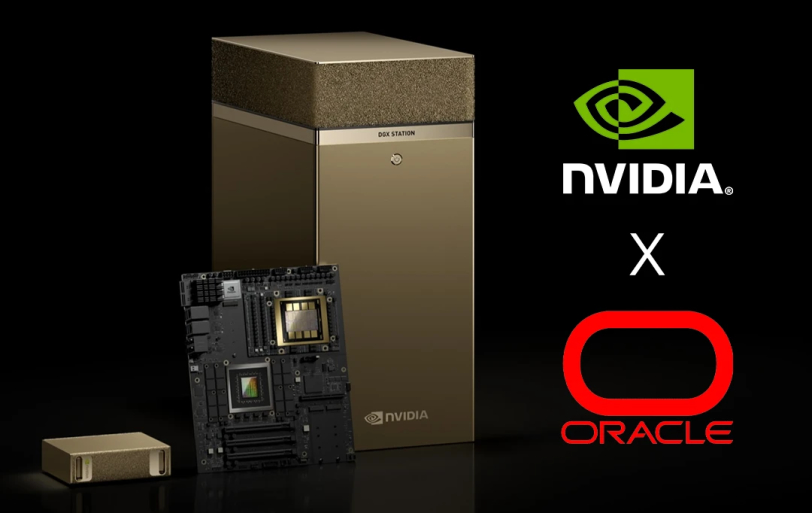
Solstice system with unprecedented 2,200 exaflops will accelerate AI-driven scientific discovery at Argonne National Laboratory starting in 2026.
Nvidia and Oracle just declared a history-making alliance at the GPU Technology Convention in Washington, D.C. The two firms have collaborated to build the largest-ever AI supercomputer for the U.S. Department of Energy. This is a big leap towards becoming a global leader in artificial intelligence and scientific discovery for the US.
The Solstice system is the core of this program, and it will include an impressive 100,000 Nvidia Blackwell GPUs. In tandem with this, the program will also have a companion system, “Equinox,” with 10,000 Blackwell GPUs. In combination, these interconnected supercomputers will provide an unprecedented 2,200 exaflops of AI power in the Argonne National Laboratory in Illinois.
"AI is the most powerful technology of our time, and science is its greatest frontier," said Jensen Huang, founder and CEO of Nvidia. "Together with Oracle, we're building the Department of Energy's largest supercomputer that will serve as America's engine for discovery, giving researchers access to the most advanced AI infrastructure to drive progress across fields ranging from healthcare research to materials science."
Accelerating Scientific Discovery
The new systems represent a significant expansion of the DOE's computational capabilities, with Equinox expected to come online in the first half of 2026. Both supercomputers will enable scientists and researchers to develop and train frontier AI models using the Nvidia Megatron-Core library and scale them with Nvidia's TensorRT inference software stack.
U.S. Secretary of Energy Chris Wright emphasized the strategic importance of the partnership, stating:
"Winning the AI race requires new and creative partnerships that will bring together the brightest minds and industries American technology and science has to offer. These systems will be a powerhouse for scientific and technological innovation."
According to Wright, construction will begin immediately, with computing power starting to flow into the Department as early as next week. The secretary noted that "the majority of that computational power will be used for commercial applications to drive American business." At the same time, a significant minority will be dedicated to science and national security applications.
Beyond Argonne: Expanding AI Infrastructure
The partnership extends beyond the flagship Solstice and Equinox systems. Nvidia and the DOE announced plans for seven new AI supercomputers in total, including three additional systems at Argonne (Tara, Minerva, and Janus), which will be open to researchers at other facilities to expand access to AI-driven supercomputing.
Los Alamos National Laboratory in New Mexico will also receive two new Nvidia Vera Rubin-based systems: Vision for unclassified workloads and Mission for classified national security science applications. Both systems, built in collaboration with HPE using its Cray Supercomputing GX5000 platform, are scheduled to come online in 2027.
"The Mission and Vision systems represent a significant investment in our national security science and basic science capabilities…. These systems are purpose-built for supercomputing in the AI era," said Thom Mason, director of Los Alamos National Laboratory.
Pioneering Agentic AI for Science
A key innovation in these systems is their support for developing "agentic scientists"—autonomous AI systems capable of conducting scientific research. Paul K. Kearns, director of Argonne National Laboratory, explained that "the Equinox and Solstice systems are designed to accelerate a broad set of scientific AI workflows, and we are collaborating with Oracle and Nvidia to prepare thousands of researchers to effectively leverage the systems' groundbreaking capabilities."
The systems will seamlessly connect to DOE experimental facilities such as Argonne's Advanced Photon Source, allowing scientists to address pressing national challenges through accelerated discovery. These agentic AI workflows aim to boost R&D productivity and accelerate scientific breakthroughs enabled by public research dollars within a decade.
Public-Private Partnership Model
Solstice will be built using the DOE's new public-private partnership model, incorporating industry investments and use cases. This approach represents a shift in how the government collaborates with technology companies to advance AI capabilities.
"At Oracle, we are proud to partner with the Department of Energy to deliver sovereign, high-performance AI capabilities," said Clay Magouyrk, CEO of Oracle. "Our collaboration at Argonne, tapping into the power of OCI, will provide a critical resource to address the nation's most complex challenges and accelerate the next wave of scientific breakthroughs."
The announcement highlights the increasing alignment between Silicon Valley and the Trump administration, where Huang is thankful for the energy policies the administration has to offer. The Nvidia CEO emphasized that "everything from the beginning, from idea, silicon, all the way to the generation of intelligence will be here in the United States," reflecting the administration's agenda for domestic production.
This partnership between Nvidia and Oracle, and the Department of Energy is one of the biggest artificial intelligence infrastructure investments in scientific research to date, as the United States competes to keep a technological pace in artificial intelligence. It might even transform the way scientific discoveries are made within the next decade.