Date: December 31, 2025
Deal would mark chipmaker's fourth major Israeli acquisition and signal shifting dynamics in enterprise AI.
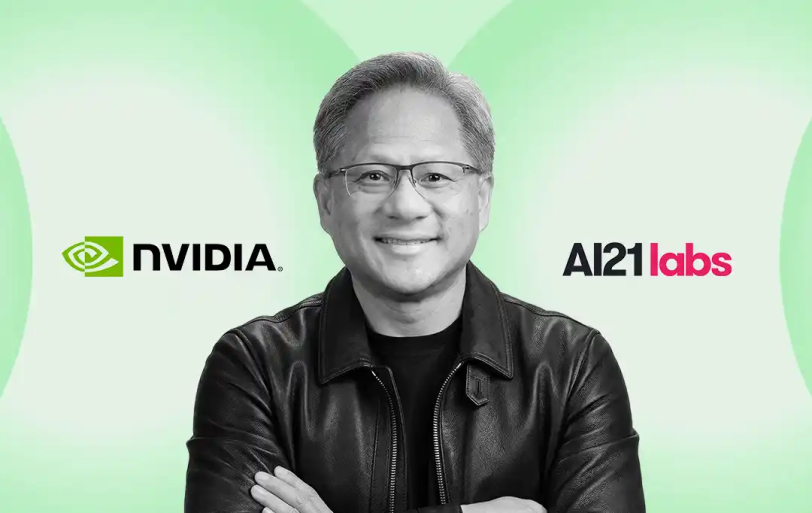
Nvidia is in advanced talks to acquire AI21 Labs, one of Israel's pioneering artificial intelligence startups, in a deal that could be valued between $2 billion and $3 billion, according to a report first published by Calcalist on Monday.
The potential acquisition would represent more than double AI21's last known valuation of $1.4 billion. If finalized, the deal would mark Nvidia's fourth significant acquisition in Israel and its second-largest after the $7 billion purchase of Mellanox.
According to sources, talks with Nvidia have advanced significantly in recent weeks and have reached the most senior levels of both companies. Nvidia's primary interest in AI21 appears to be its workforce of roughly 200 employees. Most of whom hold advanced academic degrees and possess rare expertise in artificial intelligence development.
The transaction structure suggests this would effectively be an acquihire (focused primarily on talent rather than technology) at an implied cost of roughly $10-15 million per employee. While this reflects strong international demand for Israeli AI talent, it also represents a retreat from AI21's original ambition to compete directly with leading AI model developers such as OpenAI or Anthropic.
AI21 Labs was founded in November 2017 by Yoav Shoham, Ori Goshen, and Amnon Shashua in Tel Aviv, Israel. The company was initially seen as a flagship effort to place Israel at the forefront of artificial intelligence, years before the generative AI boom that began in 2022.
The founding team brought formidable credentials: Professor Amnon Shashua is the founder and CEO of Mobileye, while Professor Yoav Shoham is Professor Emeritus at Stanford University and former Principal Scientist at Google. Shashua previously orchestrated the $15 billion sale of Mobileye to Intel in 2017.
However, over the past two years, AI21 has struggled to keep pace with the rapid advances of the industry's leading players. In April this year, the company halted development of Wordtune, its long-running consumer-facing product for AI-assisted writing and reading.
AI21 offers a series of open-source LLMs called Jamba and its flagship enterprise product, Maestro, is designed to improve language-model accuracy by up to 50%. Despite these efforts, estimates suggest the company's annual revenue remains modest, at around $50 million.
The potential acquisition comes amid Nvidia's aggressive expansion in Israel. In 2023, Nvidia acquired Deci and Run:ai for a combined $1 billion. The chipmaker currently employs about 5,000 people in Israel, including roughly 3,000 in Yokneam, the former headquarters of Mellanox.
Earlier this month, Nvidia announced plans to build a massive campus in Kiryat Tivon, expected to house up to 10,000 employees by 2031. CEO Jensen Huang has previously described Israel as Nvidia's "second home."
The acquisition comes less than a week after Nvidia inked a $20 billion deal to license the technology of Groq Inc., a venture-backed chip developer whose processors are optimized for inference workloads.
An acquisition of AI21, relatively small by Nvidia's standards given its roughly $60 billion cash position, would further extend Huang's strategy of building AI capabilities through strategic purchases.
AI21 has long been considered "on the shelf," with Google also previously exploring a potential acquisition. Both Nvidia and Google participated in AI21's 2023 funding round, and AI21 completed a $300 million fundraising round earlier this year led by Nvidia and Google—though the company never officially confirmed this round.
Nvidia might be planning to integrate Maestro into Nvidia AI Enterprise, the AI software suite it ships with its graphics cards.
For Shashua, a sale of AI21 would mark a more muted outcome compared with his Mobileye success. However, he is already engaged in a new venture: AAI, a startup focused on AI reasoning that recently achieved unicorn status.
By Arpit Dubey
Arpit is a dreamer, wanderer, and tech nerd who loves to jot down tech musings and updates. With a knack for crafting compelling narratives, Arpit has a sharp specialization in everything: from Predictive Analytics to Game Development, along with artificial intelligence (AI), Cloud Computing, IoT, and let’s not forget SaaS, healthcare, and more. Arpit crafts content that’s as strategic as it is compelling. With a Logician's mind, he is always chasing sunrises and tech advancements while secretly preparing for the robot uprising.
OpenAI Is Building an Audio-First AI Model And It Wants to Put It in Your Pocket
New real-time audio model targeted for Q1 2026 alongside consumer device ambitions.
Nvidia Finalizes $5 Billion Stake in Intel after FTC approval
The deal marks a significant lifeline for Intel and signals a new era of collaboration between two of America's most powerful chipmakers.
Manus Changed How AI Agents Work. Now It's Coming to 3 Billion Meta Users
The social media giant's purchase of the Singapore-based firm marks its third-largest acquisition ever, as the race for AI dominance intensifies.
China Proposes Crackdown on AI Chatbots Emotional Influence and Suicide Risk
Rules target emotional manipulation, suicide prevention, minors, and security assessments