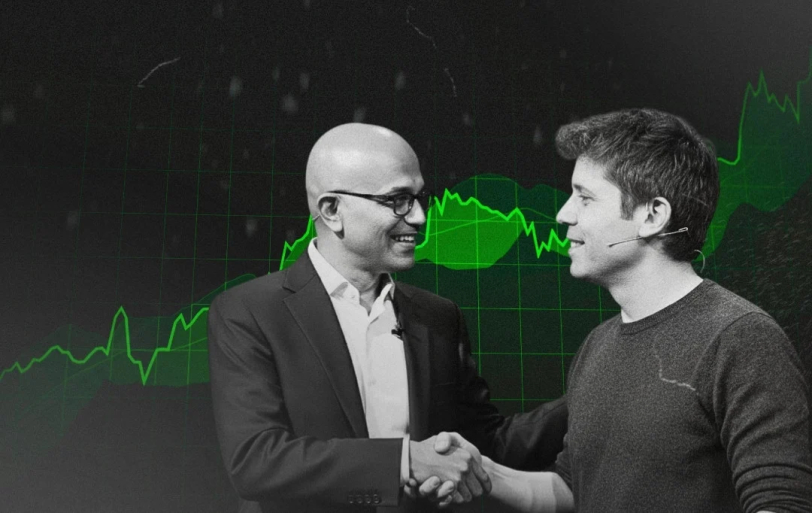
The new agreement fundamentally alters the OpenAI Microsoft partnership, granting Microsoft IP rights through 2032 and a 27% stake, while setting a new $250 billion cloud commitment and establishing an expert panel to one day define AGI.
In global tech news, one of the most significant partnerships in the AI era has been officially restructured. OpenAI has completed its long-negotiated shift into a for-profit corporation, a move that recalibrates its relationship with its primary backer, Microsoft. The finalized Microsoft OpenAI deal gives the Redmond-based tech giant a 27% ownership stake in the new entity, valued at approximately $135 billion.
A Redefined Partnership with Long-Term Control
What this Microsoft deal truly signifies for the Windows maker is control and a decade-long runway. The agreement extends Microsoft’s rights to all OpenAI intellectual property, including its powerful AI models, through 2032. Critically, this now includes technology developed after OpenAI declares it has achieved Artificial General Intelligence (AGI) — a previously ambiguous area that posed a major strategic risk.
This solidifies the OpenAI Microsoft integration for years to come, though it specifically excludes consumer hardware, a category OpenAI is reportedly exploring with designer Jony Ive.
The $250 Billion Azure Commitment
The OpenAI deal isn’t a one-way street. Microsoft loses its coveted right of first refusal to serve as OpenAI’s exclusive cloud provider, a move that theoretically allows OpenAI to work with other vendors. However, that concession is offset by a staggering new agreement — a contract committing OpenAI to purchase $250 billion worth of Azure services.
This deal underscores the symbiotic and immensely profitable nature of the Microsoft OpenAI partnership, ensuring that even as OpenAI expands outward, Microsoft remains its core infrastructure backbone. Following the announcement, Microsoft (MSFT) shares surged nearly 4%, briefly pushing its market capitalization past $4 trillion for the second time this year.
Defining the AGI Endgame
Perhaps the most fascinating component of the new OpenAI Microsoft deal is how it contractually handles the pursuit of AGI — artificial intelligence that surpasses human capability. The partnership mandates that an independent expert panel must officially verify any claim by OpenAI that it has achieved AGI. Once that milestone is confirmed, Microsoft’s reported 20% revenue-sharing agreement with OpenAI will terminate.
This clause effectively defines the “endgame” of the AI race, tying billions in future revenue to third-party verification of superintelligence. Interestingly, the new structure also explicitly allows Microsoft to pursue AGI independently, marking a potential shift toward more diversified innovation.
OpenAI’s For-Profit Shift and Governance Overhaul
This corporate restructuring, finalized after extensive discussions with regulators, completes OpenAI’s transformation into a Public Benefit Corporation (PBC) — OpenAI Group PBC — overseen by the OpenAI Foundation, a nonprofit that will hold a 26% equity stake valued at about $130 billion based on the company’s $500 billion valuation.
“OpenAI has completed its recapitalization, simplifying its corporate structure and securing direct access to major resources ahead of AGI,” said Bret Taylor, OpenAI’s chairman. CEO Sam Altman, who holds no equity stake in the new company, described the foundation’s goal as becoming “the biggest nonprofit ever,” with a focus on funding global health breakthroughs and ensuring AI safety research.
A Signal for the Future of AI Power
The Microsoft OpenAI deal resolves a year-long uncertainty that had clouded Silicon Valley’s most-watched partnership and clears the path for OpenAI’s eventual public offering. Analysts say the deal gives Microsoft both stability and strategic leverage in the escalating AI arms race against Google, Amazon, and Anthropic.
Anurag Rana, senior analyst at Bloomberg Intelligence, noted that Microsoft retaining IP rights through 2032 is “the most critical aspect” of the agreement, adding that it “keeps Microsoft at the forefront of the AI revolution while it develops its own Copilot ecosystem.”
With Microsoft now holding a 27% stake and OpenAI entering its for-profit era, the partnership represents more than a corporate deal — it’s the blueprint for how Big Tech intends to build, govern, and profit from the next generation of artificial intelligence.
Meet Manish Chandra Srivastava, the Strategic Content Architect & Marketing Guru who turns brands into legends. Armed with a Marketer's Soul, Manish has dazzled giants like Collegedunia and Embibe before becoming a part of MobileAppDaily. His work is spotlighted on Hackernoon, Gamasutra, and Elearning Industry.
Beyond the writer’s block, Manish is often found distracted by movies, video games, artificial intelligence (AI), and other such nerdy stuff. But the point remains, if you need your brand to shine, Manish is who you need.