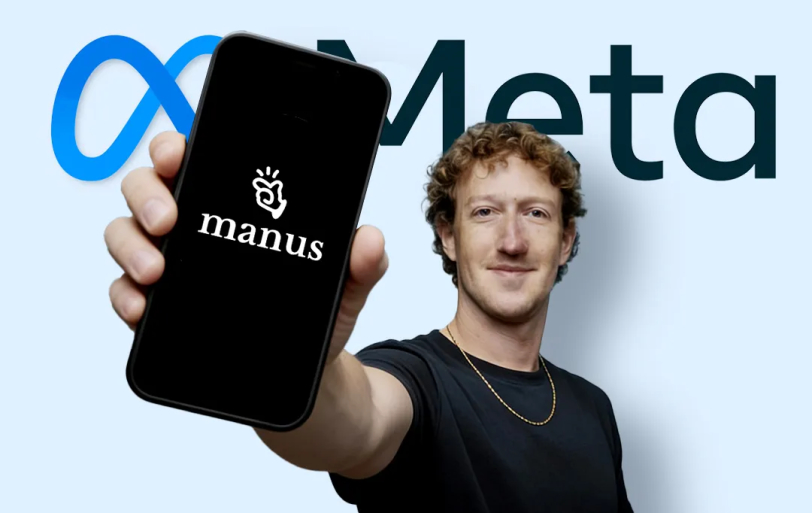
The social media giant's purchase of the Singapore-based firm marks its third-largest acquisition ever, as the race for AI dominance intensifies.
Meta Platforms has agreed to acquire Manus, a Singapore-based artificial intelligence startup, in a deal valued at over $2 billion, according to sources familiar with the transaction cited by The Wall Street Journal. The acquisition represents Meta's third-largest deal in company history, following WhatsApp and Scale AI.
The deal, which was finalized in approximately ten days, signals Mark Zuckerberg's aggressive push to transform Meta into an AI powerhouse capable of competing with OpenAI, Google, and Microsoft in the rapidly evolving autonomous agent market.
Manus burst onto the scene this spring with a demo video so slick it went instantly viral. The clip showed an AI agent that could screen job candidates, plan vacations, and analyze stock portfolios. The company claimed its technology outperformed OpenAI's Deep Research system.
From Wuhan to Silicon Valley's Radar
Founded in 2022 by entrepreneur Xiao Hong in Wuhan, China, Manus operates under the parent company Butterfly Effect. The founding team includes Ji Yichao, a former high school dropout who gained recognition for developing Mammoth Browser at age 17.
After the acquisition is completed, Xiao Hong will join Meta and serve as a vice president. In a company statement, Xiao said: "Joining Meta allows us to build on a stronger, more sustainable foundation without changing how Manus works or how decisions are made."
The startup's rapid ascent has been remarkable. Manus claimed it had achieved an annualized average revenue of more than $100 million just eight months after launch, while its revenue run rate exceeded $125 million.
Strategic Rationale for Meta
For Zuckerberg, who has staked Meta's future on AI, Manus represents something new: an AI product that's actually making money. The acquisition comes as investors have grown increasingly skeptical of Meta's massive infrastructure spending, with the company pledging $60 billion for AI-related projects.
Meta Chief Executive Officer Mark Zuckerberg has made AI his company's top priority, and is spending billions to hire researchers, build data centers and develop new models.
In June, Meta invested $14.3 billion in AI start-up Scale AI, in a deal that brought its founder and CEO, Alexandr Wang, onto Meta's AI leadership team. The company also acquired AI-wearables startup Limitless earlier this month.
Meta stated it will continue operating Manus's subscription service while integrating the startup's agents into Facebook, Instagram, and WhatsApp, where Meta AI is already available to users.
Navigating Geopolitical Sensitivities
The acquisition carries significant geopolitical implications. Manus has Chinese founders who founded Butterfly Effect in Beijing in 2022 before decamping to Singapore in the middle of this year.
The firm's Chinese origins have drawn scrutiny from Washington. Senator John Cornyn, a Texas Republican and senior member of the Senate Intelligence Committee, has been among Congress's most vocal critics of American investment in Chinese AI companies.
VC firm Benchmark was criticized earlier this year by lawmakers and other venture investors for backing an AI company with ties to China when it led Manus's $75 million funding round.
To preempt regulatory concerns, Meta has moved swiftly. Meta has already told Nikkei Asia that after the acquisition, Manus won't have any ties to Chinese investors and will no longer operate in China. "There will be no continuing Chinese ownership interests in Manus AI following the transaction, and Manus AI will discontinue its services and operations in China," a Meta spokesperson said.
The Rise of AI Agents
AI agents are tools that don't need human supervision to perform specific digital tasks. Enterprise software companies such as Salesforce and ServiceNow have heavily promoted their own versions as the most effective way for businesses to leverage emerging technology.
In October, Microsoft began testing Manus in Windows 11 PCs, allowing users to create websites from local files. The company claims to have processed more than 147 trillion tokens and supported over 80 million virtual computers.
Technology journalist Rowan Cheung, founder of The Rundown AI newsletter, described Manus's launch as "China's second DeepSeek moment." Former Google employee Bilawal Sidhu called it "the closest thing I have seen to an autonomous AI agent."
The deal underscores a broader shift in the AI industry—from competing on model benchmarks to developing deployable, revenue-generating autonomous systems. For Meta, Manus offers both immediate subscription revenue and a potential pathway toward what Zuckerberg has described as his vision for "personal superintelligence."