#News

Robot Dogs and Drone Swarms: China’s DeepSeek Push Redefines the Future Battlefield

Robot Dogs and Drone Swarms: China’s DeepSeek Push Redefines the Future Battlefield

Date: October 27, 2025

Listen to This Article

Beijing accelerates its AI-driven warfare program, and DeepSeek powers China’s next-generation military ambitions.

China’s Norinco rolled out its P60 autonomous combat-support vehicle in February as a declaration. It is supposed to be moving at 50 kilometers per hour without a driver. The vehicle runs on DeepSeek, an AI model now considered the crown jewel of China’s tech rise. Party officials framed the P60 as an early example of how Beijing plans to close the gap with the U.S. in military technology.

According to Reuters documents, the People’s Liberation Army (PLA) and its affiliates have filed dozens of tenders this year that reference DeepSeek, while just one mentions Alibaba’s Qwen, its closest domestic rival. The PLA’s interest illustrates China’s drive for “algorithmic sovereignty,” reducing dependence on Western chips and software as U.S. export controls tighten.

Yet the dependency is far from over. Military-linked research institutes continue to cite Nvidia’s A100 and H100 chips in patents, even after Washington banned their export in 2022. Some researchers say stockpiled hardware is still being used to train AI systems critical for autonomous operations.

Beijing’s Robot Dogs, Drone Swarms, and Instant Warfare

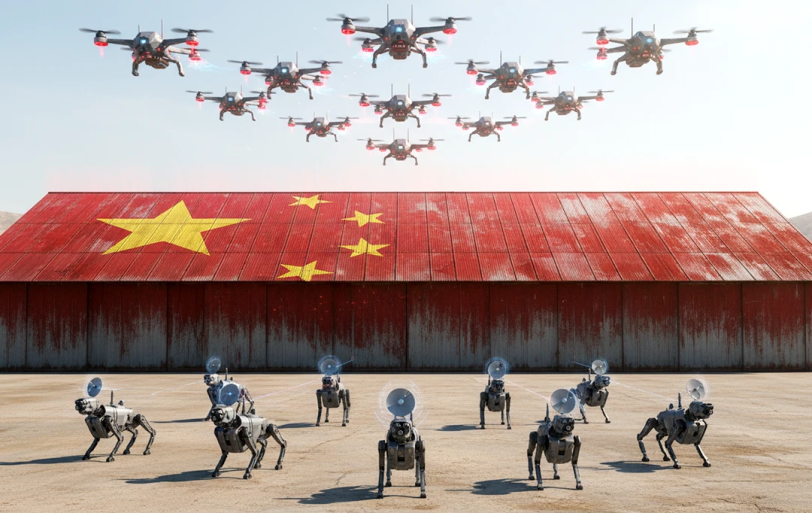
Beijing’s vision for AI combat extends beyond vehicles. The PLA is experimenting with robot dogs that move in packs to scout and clear explosive hazards, and drone swarms that can hunt targets independently. Patent filings from Beihang University show how DeepSeek is being used to improve swarm decision-making against “low, slow, small” airborne threats.

In Xi’an, technologists claim their DeepSeek-based system can evaluate 10,000 battlefield scenarios in 48 seconds. Now, originally, this would normally take human planners two days. Although the claim remains unverified, it signals a massive shift toward real-time AI war planning.

Wang Yongqing, lead designer at the Shenyang Aircraft Design Institute, confirmed his team is using AI to develop China’s most advanced warplanes. “The technology has already shown promising potential,” he said, calling large language models a key tool for solving “complicated aerospace research needs.

As Washington moves to deploy thousands of autonomous drones by 2025 to counter China’s expanding arsenal, Beijing’s investment in DeepSeek suggests it’s racing to stay ahead. With robot dogs in formation and drone swarms learning on the fly, the next battleground may no longer be won by troops on the ground, but by the algorithms that command them.

Riya

By Riya

Have newsworthy information in tech we can share with our community?

Post Project Image

Fill in the details, and our team will get back to you soon.

Contact Information
+ * =