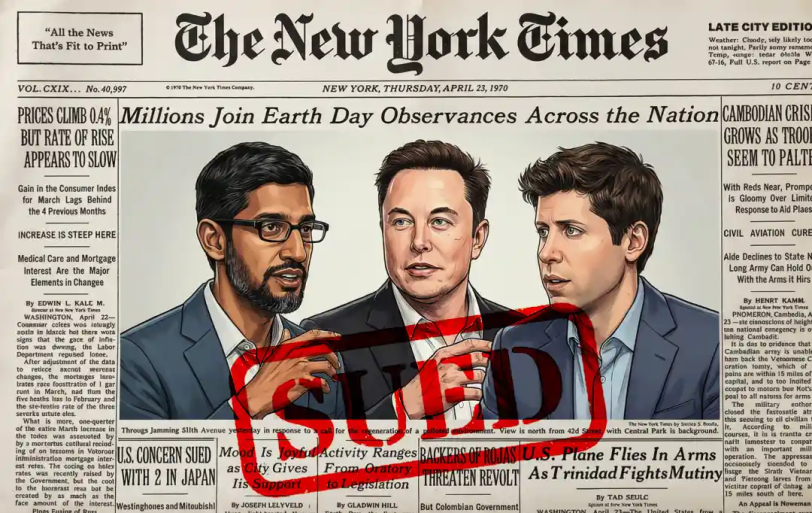
Theranos whistleblower John Carreyrou sues OpenAI, Google, xAI, and Meta, alleging AI giants trained chatbots on stolen copyrighted books.
John Carreyrou, the Pulitzer Prize-winning New York Times investigative reporter who brought down blood-testing startup Theranos, has filed a federal lawsuit against six of the world's most prominent artificial intelligence companies, accusing them of illegally using copyrighted books to train their chatbots.
Carreyrou filed the lawsuit in California federal court on December 22 alongside five other writers (Lisa Barretta, Philip Shishkin, Jane Adams, Mathew Sacks, and Michael Kochin) accusing the AI companies of pirating their books and feeding them into the large language models (LLMs) that power the companies' chatbots.
The defendants include Google, OpenAI, Meta Platforms, Elon Musk's xAI, Anthropic, and AI search startup Perplexity. The case marks a significant escalation in the ongoing battle between content creators and technology companies over intellectual property rights in the age of generative AI.
A First for Musk's xAI
The lawsuit is one of several copyright cases brought by authors and other copyright owners against tech companies over the use of their work in AI training. The case is the first to name xAI as a defendant.
xAI's response was succinct: "Legacy Media Lies." Other defendants did not immediately respond to requests for comment on the lawsuit.
Rejecting "Bargain-Basement" Settlements
The lawsuit comes in the wake of Anthropic reaching the first major settlement in an AI-training copyright dispute in August, agreeing to pay $1.5 billion to a class of authors who said the company pirated millions of books.
However, Carreyrou and his co-plaintiffs argue such settlements grossly undervalue their work. The complaint states that authors in the Anthropic class action are expected to receive about $3,000 per work, before legal costs, which it describes as "a tiny fraction (just 2 per cent)" of the Copyright Act's statutory damages ceiling of $150,000 per infringed work.
"LLM companies should not be able to so easily extinguish thousands upon thousands of high-value claims at bargain-basement rates," the filing reads.
Carreyrou made his position clear during November court hearings on the Anthropic settlement, calling pirated training data Anthropic's "original sin" and rejecting the August settlement entirely.
Strategic Legal Approach
Carreyrou and his five co-plaintiffs deliberately avoided class-action status, positioning themselves to claim up to $150,000 per infringed work instead of accepting the smaller settlements that have become standard in AI copyright disputes.
The complaint was filed by attorneys at law firm Freedman Normand Friedland including Kyle Roche, whom Carreyrou profiled in a 2023 New York Times article. Roche declined to comment on the lawsuit.
During a November hearing in the Anthropic class action, U.S. District Judge William Alsup criticized a separate law firm Roche co-founded for gathering authors to opt out of the settlement in search of "a sweeter deal."
A Growing Wave of AI Copyright Litigation
The lawsuit adds to a mounting legal challenge facing the AI industry. This comes after a banner year for intellectual property lawsuits against AI companies brought by rights holders. Just about every type of entity that deals in protected content has gone to court against AI companies this year, from movie studios like Disney and Warner Bros. to papers like the Chicago Tribune.
Central legal questions in these cases include whether ingesting full articles and books into training datasets constitutes a public performance or reproduction, and whether downstream uses of those trained models can be characterized as fair use when they generate text informed by copyrighted sources.
Industry Implications
The timing couldn't be more pointed. OpenAI is reportedly negotiating funding that could value it at $830 billion, while Anthropic explores valuations above $300 billion.
Beyond the courtroom, the litigation underscores a broader industry tension. Publishers and creators argue that widespread ingestion of their reporting and books threatens both the ad-supported model of news and authorship income, while tech companies maintain that access to diverse textual sources is integral to building useful AI systems.
Courts will now assess whether settlements negotiated when these companies were worth a fraction of their current value adequately compensate the creators whose work built multi-hundred-billion-dollar businesses.
How judges treat those competing interests in the coming months could reshape content licensing, model design, and the economics of journalism and publishing.