Share It On:
 Your roadmap to integrating Natural Language Processing into your operations. Also, learn the core techniques for NLP implementation, its top use cases, and more.
Your competitors are processing millions of customer interactions in seconds while you're still manually analyzing feedback. They're automating document workflows that take your team days to complete.
The difference?
They've mastered Natural Language Processing implementation. Yes, you read it right!
In fact, Statista reports, the NLP market is booming and is expected to reach $53.42 billion by 2026. So, if you still have not embraced the implementation of natural language processing solutions, now is the time.
In this guide, we will walk you through the nitty-gritty of Natural Language Processing. You will get to learn about the importance of implementing NLP, steps to integrate NLP solutions, NLP use cases, and more.
Let’s get started!
A Basic Understanding of Natural Language Processing in AI
Natural Language Processing (NLP) is a subset of Artificial Intelligence (AI) that focuses on teaching machines about the patterns of human language. In other words, NLP bridges the gap between human communication and machine understanding to make the usability more accessible.
The quick advancements in NLP technologies have encouraged businesses across all industries to integrate these capabilities into their systems. To an extent that many tech-savvy people are inclining more towards the adoption of NLP by building chatbots, crafting translation apps, fraud detection apps, and more.
To unlock NLP's true potential for your organization, consider partnering with machine learning development companies that can help you leverage this advanced technology effectively. But, always remember that NLP’s seamless implementation is one that requires a thoughtful strategy and deep technical expertise.
Why Implementation of NLP is Important for Modern Businesses
Natural Language Processing has shifted from experimental technology to essential business infrastructure across industries. For instance, banks implementing NLP technology have reported up to 60% improvement in fraud detection rates. No wonder industries are rushing to NLP implementation.
There are three significant reasons why the implementation of NLP programs can help your business earn more:
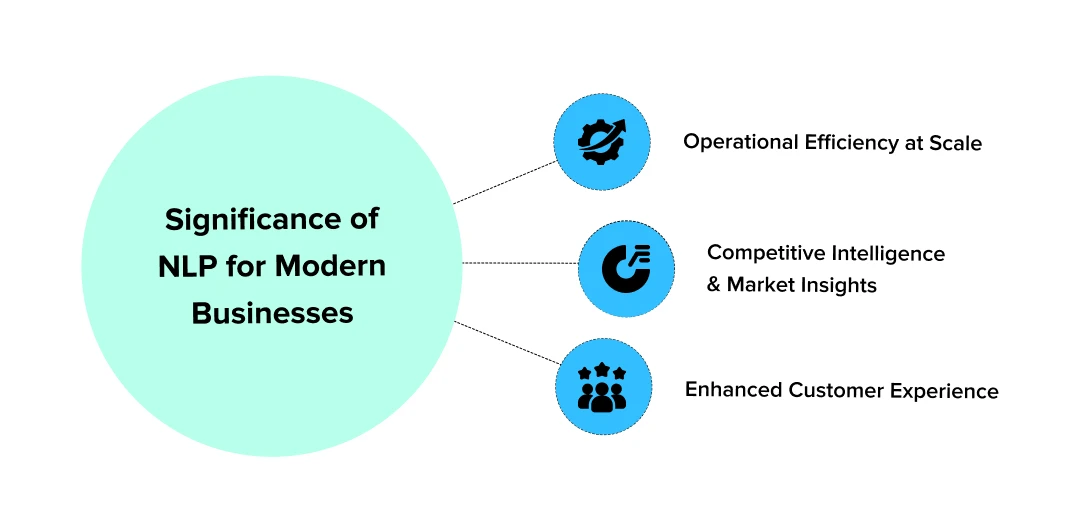
1. Operational Efficiency at Scale: Doing tasks manually across all the departments can sometimes be a little overwhelming. For example, legal teams might spend hours going through contracts, whereas customer support keeps answering the same questions repeatedly.
NLP eliminates these inefficiencies through:
- Automated document classification and extraction
- Real-time sentiment analysis across all customer touchpoints
- Intelligent routing of support tickets based on content analysis
- Contract analysis that flags risks and anomalies in seconds
2. Competitive Intelligence and Market Insights: Are you still going through those quarterly reports all by yourself? While you’re sifting through these reports, your competitors are already a step ahead of you and analyzing millions of data points every day. So, make it sooner before they outpace you.
Key competitive advantages include:
- Real-time analysis of customer feedback across all channels
- Predictive insights from unstructured data sources
- Automated competitive intelligence gathering
- Early detection of market shifts and customer preference changes
3. Enhanced Customer Experience: Modern customers expect instant, personalized responses. They abandon brands that can't understand their needs or resolve issues quickly. NLP transforms customer interactions from transactional to conversational.
Customer experience improvements through NLP:
- 24/7 intelligent support that understands context and intent
- Personalized content recommendations based on communication history
- Proactive issue resolution through sentiment detection
- Multilingual support without expanding headcount
Steps to Integrate NLP Solutions into Your System
Successful NLP implementation requires systematic execution, not scattered experiments. We've distilled hundreds of enterprise deployments into a five-phase roadmap that minimizes risk while maximizing quick wins.
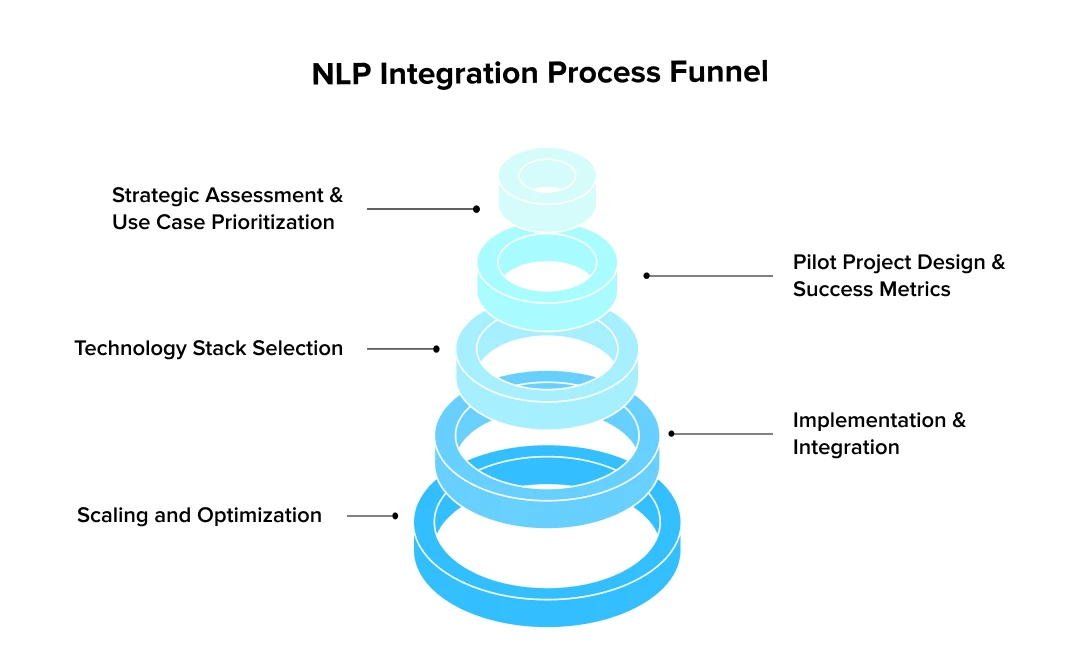
Phase 1: Strategic Assessment and Use Case Prioritization
Begin the process by aligning the business goals with the existing workflows and data. With the help of this approach, you can prioritize high-value problems and make sure that natural language processing solutions are delivering impactful, accurate, and efficient outcomes.
High-impact starting points typically include:
- Customer support ticket classification
- Email routing and response automation
- Document information extraction
- Sentiment analysis of customer feedback
Phase 2: Pilot Project Design and Success Metrics
The key to a successful NLP implementation strategy is a well-planned pilot project. This stage is about picking the important and manageable tasks so that NLP can show quick and clear results. Make sure you’ve set your goals, along with measurable outcomes, to build confidence in the technology.
Example pilot metrics:
- Reduce document processing time by 70%
- Achieve 85% accuracy in customer intent classification
- Decrease average response time from hours to minutes
- Generate $500K in cost savings within the first quarter
Phase 3: Technology Stack Selection
Here comes a vital stage where you will have to make key decisions about the technology. Ask yourself if you want to find the right balance between customizing the solutions or you want to use ready-made, fast & scalable platforms. The tools you’ll choose will automatically affect the deployment and ongoing maintenance of your business.
Build vs. Buy Decision Matrix:
| Factor | Build Custom | Buy/Integrate Platform |
|---|---|---|
| Initial Cost | High | Moderate |
| Time to Deploy | 6-12 months | 1-3 months |
| Customization | Complete | Limited to APIs |
| Maintenance | Internal team required | Vendor supported |
| Scalability | Design dependent | Pre-built |
| Best For | Unique use cases | Standard applications |
- Google Cloud Natural Language: Best for companies already on GCP
- AWS Comprehend: Ideal for AWS-native architectures
- Azure Cognitive Services: Strong for Microsoft ecosystems
- IBM Watson: Provides comprehensive enterprise features
- Hugging Face Enterprise: Best for custom model deployment
Phase 4: Implementation and Integration
Now, this is where your pilot project will come into action; that doesn’t just mean building the model. This stage is all about testing, making sure that everything’s working as desired, and is highly scalable. The main goal of implementing NLP solutions is to create something that is easy to use and value-driven right from the beginning.
Implementation checklist for your project:
- Set up development and testing environments
- Configure APIs and data pipelines
- Train and fine-tune models
- Implement feedback loops
- Create user training materials
Integration considerations:
- API rate limits and latency requirements
- Data security and compliance protocols
- Failover and redundancy planning
- Performance optimization strategies
Phase 5: Scaling and Optimization
Here comes the final stage, where the focus is on expanding the NLP capabilities across the entire organization and fine-tuning your existing systems to deliver long-term value. Focus on boosting the performance, addressing challenges, and embedding NLP as a significant part of your operations for better growth and innovation.
Scaling strategies:
- Replicate successful patterns across departments
- Build reusable components and templates
- Establish a Center of Excellence for NLP
- Create a governance framework for AI initiatives
- Implement MLOps practices for production systems

Core Techniques for an Effective NLP Implementation
NLP has become one of the most suited AI products when it comes to optimizing business processes, automating tasks, and extracting actionable insights. But the true potential of natural language processing can only be unlocked when used with the right set of techniques, like:
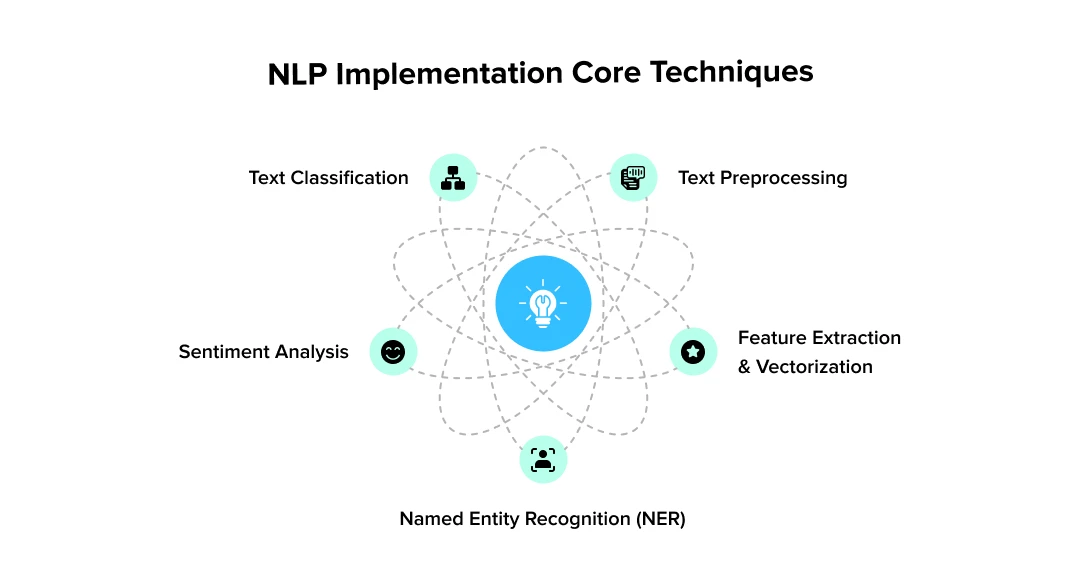
1. Text Preprocessing
Text preprocessing is the critical first step, which involves preparing raw text by removing unnecessary elements and standardizing it for analysis. This process includes:
- Tokenization: Dividing the text into words or phrases.
- Stop-word Removal: Eliminating common words that don't contribute to meaning.
- Stemming and Lemmatization: Reducing words to their base forms.
Text preprocessing ensures that your NLP models are not in contact with irrelevant data to deliver better performance and more reliable outputs.
2. Feature Extraction & Vectorization
After preprocessing the text, it’s time to convert it into a format that machine learning models can interpret. This is where feature extraction and vectorization come into play, which comprises two common methods that are:
- Bag of Words (BoW): This technique counts the frequency of words and creates a sparse matrix representation.
- TF-IDF (Term Frequency-Inverse Document Frequency): This approach evaluates the significance of words based on their occurrence within a document relative to the entire dataset.
Additionally, Word Embeddings like Word2Vec and GloVe offer more advanced, context-aware representations by mapping words to dense vectors, improving the model’s ability to understand meaning beyond simple frequency.
3. Named Entity Recognition (NER)
Named Entity Recognition (NER) is a technique used to identify and categorize entities in text, such as organizations, locations, dates, and products. This adds a layer of semantic understanding to your NLP system, making it more capable of handling complex, real-world text data.
NER is especially useful for tasks like extracting structured data from unstructured documents, enhancing search and retrieval systems, and automating document classification and indexing.
4. Sentiment Analysis
Sentiment analysis allows businesses to evaluate the emotional tone behind textual content. It further helps in analyzing customer feedback, assessing brand sentiment across social media or reviews, and monitoring public opinion on specific topics.
By implementing sentiment analysis, businesses can make data-driven decisions, improve customer relations, and refine marketing strategies.
5. Text Classification
Text classification automates the categorization of textual data into predefined categories, enabling efficient document management and information retrieval. By implementing text classification, businesses can significantly reduce manual efforts, enhance efficiency, and improve response times.
Common applications used in text classification are:
- Spam detection in emails or support tickets.
- Sorting customer inquiries into categories like billing, technical support, or product questions.
- Organizing content for faster search and retrieval.
Top Use Cases of NLP Solutions Across Industries
Businesses across all industries have started to avail NLP services for task automation, improved decision-making processes, and extracting valuable insights. Let’s deep dive into the top use cases of natural language processing AI.
1. Healthcare Industry
Hundreds of healthcare app development companies are leveraging natural language processing solutions to handle vast amounts of unstructured data. For instance, they make a smart choice by using AI-based virtual assistants to provide better patient care, streamline administrative processes, and boost the overall efficiency.
The key applications are medical health review, clinical research, and chatbots for resolving patient queries smartly. The impact that it drives is: improved diagnostics & patient care, reduced manual data entry, and faster drug development.
2. Finance and Banking
NLP is revolutionizing the finance & banking industry by quickly detecting fraud and providing instant customer support. The financial sector has a vast amount of unstructured data, like financial reports, customer interactions, or social media interactions, which makes the management difficult.
But, with NLP, you can get better insights for a better decision-making process and improved security. The technology also helps in automating the document processing and monitoring the public sentiment around ongoing market trends.
3. eCommerce and Retail
If you want to improve the customer experience for your online store, embrace the power of an NLP solution. You will be able to personalize product recommendations and streamline operations as per the latest eCommerce trends.
AI-powered NLP solutions help in providing valuable insights into customer behavior and sentiment, and also provide round-the-clock support through chatbots. As a result, it increases sales, improves customer satisfaction, and more.
4. Legal & Compliance
In the legal industry, NLP is making its way and significant strides by automating repetitive tasks, such as document reviews, legal research, and contract analysis. Many legal firms use NLP tools for fewer human errors, faster workflows, and adherence to security compliances like GDPR.
The implementation of NLP helps in generating legal documents and agreements based on predefined templates and inputs. Moreover, it extracts key clauses, terms, and risks from contracts to ease the review process.
Addressing Key Challenges & Ethical Considerations in NLP Implementation
Successful NLP deployment requires navigating technical, organizational, and ethical challenges. Addressing these proactively prevents costly setbacks.
| Category | Challenge | Mitigation / Solution |
|---|---|---|
| Data Quality and Availability | Poor data quality is a leading cause of NLP project failures. |
|
| Language Complexity and Context | Human language contains nuance, sarcasm, and cultural references. |
|
| Integration and Scalability | NLP systems must integrate with existing infrastructure and scale effectively. |
|
| Bias Detection and Mitigation | NLP models can perpetuate or amplify existing biases, leading to unfair outcomes. |
|
| Privacy and Data Protection | Text data often involves personal information, requiring privacy controls. |
|
| Transparency and Accountability | Stakeholders need to understand how NLP systems make decisions. |
|
Concluding Words
NLP implementation transforms how enterprises process information, interact with customers, and make decisions. The technology has matured beyond experimentation—companies not implementing NLP risk falling behind competitors who process information at machine speed.
Your journey starts with selecting the right pilot project. Focus on a specific problem with measurable impact. Build momentum through quick wins before scaling across the organization. Remember that successful NLP implementation combines technology excellence with organizational change management.
The roadmap we've outlined provides a proven path from initial assessment through enterprise-scale deployment. Following these steps, enterprises typically see positive ROI within 6 months and transformational benefits within 18 months.
Take action today. Assess your text-heavy processes, identify quick wins, and begin your NLP transformation. The competitive advantage belongs to those who act decisively while others deliberate.
Frequently Asked Questions
What's the minimum budget required for enterprise NLP implementation?
Pilot projects start around $50,000 using cloud platforms. Enterprise-wide implementations typically require $250,000-$2M in the first year, including technology, integration, and change management. ROI usually justifies expansion after successful pilots.
How long does it take to see results from NLP implementation?
Quick wins appear within 30-60 days for simple use cases like email classification. Complex implementations like contract analysis take 3-6 months. Enterprise-wide transformation typically spans 12-18 months.
Do we need a dedicated data science team for NLP?
Not initially. Cloud platforms offer pre-trained models requiring minimal expertise. However, scaling beyond pilots benefits from at least one NLP specialist. Many organizations start with consultants and build internal capabilities over time.
How do we measure NLP implementation success?
Define metrics tied to business outcomes: processing time reduction, accuracy improvements, cost savings, and customer satisfaction scores. Avoid vanity metrics like model accuracy without business context.
What are the biggest risks in NLP implementation?
Common pitfalls include starting too broadly, underestimating data preparation needs, ignoring change management, and lacking executive sponsorship. Mitigate through phased approaches, realistic timelines, and strong governance.
How do we ensure our NLP system remains accurate over time?
Implement continuous learning pipelines, monitor performance metrics, retrain models quarterly, and maintain human oversight for quality assurance. Language evolves, so your models must too.

Uncover executable insights, extensive research, and expert opinions in one place.