Share It On:
The statistics are brutal, and frankly, they haven't changed much in a decade.
According to industry data from Quettra, the typical mobile app bleeds 77% of its daily active users (DAUs) within the first three days. By day 30, you’ve lost 90%. By day 90? You are essentially a ghost town.
When churn spikes, the panic in the boardroom is palpable. The default reflex in almost every startup I’ve consulted with is to blame the build.
“The features aren't robust enough,” they say. “We need to refine the UX.”
The assumption is that if users are leaving, the product must be broken.
I’m here to tell you that this is lazy thinking. Not only is it usually incorrect, but it’s also incredibly expensive.
As a digital marketing and SEO strategist focusing on the psychology of growth, I see the same pattern repeat itself. The uncomfortable truth is that most apps don’t have a product problem; they have a strategy void. Poor user onboarding, superficial lifecycle marketing, and acquisition plans that prioritize vanity metrics over intent are what actually kill retention.
Your marketing execution is failing long before your product code ever gets a chance to run.
Product-Market Fit: The Convenient Scapegoat
Let’s be clear: Product-Market Fit (PMF) is non-negotiable. No amount of clever retention hacking can save a tool that solves a nonexistent problem.
But here is where founders get it wrong: Early churn does not prove a lack of PMF.
In my experience, the value proposition is often solid. A core segment of users desperately wants what you are selling. The problem isn't the "what"; it's the "how." The activation pathways are murky, or you are paying to acquire users who were never going to convert in the first place.
PMF often exists in pockets before it exists at scale. If you see churn, don't tear down the roadmap. Look at your distribution and activation friction first.
The Onboarding Illusion and the "Aha!" Moment
Most product teams drastically underestimate the power of first impressions and overestimate the allure of their feature set.
Retention isn't about how many buttons you have; it’s about the speed at which a user realizes, “Okay, this solves my problem.”
Activation is your only real growth lever.
Install numbers look great in a pitch deck, but the activation rate dictates your survival. If a user installs your app and doesn't reach that psychological "aha!" moment immediately, they are gone. Activation is a behavioral commitment. Without that early dopamine hit of a "quick win," there is no emotional anchor.
Cognitive Overload is the Silent Killer
The human brain is efficient, which is a polite way of saying it’s lazy. It hates working without a guaranteed reward. Yet, I see onboarding flows that interrogate users with permission requests, complex tutorials, and multi-stage signups before delivering a shred of value.
That struggle compounds. If your onboarding requires high cognitive load, distraction wins.
Clarity Beats Complexity
Stop trying to impress users with the scope of your app. Impress them with the depth of your solution to their specific pain point. The paradox I preach to my clients is simple: showing everything communicates nothing. Strong onboarding focuses on one outcome, one action, and one clear path.
Case Study: Friction vs. Features
Product–market fit is the bedrock; without solving a tangible problem, retention is dead on arrival. However, interpreting early churn as a definitive lack of PMF is often a misdiagnosis. Frequently, the issue isn't that the product lacks value, but that the user isn't reaching that value fast enough, or the acquisition channels are feeding the wrong audience into the funnel.
Activation is the definitive lever here, capable of swinging retention by 20-50%.
Consider the trajectory of a feature-rich budgeting app sitting at a stagnant Day 7 retention rate of 18%. The failure wasn't a question of depth; it was an excess of friction. By radically simplifying the onboarding to focus on a singular action—presenting an instantaneous snapshot of spending rather than a full setup—that retention figure jumped to 25%. The product code barely changed. The path to value did.
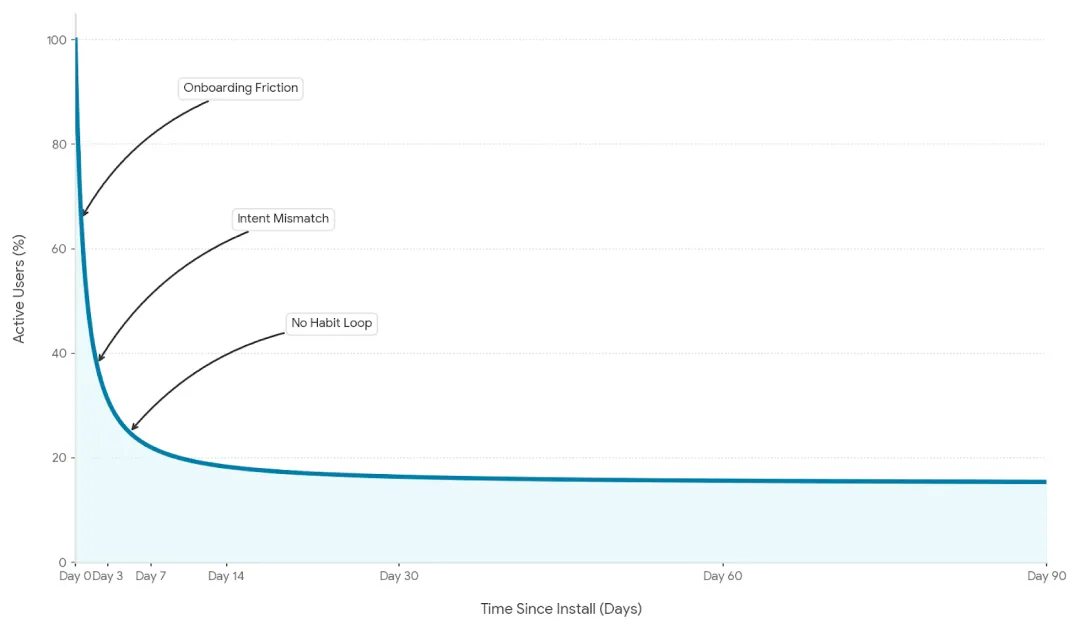
Reinforcement cements these wins. Habits are forged through precise behavioral loops, not generic broadcast pushes. Given that acquiring a new user costs 5-7 times more than retaining an existing one, retention acts as a massive growth multiplier.
Sometimes, the product is indeed the villain. But more often, the real culprits are the speed of activation, mismatched acquisition, and the chaos of premature scaling.
Messaging Is the Engine, Not the Paint
If onboarding is the ignition, messaging is the fuel. Yet, most apps treat communication like a distinct afterthought rather than a strategic mechanism.
Lifecycle Marketing Must Drive Behavior
Retention isn't a one-time event; it’s a relationship built on consistency. But successful lifecycle marketing relies on triggers, not calendars.
If a user drops off a critical flow, that is when the reminder triggers. When a milestone is hit, recognition should be immediate. If silence sets in, re-engagement must be contextual. Sending a generic "We miss you" email is desperate. Sending a "Here is exactly how to finish what you started" push notification is helpful.
Habit Formation Requires Reinforcement
Behavioral psychology dictates that habits are formed through a loop: Cue, Action, Reward. If your communication strategy doesn't support that loop, you are relying on the user’s memory. And trust me, user memory is unreliable.
The "Scale Fast" Trap
The startup ecosystem glorifies speed. "Scale fast" is the mantra. But scaling before you have fixed your retention leak is like pouring water into a bucket with no bottom.
Vanity Metrics Create False Confidence
Spikes in installs and press mentions feel good. They stroke the ego. But if your LTV-to-CAC ratio (Lifetime Value to Customer Acquisition Cost) is upside down because your Day 30 retention is garbage, you are just accelerating your own demise.
When you scale prematurely, churn builds silently in the background. A short-term revenue bump masks the structural rot. Eventually, acquisition costs rise, retention stagnates, and the math stops working. By the time leadership pivots back to product, it’s usually too late.
SEO & Intent: The Overlooked Variable
Here is the factor most people miss: Retention issues often start before the install.
As a strategist, I look at where the user came from. If your SEO and paid acquisition are bringing in high volumes of low-intent traffic, your retention will tank, no matter how good your product is.
Keyword Intent Shapes Expectations
Ranking for a high-volume keyword is useless if the intent doesn't match your product reality. Users arriving with mismatched expectations will never activate.
Content Strategy Pre-Qualifies Users
Great SEO isn't just about traffic; it’s about expectation management. Your content should pre-qualify users before they ever hit the App Store. When a user knows exactly what the app does, who it’s for, and what results to expect, they arrive ready to activate.
Traffic quality always outperforms traffic quantity. Always.
The Bottom Line
Stop blaming the code for marketing failures.
Mobile apps don't fail because founders build bad products. They fail because users never get clarity, momentum, or reinforcement. They fail because the marketing systems are superficial, while the feature list keeps bloating.
Retention is a strategic science sitting at the intersection of psychology, messaging, and acquisition quality. Even a simple product can dominate if these elements are aligned.
Remember: Acquisition without retention isn’t growth. It’s just churn in disguise.

Uncover executable insights, extensive research, and expert opinions in one place.
Latest Content