Laptop Just Rolled Away From $900M droid deals to holographic desktop "waifus," the virtual world has finally crashed into reality.
If previous years were about chatbots and code, CES 2026 Day 1 has delivered a loud, undeniable rebuttal: AI now has a body.
The era of "Physical AI" has officially begun. The screens are stretching, the chips are government-backed, and intelligence is being poured into steel, silicon, and sensors. Reporters on the ground describe a show floor dominated by machines that can walk, cook, reason, and drive—marking a historic shift where software finally gets its hands dirty.
The Robot Revolution: From Factory Floors to Kitchen Counters
The "novelty" phase of robotics is dead. At CES 2026, the droids are here to work.
- Boston Dynamics x Hyundai (The 2028 Deadline): In a definitive move for industrial automation, Boston Dynamics confirmed its fully electric Atlas humanoid will officially deploy at Hyundai’s electric vehicle plant in Georgia by 2028, tasked with complex assembly roles alongside human workers.
- Mobileye (The $900M Pivot): Shattering its "car-only" reputation, Mobileye announced "Mobileye 3.0" and the $900 million acquisition of Mentee Robotics, signaling a strategic shift to transplant its autonomous driving brain into bipedal bodies.
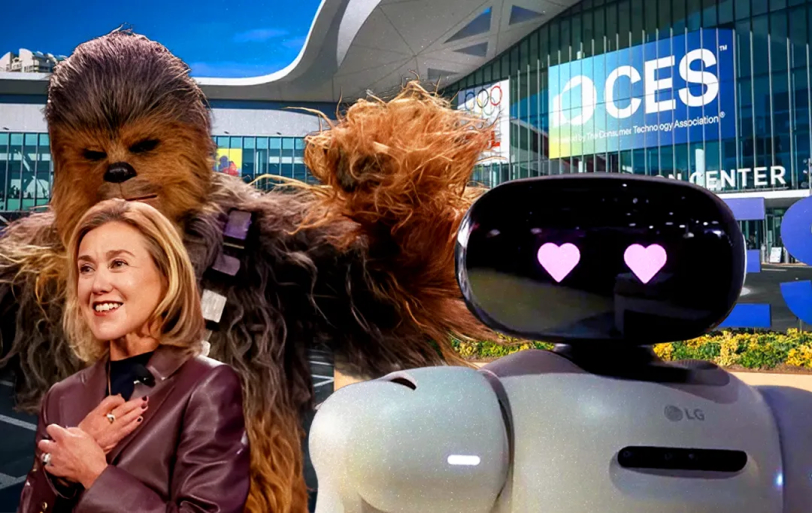
- LG CLOiD (The Home Butler): LG’s humanoid smart home agent, CLOiD, was demonstrated using Vision-Language-Action (VLA) models to fold laundry and fetch food. (Though early reports note it still struggled with the laundry machine—the "Rosie the Robot" dream is real, but buggy).
- SwitchBot Onero H1: While others remain concepts, SwitchBot’s Onero H1 was cited as the "only multi-purpose home robot" with a firm release window, positioning it as the first true generalist droid for consumers.
- Nosh (The Robot Chef): The talk of the smart home hall. This 16x22-inch countertop device ($1,200 early bird, $2,000 MSRP) cooks meals from fresh ingredients in 45 minutes. It holds spices/liquids in modular hoppers and launches on Kickstarter on February 1.
- Mammotion Spino S1 Pro: A pool cleaning robot that finally solves the biggest pain point of ownership: it features a robotic arm and underwater comms system to mechanically lift itself out of the water to charge.
The Chip Wars: Politics Meets Handhelds
- Intel’s "Uncle Sam" Era: The atmosphere at the Intel booth was heavy following news that the U.S. government had converted a portion of federal funding into a 10% equity stake in Intel.
- The "Core G3" Reveal: Emboldened by this backing, Intel confirmed it is cutting a specific die variant—the Core G3—on its new 18A process. This chip is dedicated solely to handheld gaming PCs to fight AMD’s dominance.
- NVIDIA’s "Physical AI": CEO Jensen Huang unveiled "Cosmos" (a physics-aware world model) and "Alpamayo" (an autonomous reasoning model).
- Fusion Goes Digital: In a massive leap for clean energy, Commonwealth Fusion Systems (CFS) joined Siemens and Nvidia to unveil a digital twin of the SPARC fusion reactor, allowing real-time plasma physics simulation.
AMD Pushes AI PCs and Gaming Silicon Back Into the Spotlight
While Nvidia framed the philosophical future of “Physical AI,” AMD focused on shipping silicon meant to live inside real machines this year.
CEO Lisa Su unveiled a new lineup of Ryzen AI processors, doubling down on the company’s push to make on-device AI acceleration standard across consumer laptops. These chips are designed to handle local inference workloads without relying entirely on the cloud, reinforcing AMD’s position in the rapidly expanding AI PC category.
For gamers, AMD also revealed the Ryzen 7 9850X3D, the latest evolution of its cache-stacked gaming CPUs. The chip targets enthusiasts chasing higher frame rates and lower latency, signaling that even as AI dominates the CES narrative, traditional performance wars are far from over.
Intel’s Handheld Ambition Goes Beyond the Chip
Intel’s handheld strategy extends past the Core G3 silicon itself. Alongside the custom 18A-based die, the company outlined a broader handheld gaming platform, combining hardware enablement, software optimization, and OEM support to accelerate adoption.
The move positions Intel not just as a component supplier, but as an ecosystem player attempting to replicate the end-to-end approach that has helped rivals dominate portable gaming PCs.
On the Show Floor: Robots as Demonstrations, Not Promises
Away from the headline humanoids, the CES floor was packed with robots designed to prove specific capabilities rather than sell finished products.
Sharpa showcased a full-bodied ping-pong-playing robot primarily as a live demonstration of its robotic hand dexterity, a product already used by universities for research. Unitree drew crowds with agile quadruped robots performing choreographed movements, highlighting advances in balance, locomotion, and real-time control rather than consumer readiness.
Together, these demos reinforced a recurring CES 2026 theme: many robots on display are not products yet, but evidence that the underlying mechanics are finally catching up to the hype.
Lenovo’s Shapeshifters: The Screens Are Moving
Lenovo dominated the laptop conversation with a fleet of devices that refuse to stay still.
- ThinkPad Rollable XD: A concept where the 13.3-inch screen extends vertically to 15.9 inches by "rolling" out of the lid. It features Gorilla Glass Victus 2 and a "knock-to-extend" gesture.
- Legion Pro Rollable: A gaming beast that expands horizontally from a standard 16-inch (16:10) display to a massive 24-inch ultrawide canvas, powered by the RTX 5090.
- ThinkBook Plus Gen 7 Auto Twist: A laptop with a motorized hinge that uses AI to track your face, rotating the screen to follow you around the room or flipping orientation instantly for live translations.
- Legion Go 2: Confirmed to launch in June for $1,199, this handheld ditches Windows for SteamOS and features detachable controllers, aiming to be the premium alternative to the Steam Deck.
Motorola’s Hardware Blitz
Motorola arrived with a massive, unexpected lineup, proving it is ready to fight on every front.
- Razr Fold: A true "book-style" foldable flagship with a 6.6-inch outer and 8.1-inch 2K LTPO inner display. It packs three 50MP rear cameras and supports the new Moto Pen Ultra stylus.
- Moto Watch: Claims a market-shattering 13-day battery life (7 days with Always-On Display), featuring Polar-powered health algorithms and dual-frequency GPS.
- Moto Tag 2: A tracker with a massive 500-day battery life and UWB precision finding.
- Maxwell: A concept AI wearable pendant (lighter than previous AI pins) designed for hands-free meeting notes and photography.
The "WTF" Factor: Hologram Waifus & Bone-Conduction Candy
- Razer’s Project Ava: The most viral story of Day 1. A desktop capsule containing a 5.5-inch holographic anime character (avatars include "Kira" or "Zane"). Powered by the Grok LLM and computer vision, it watches your screen to provide gaming coaching or companionship. Reservations are open for $20.
- Nintendo Switch 2 (Unofficially): Accessory maker Genki launched a Kickstarter for "Genki Grips," explicitly marketing them for the Switch 2, effectively confirming the console’s form factor and imminent release.
- Lollipop Star: A literal candy that uses bone conduction to play music (tracks from Akon and Ice Spice) inside your head while you eat it. Price: $8.99.
Mobility & Smart Living
- Evotrex-PG5: A "power-generating RV" featuring a 43kWh battery, 1.5kW solar array, and a gas generator that can charge the electric truck towing it, theoretically extending towing range indefinitely.
- Uber x Lucid x Nuro: Uber returned to hardware with a luxury robotaxi built on the Lucid Gravity platform, featuring a "Halo" roof sensor and spa-like interior.
- Waymo’s "Passenger Princess": Waymo gamified its ride-hailing service, handing out physical merit badges to attendees who could verify their rider stats.
- Wi-Fi 8 Arrives: ASUS showed the ROG NeoCore concept router, the first demo of Wi-Fi 8. The focus is no longer just speed, but "peer-to-peer" stability to eliminate dead zones entirely.
Smart Homes, Security, and Quietly Important Consumer Tech
Not all of CES 2026’s most consequential announcements walked on two legs or rolled on tracks. Several quieter launches showed how AI is being threaded into everyday environments where reliability matters more than spectacle.
Ring’s Context-Aware Home Security Push
Ring expanded its smart security platform with two AI-driven features designed to reduce false alarms and notification fatigue.
The first, Unusual Event Alerts, learns a household’s normal activity patterns over time and only notifies users when something deviates from the baseline. The second, Active Warnings, uses contextual understanding to issue real-time alerts when people are detected, adjusting its response based on behavior rather than simple motion triggers.
Both features are rolling out to compatible existing devices, signaling a shift toward adaptive, behavior-aware home monitoring instead of constant surveillance noise.
Bloomin8 Brings AI to Ultra-Low-Power Displays
Bloomin8 introduced an updated E-ink Canvas, positioning it as a long-life alternative to traditional digital displays.
The device offers paper-like visuals with no backlight, enabling one to three years of battery life on a single charge. Users can display personal photos or artwork, generate images using AI tools, and schedule content changes via a companion app. A new 10-inch model priced under $200 expands accessibility, alongside larger 13.3-inch and 28.5-inch versions.
The product reflects a growing CES theme: intelligence doesn’t always need brightness, speed, or constant power.
Nodi Targets the “Too Young for a Smartphone” Gap
Nodi showcased a handheld communication device designed for children who want independence without a full smartphone.
The device supports voice messaging with parent-approved contacts, controlled music streaming through Spotify playlists, and multi-day battery life. It will be available in Wi-Fi and Wi-Fi plus LTE variants, with pricing starting below typical entry-level smartphones. A U.S. launch is planned for later this year.
Rather than replacing phones, Nodi positions itself as a transitional device—introducing connectivity without open internet exposure.
Aviation, Venues, and Brand-Scale Experiences
CES 2026 also highlighted how technology is increasingly shaping physical spaces and large-scale experiences, not just personal devices.
Delta and the Sphere Redefine Airline Partnerships
Delta Air Lines announced a multi-year partnership with Sphere Entertainment Co., becoming the official airline partner of the Las Vegas Sphere.
The collaboration includes a Delta SKY360° Club lounge, SkyMiles-exclusive access to events and experiences, and Delta branding integrated into the Sphere’s massive exterior LED display. Additional premium experiences for loyalty members are expected to roll out throughout 2026 and beyond.
The move reflects how airlines are increasingly positioning themselves as experience platforms, not just transportation providers.
CES Culture Moments That Cut Through the Noise
Amid industrial robots and geopolitical chip deals, CES still delivered moments that captured the show’s uniquely strange spirit.
A $25,000 Hunt for a Ghost of Silicon Valley
During an AI and workforce discussion, investor and podcast host Jason Calacanis offered $25,000 to anyone who could locate an authentic Theranos medical device. The moment served as an unintentional reminder that as AI accelerates into the physical world, the industry’s past failures still loom close enough to joke about—and learn from.
HP Shrinks the Desktop Into a Keyboard
HP quietly unveiled the Eliteboard G1a, a full desktop computer built directly into a keyboard form factor. Designed for space-constrained environments, the device collapses traditional desktop components into a single unit, blurring the line between peripherals and computing systems.
It was one of several examples at CES 2026 where radical form-factor experimentation appeared without fanfare—but with real commercial intent.
Final Assessment
With these additions, CES 2026 Day 1 comes into full focus:
- Industrial humanoids with deployment timelines
- Consumer robots edging toward real utility
- Governments are directly reshaping semiconductor power structures
- AI models trained for the laws of physics, not just language
- Screens that roll, twist, disappear—or last years on a single charge
- Everyday products quietly absorb intelligence without demanding attention
CES 2026 did not signal the arrival of artificial general intelligence. Instead, it marked something arguably more disruptive: AI growing legs, weight, energy demands, and accountability in the real world.
The Verdict
CES 2026 Day 1 made one thing clear: The AI speculation bubble didn't burst; it hardened into infrastructure. From the fusion reactor digital twins to the holographic anime companions, the technology industry has stopped asking "What can AI do?" and started building the bodies—and the bizarre form factors—for it to do it.