Share It On:
 From drug discovery to post-quantum cryptography, our research covers the quantum computing use cases that have moved past the press release.
 Quantum computers are already simulating molecules, securing data against attacks that don't yet exist, and optimizing portfolios inside real banks. They are also nowhere close to replacing the laptop on your desk.
Both are true because quantum computing isn't a general-purpose machine; it's a specialized one. It's built for problems with too many variables for classical computers to work through.
Inside that band, the list of use cases is widening fast; drug discovery, materials science, logistics, energy grids, climate modeling, and post-quantum cryptography are all moving from research papers into industry pilots and production systems.
We've spent time mapping every quantum computing use case worth knowing and noting what each one does, who's running it, what hardware it requires, and how close it is to scale.
What is Quantum Computing?
Our classic computers store data as bits, which are single units that hold either 0 or 1. Quantum computers use qubits, which can represent 0, 1, or both at once through a property called superposition.
A second property, entanglement, links the state of one qubit to another regardless of distance. These properties, together, enable a quantum computer to evaluate many possible answers in parallel rather than testing them one at a time.
That parallelism is what makes the latest quantum computing applications one of the most talked-about latest tech trends, useful for certain problems yet incredibly difficult to build. At the same time, it's also what makes the hardware difficult to build.
Qubits are complex, unstable, and even minor environmental interference can destroy a calculation. That fragility is why most quantum computers operate in tightly controlled environments.
The state of quantum computing technology
Quantum computing has crossed into commercial territory. McKinsey's Quantum Technology Monitor 2026 highlights two numbers that anchor the shift:
- Over 300 global companies, including Airbus, Boehringer Ingelheim, E.ON, JPMorgan Chase, and Liberty Mutual, are now actively collaborating with quantum technology firms.
- Quantum computing could deliver up to $2.7 trillion in economic value worldwide by 2035.
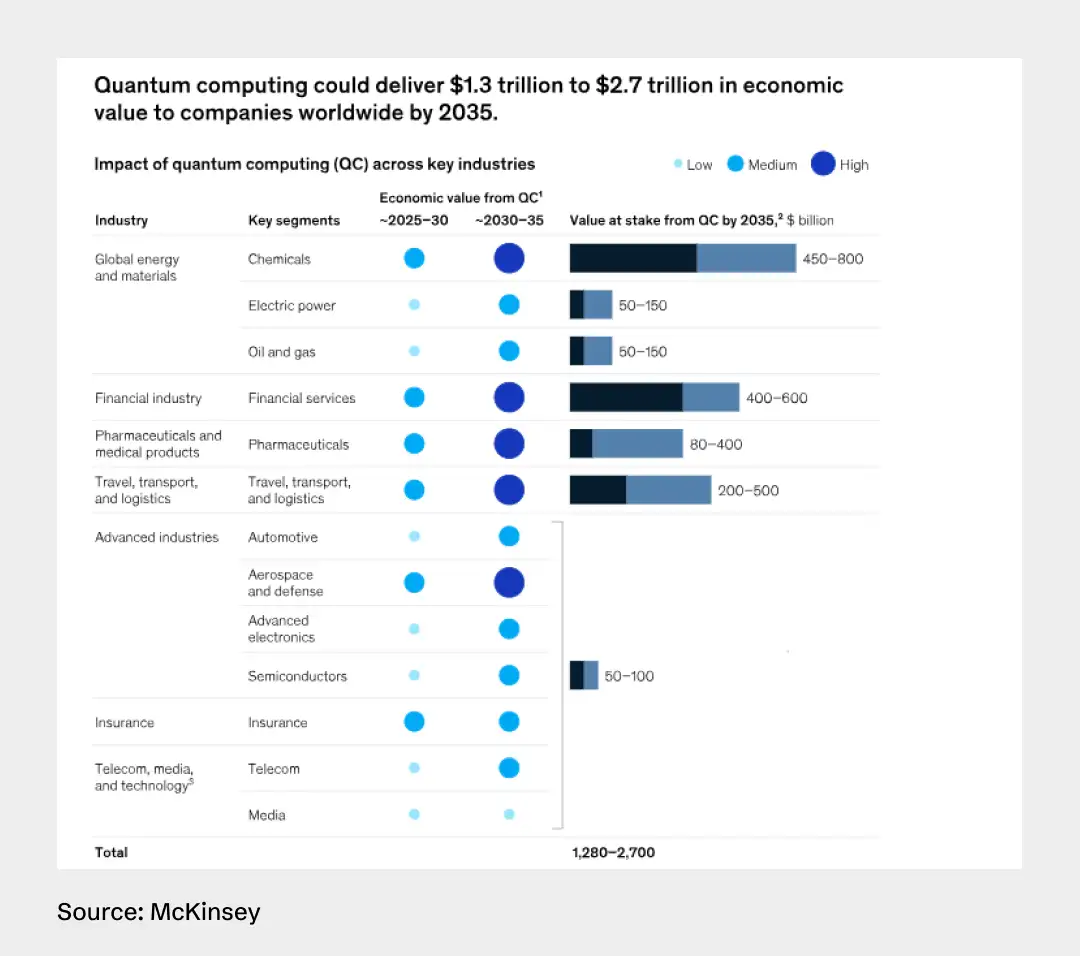
Two patterns stand out from the breakdown:
- The opportunity is concentrated. Chemicals ($450–$800B), financial services ($400–$600B), and travel and logistics ($200–$500B) account for the majority of the projected value.
- The bulk of value lands in 2030–35, not before. Most sectors show only modest economic impact in the early window and a sharp expansion in the second half of the decade.
That second pattern reflects the technology's central limitation. Today's quantum computers operate in the noisy intermediate-scale quantum (NISQ) era, with hundreds to a few thousand qubits, with error rates that limit them to short workloads.
The real economic upside arrives with fault-tolerance, when errors get corrected in real time. Some industries are extracting value from NISQ-era hardware now, while many others are still waiting.

8 Quantum Computing Cases Across Industries
Quantum computing is finding traction in industries where general computing strains against the math itself. Much like AI use cases, quantum is showing up in narrow but high-value pockets, and the list keeps widening.
Here is a list of existing and potential use cases of quantum computing technology-
1. Drug discovery and pharmaceuticals
Pharmaceutical companies use quantum computing to simulate how potential drug molecules interact with proteins in the body. The simulations help researchers screen compounds faster and predict how a drug will behave before any of it is synthesized in a lab.
These programs aren't producing approved drugs yet. They're building the algorithmic and methodological foundation pharma will need when fault-tolerant hardware arrives.
Who's running it:
- IBM + Cleveland Clinic: Discovery Accelerator partnership for biomarker discovery and disease modeling.
- AstraZeneca + IonQ + AWS: Reported as the largest quantum-accelerated electronic structure simulation in a commercial pharmaceutical setting.
2. Materials science and battery design
Materials science draws on the same quantum-mechanical math as drug discovery, applied to a different problem set: better batteries, more efficient solar cells, lighter alloys, industrial catalysts. The molecules involved are smaller than pharmaceutical compounds, but the same exponential complexity makes simulation expensive.
These quantum computing services are currently research-stage applications. The hardware can simulate small molecules but not the industrial-scale chemistry that would justify replacing older methods. The collaborations exist to build expertise that will be deployable when the hardware scales.
Who's running it:
- Mercedes-Benz Group + IBM Quantum: battery cathode material simulations as part of EV development.
- ExxonMobil + IBM Quantum: research on carbon capture chemistry and hydrogen production.
3. Finance and risk modeling
Banks and asset managers use quantum computing to model risk, price complex financial instruments, and optimize investment portfolios. These are problems where the number of possible outcomes is so large that most computers struggle to evaluate them in a usable time window.
Production-scale quantum advantage in finance hasn't been demonstrated yet. What banks are doing is preparing, building the algorithmic talent and infrastructure they'll need once fault-tolerant hardware makes the math tractable.
Who's running it:
- JPMorgan Chase: one of the largest in-house quantum research programs in financial services, with published work on quantum streaming algorithms, deep hedging, and option pricing.
- HSBC + IBM Quantum: partnerships on cybersecurity, fraud detection, and natural language workflows.
4. Cybersecurity and post-quantum cryptography
A future quantum computer could be powerful enough to break the encryption protecting today's internet, the systems behind online banking, messaging apps, and digital identity. The hardware does not exist yet, but attackers are already collecting encrypted data, counting on being able to decrypt it once the hardware arrives.
The defense is post-quantum cryptography (PQC), a new encryption designed to resist quantum attacks. In August 2024, the U.S. National Institute of Standards and Technology (NIST) published the first three official PQC standards, with a fourth following soon after.
Unlike most use cases of quantum computing, this one is being deployed at scale right now, and the deployments aren't pilot programs; they are already in the production stage.
Who's deploying it:
- U.S. federal agencies: mandated to migrate to PQC.
- Apple: deployed PQC for iMessage.
- Google: rolled it into Chrome and TLS.
- Cloudflare: uses PQC on a portion of TLS connections it terminates.
5. Logistics and routing optimization
Logistics companies use quantum computing solutions to optimize how goods move across networks, finding the best routes for trucks, planes, and ships, scheduling deliveries, and balancing inventory across warehouses. These problems get harder as networks grow, and computers run out of time before they find the best answer.
Who's running it:
- Volkswagen + D-Wave: one of the earliest real-world demonstrations, a quantum-optimized public transit routing system in Lisbon.
- ExxonMobil + IBM Quantum: maritime shipping route optimization.
6. Energy grids and climate modeling
Primary quantum computing uses in the utilities and climate research industry can be classified for two different problems. Power grids need to balance solar, wind, batteries, and demand in real time across millions of nodes. Climate models need to simulate atmospheric and ocean systems at scales that push hardware to its limits.
These programs are exploratory. Climate models are far beyond what current quantum hardware can handle. The expectation isn't that quantum computing applications will replace climate modeling, but that it could accelerate specific subroutines once it scales.
Who's running it:
- Iberdrola + Multiverse Computing: grid optimization research at the Spanish utility.
- E.ON + IBM Quantum: similar work at the German energy company.
7. Manufacturing
Use cases for quantum computing in the manufacturing industry primarily include predicting equipment failures, scheduling production lines, and designing supply chains that can absorb disruption. Older methods handle most of these problems well, but quantum approaches are being tested for the harder edge cases, the ones where small errors compound at scale.
Manufacturing optimization is a competitive field where most methods, recently improved by AI, are highly mature. Quantum engineering will need to demonstrate a clear advantage on production-relevant problems before it displaces them.
Who's running it:
- Bosch + Multiverse Computing: digital twins of industrial production lines that simulate failure modes and predict maintenance needs.
- BMW Group: quantum computing challenge with industry partners covering production planning and material handling problems.
8. Machine learning and AI
Researchers are testing quantum computing as an accelerator for specific parts of machine learning workflows, pattern recognition, sampling, and certain optimization steps that computers handle slowly. Leading AI development companies are already exploring where quantum methods fit in, not to replace AI, but to speed up the operations where quantum could give an edge.
The goal isn't to replace AI, but to speed up the operations where quantum methods could give an edge.
Who's running it:
- IBM Qiskit Machine Learning: an open-source library for hybrid quantum-classical experiments.
- IonQ + Hyundai: quantum image recognition trained on road signs as part of autonomous driving research.
Frequently Asked Questions
What is the meaning of quantum computing?
Quantum computing is a type of computing that uses the principles of quantum mechanics to process information faster and more efficiently than classical computers. Instead of using bits (0s and 1s), it uses qubits, which can represent both 0 and 1 simultaneously, enabling it to solve complex problems that traditional computers struggle with.
Which industries can harness the benefits of quantum computing?
Pharma, finance, materials science, and cybersecurity have the most active quantum programs today. Pharma uses it for molecular simulation, finance for risk modeling, materials science for designing new compounds, and cybersecurity for migrating to post-quantum encryption.
What is the most practical quantum computing use case today?
Post-quantum cryptography (PQC). Apple, Google, Cloudflare, and U.S. federal agencies have already deployed it at scale. No other quantum computing use case is in production at the same level.
Can quantum computers break encryption?
Not yet. A future quantum computer could theoretically break the encryption that protects today's internet, but the hardware to do it doesn't exist. Attackers are already collecting encrypted data now in case they can decrypt it later, which is why post-quantum cryptography is being deployed today.
When will quantum computing be commercially viable for most applications?
Most major hardware roadmaps target fault-tolerant quantum systems near the end of the decade. Useful pilot applications already run on today's hardware, but a broad commercial impact depends on fault-tolerance.
How is quantum computing different from classical computing?
Classical computers store data as bits, 0 or 1. quantum computers use qubits, which can represent both states at once through a property called superposition. That lets them evaluate many possibilities in parallel, which makes them faster than classical machines for a specific kind of problem.

Uncover executable insights, extensive research, and expert opinions in one place.
Related Content