- 1. The Great Decoupling: Downloads Stall, Revenue Explodes
- 2. The "App-ocalypse" Reversal: Non-Gaming Eclipses Gaming
- 3. The Engagement Economy: Time Is the New Currency
- 4. The Globalization of Competition
- 5. AI as the Core OS, Not Just a Feature
- 6. Generative AI for Hyper-Creative Optimization
- 7. True Hyper-Personalization at Scale
- 8. Conversational AI as the New UX
- 9. Predictive Churn Modeling (The "Next Best Experience")
- 10. AI-Powered App Store Optimization (ASO)
- 11. The Dominance of the Subscription Model
- 12. The Creator Economy as a Primary UA Channel
- 13. The Rise of In-App Retail Media Networks (RMNs)
- 14. The Hybrid-Casual Gaming Model
- 15. Cross-Platform User Acquisition Goes Mainstream
- 16. Social Commerce: The Feed Is the New Storefront
- 17. Livestream Shopping Integration
- 18. The Super-App & Mini-Program Ecosystem
- 19. FinTech as the "Ultimate Super App"
- 20. Voice Search & "Audio-First" Apps
- 21. Wearable Tech & Ambient Computing
- 22. Data Privacy as a Marketing Feature
- 23. Gamification as a Core Retention Engine
- 24. The Technical Imperative: Performance is Marketing
- 25. Composable Architecture for Marketing Agility
- 26. In-App Advertising Trends (IAA) Became the New Prime-Time TV
 Share It On:
 The market is mutating—this is your actionable guide to the 26 data-backed mobile app marketing trends for 2026 you must master to pivot from dead installs to the $150B revenue boom.
Global app downloads have flatlined—falling 1% year-over-year—yet in-app purchase revenue has exploded to $150 billion, a 12.5% surge that rewrote the rules of growth. The message is unmistakable: the era of “more installs = more success” is over. The future of mobile app marketing trends in 2026 lies not in chasing installs, but in mastering monetization, engagement, and AI-powered precision.
In 2026, app marketing isn’t evolving—it’s mutating. Non-gaming apps have officially overtaken gaming in global consumer spend, AI is now the invisible operating system behind every winning campaign, and generative creativity is redefining how teams test, iterate, and convert. Meanwhile, subscription-driven ecosystems and creator-powered user acquisition are setting new standards for retention and lifetime value.
What follows isn’t another buzzword compilation influencing the modern app marketing strategies. It’s a data-backed playbook for the next frontier of app marketing—where competition is borderless, engagement is currency, and intelligence (outthinking, not outspending) is the ultimate growth engine.
Latest Mobile App Marketing Trends for 2026
Here’s your guide to the evolving world of app marketing!
1. The Great Decoupling: Downloads Stall, Revenue Explodes
The old math is broken. For a decade, the core mobile app growth strategy before 2026 was simple: more downloads = more revenue. That correlation is now dead. The Sensor Tower report reveals that new app downloads are stagnant, falling -1.0% year-over-year.
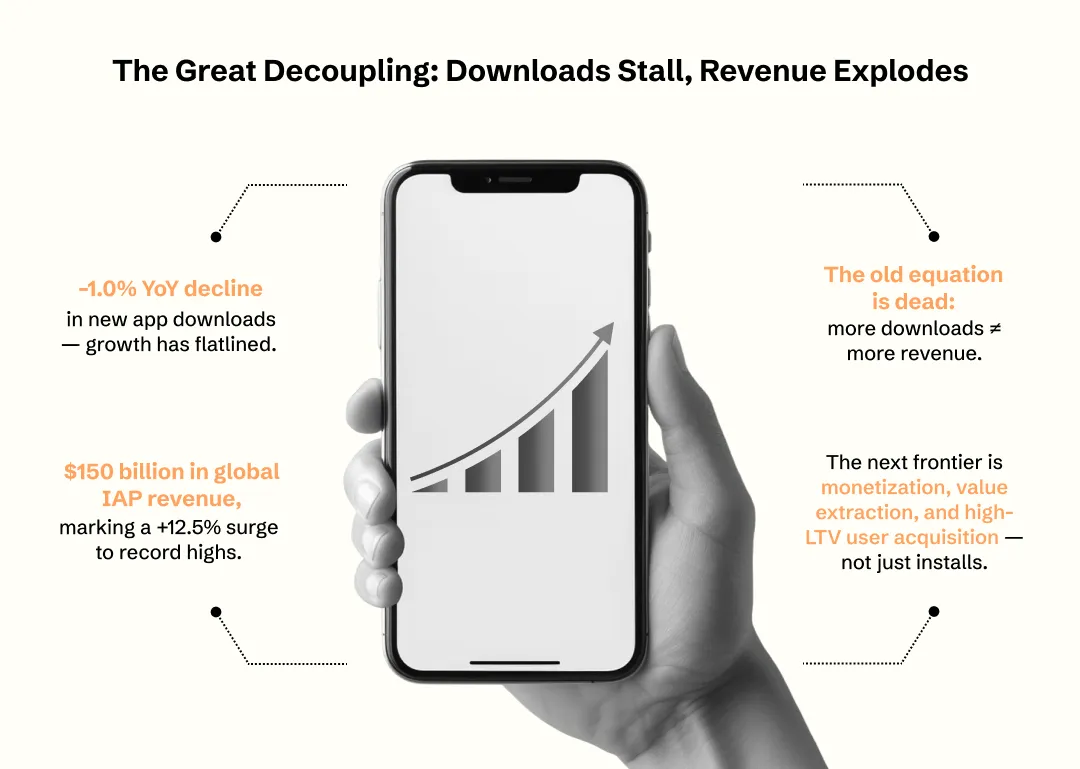
Yet, global in-app purchase (IAP) revenue soared to a record $150 billion, a staggering +12.5% jump. The future of app marketing is therefore not in acquisition. It's in monetization, value extraction, and mastering the strategies to boost app downloads from high-LTV users, not just any user.
2. The "App-ocalypse" Reversal: Non-Gaming Eclipses Gaming
The second shockwave from that $150 billion figure is where the money is coming from. While mobile gaming revenue saw a mild +4% YoY rebound, the non-gaming sector was a rocket ship. The Sensor Tower report highlights that non-game revenue growth accelerated to a blistering +25% year-over-year.
This culminated in a historic milestone in Q2 2026: for the first time ever, consumer spending on non-gaming apps officially surpassed spending on mobile games. This is a fundamental inversion of the app economy, driven by the subscription model.
3. The Engagement Economy: Time Is the New Currency
Downloads are flat, but usage is not. Global total hours spent in apps climbed to a staggering 4.2 trillion in 2024. Users are consolidating their time—and money—into a smaller portfolio of high-value apps. This signals a profound shift from a war for installs to a war for engagement.
4. The Globalization of Competition
The concept of a "local" app market is evaporating. The Sensor Tower report explicitly calls out that "competition spans across regions." The most potent example is in retail, where Chinese-backed e-tailers like Temu and SHEIN have completely rewritten the rules of app user acquisition strategies in the US and European markets.
This means your competition is no longer the app in the next zip code; it's a global entity with a massive war chest, forcing domestic app marketing companies to rethink their entire approach.

5. AI as the Core OS, Not Just a Feature
Forget "AI is coming." It’s here. It's no longer an "innovation"—it's the base-level operating system for any competitive app. The GVR data clearly shows the meaning of: "AI is everywhere on mobile." Its report says, by 2030, the AI in marketing industry will be over $82.23 billion.
This isn't just about chatbots; it's a fundamental re-architecting of the entire app stack, from AI in-app personalization to the very AI prompts that define the user experience.
6. Generative AI for Hyper-Creative Optimization
This is one of the most practical generative AI use cases. Teams are now using generative AI to produce and A/B test thousands of ad creatives, video scripts, and onboarding flows, achieving a level of creative optimization and content acceleration that was manually impossible.
This is a core part of the new AI in marketing playbook. As Statista suggests, by 2024, generative AI was used by almost 88% of the tech industry with business operations and marketing departments being the core users of the tech.
7. True Hyper-Personalization at Scale
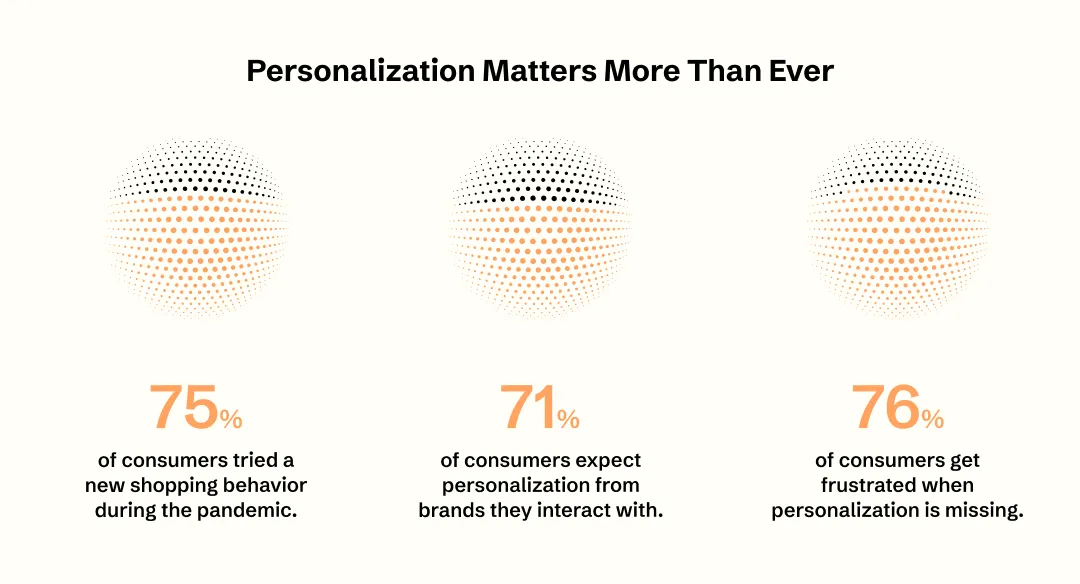
We're finally moving past the gimmick of [First_Name]. True personalization, powered by machine learning, is about anticipating user needs. A 2024 McKinsey & Company report found that companies excelling at personalization generate 40% more revenue from those activities. This is the goal of AI in mobile apps: to create a "segment of one."
8. Conversational AI as the New UX
The conversational AI market is exploding, with a Grand View Research report projecting its 2024 value at $11.58 billion and forecasting a 23.7% CAGR. Users now expect to talk to their apps. This is powering AI in customer service, where advanced chatbots and virtual assistants handle complex queries, freeing up human agents.
9. Predictive Churn Modeling (The "Next Best Experience")
This is one of the most valuable AI use cases. Why wait for a user to leave? A meticulous McKinsey analysis (October 2026) on "next best experience" models found they can slash merchant attrition (churn) by up to 20 percent per year. These AI in customer retention models predict who is at risk of churning and proactively trigger an intervention—a discount, a tutorial, or a support message.
10. AI-Powered App Store Optimization (ASO)
The app marketing channels themselves are getting smarter. Marketers are now using open source AI agents and proprietary tools to analyze keyword trends, predict competitor ASO moves, and even generate optimized screenshots and descriptions. This moves ASO from a reactive guessing game to a predictive science.
11. The Dominance of the Subscription Model
The 25% surge in non-game revenue is being carried almost entirely by the subscription economy. This isn't just a consumer trend; it's an enterprise earthquake. The market has decisively shifted from one-time purchases to recurring revenue.
New 2024-2026 market analysis from Grand View Research confirms this, finding that the B2B (Business-to-Business) segment dominated the subscription economy in 2024, accounting for the largest revenue share at 55.2%.
This fundamentally shifts the cost to market an app, as the entire industry—led by enterprise SaaS—moves from a one-time purchase to maximizing long-term lifetime value (LTV).
12. The Creator Economy as a Primary UA Channel
App user acquisition strategies are undergoing a fundamental, human-centric shift. Budget is migrating from faceless ad networks to authentic, trusted voices. The creator economy is no longer a niche tactic; it's a primary marketing channel. Data from Market Research Future values the global influencer marketing industry at $71.64 billion in 2024, projecting it to soar to beyond $929 billion in 2034.
This isn't just about paying for a shout-out. The next-gen app user acquisition model is about borrowing the parasocial trust that creators have painstakingly built. This trust is now a measurable asset, though it's complex. A 2026 "Influencer Trust Index" from BBB National Programs found that while 74% of consumers trust influencer advertising (5% "completely" and 69% "somewhat"), this trust is fragile and highly dependent on transparency.
Crucially, this trust converts. A March 2024 survey from Insider Intelligence (eMarketer) found that 39.4% of US social media users had made a purchase from a creator or influencer-founded brand in the past 12 months. This is why brands choose a marketing agency with a deep creator network.
- Beyond Installs: This is also a powerful tool for app user retention. Brands are using creator partnerships to produce exclusive in-app content, host live events, and build communities, giving users a compelling reason to return.
- Strategic Alignment: The most successful strategies to boost app downloads now involve finding creators whose audience is the app's ideal user profile. This is surgical, targeted, and far more efficient than broad, demographic-based ad buys.
13. The Rise of In-App Retail Media Networks (RMNs)
This is a massive shift. As first-party data becomes king, apps are the new ad networks. This trend is moving billions in ad spend away from traditional channels and directly into the apps where purchases occur. While Amazon dominates the RMN space, in-app platforms are seeing explosive growth.
A prime example is Instacart. According to new data from Statista (2026), Instacart reported $958 million in advertising and "other" revenue for the full year 2024. This is a significant jump from the $871 million reported in 2023, representing a 10% annual growth rate.
This revenue is generated almost entirely by its Instacart Ads platform, which allows CPG brands to purchase "premium placement" (i.e., sponsored search results and promotions) directly within the app, turning their own platform into a high-margin media channel.
14. The Hybrid-Casual Gaming Model
In the mobile app market trends for gaming, the line is blurring. Purely ad-based "hyper-casual" games, which were vulnerable to privacy changes, are evolving. The new "hybrid-casual" model combines simple, accessible gameplay with deeper, mid-core monetization mechanics like in-app purchases (IAP) and battle passes.
This is a direct response to the need for more sustainable, LTV-driven revenue streams. The success of this shift is stunning. According to the Sensor Tower "State of Mobile Gaming 2026" report, while the overall casual games category saw the largest absolute revenue gain, the hybrid-casual subgenre surged by 37% in IAP revenue year-over-year in 2024.
This model is proving to be the new, optimized strategy, blending the mass-market scale of hyper-casual with the superior monetization of mid-core.
15. Cross-Platform User Acquisition Goes Mainstream
Cross-platform user acquisition apps are no longer a luxury. With the rise of "super-apps" and fragmented ecosystems, a user's journey is chaotic. The "second screen" is now the primary screen. A 2024 analysis from Insider Intelligence (eMarketer) found that a staggering 88% of US internet users use a second device (like a mobile phone) while watching TV.
This behavior has forced a strategic shift. A successful next-gen app user acquisition strategy must now connect the dots between that web visit, a smart TV ad, and the eventual in-app conversion.
Marketers are pouring billions into this new channel specifically to drive mobile action. Insider Intelligence forecasts that US Connected TV (CTV) ad spending remained at $31.77 billion in 2024 and is projected to surge to $43.59 billion by 2026.
This massive spend requires sophisticated mobile app marketing tools to de-duplicate and attribute value from a CTV ad view to a later app install.
16. Social Commerce: The Feed Is the New Storefront
This is no longer a sub-trend of m-commerce. It's the apex predator. Grand View Research (2026) valued the global social commerce market at $1.16 trillion in 2024, projecting it to skyrocket at a blistering 36.4% CAGR.
eMarketer (2024) forecasts U.S. social commerce sales will surpass $100 billion in 2026. This collapses the sales funnel, making AI in social media recommendation engines the most powerful sales clerks on the planet.
17. Livestream Shopping Integration
A key driver of social commerce is livestreaming. This isn't just QVC on a phone; it's an interactive, community-based sales event. This model masterfully combines entertainment (the "shoppertainment" factor), social proof (seeing others buy in real-time), and FOMO (fear of missing out) to create an intense, urgent purchase funnel.
The scale of this trend, once dominated by Asia, has now fully arrived in the West. Analysis from Statista (May 2026) noted that US livestream shopping had already hit approximately $50 billion in 2023. More importantly, it is projected to surge to $68 billion by 2026, at which point it is expected to account for more than 5% of all US e-commerce sales.
This has created an arms race for app developers. The data proves that this format is unmatched for converting impulse into revenue, with some events reporting conversion rates up to 10x higher than traditional e-commerce.
As a result, apps—from fashion and beauty to electronics and retail—are scrambling to integrate native "live" features. They are no longer just content platforms; they are becoming interactive broadcast studios to capture this high-engagement, high-conversion revenue stream.
18. The Super-App & Mini-Program Ecosystem
The very definition of a "mobile app" is being challenged. A Straits Research report (2024) valued the global super-apps market at $95.83 billion in 2024, projecting it to rocket to over $838 billion by 2033.
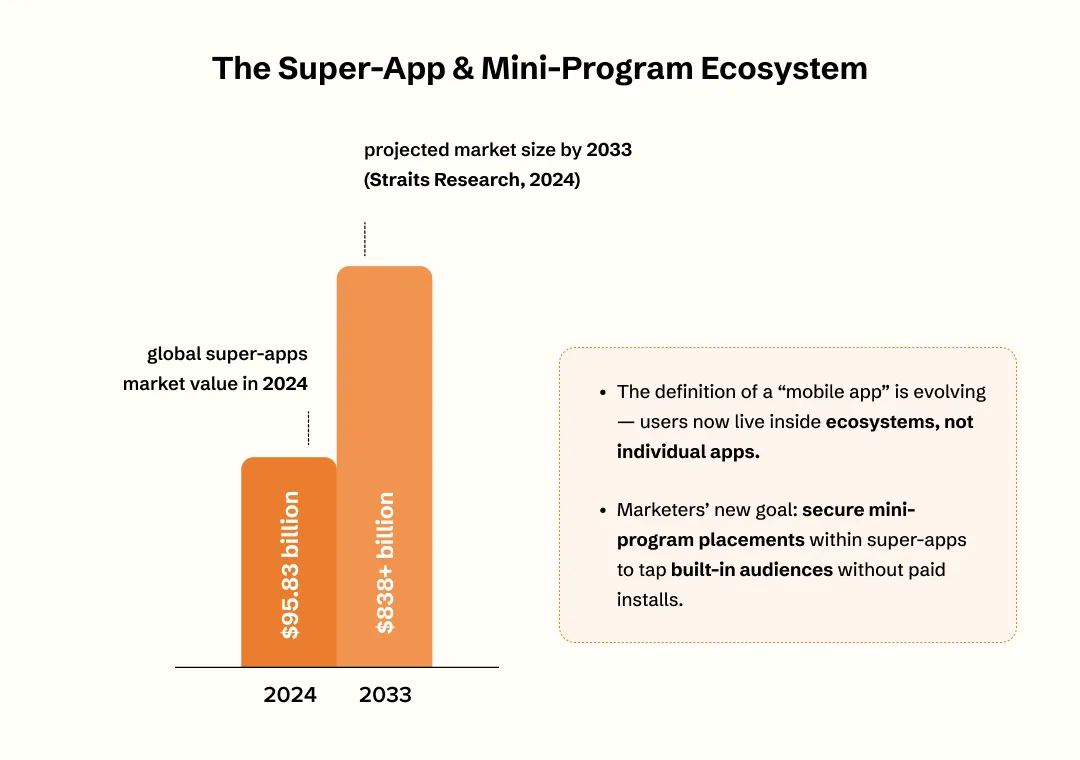
For marketers, the goal shifts from acquiring an install to securing a "mini-program" presence within a larger ecosystem, a core strategy to promote your app for free to a built-in audience.
19. FinTech as the "Ultimate Super App"
A powerful niche of the super-app trend is in FinTech. Apps that start with payments (like PayPal or Block) are aggressively expanding to become all-in-one financial hubs, integrating investing, crypto, tax services, and shopping. This is one of the key trends in mobile marketing: own the wallet, own the customer.

20. Voice Search & "Audio-First" Apps
The very concept of the interface was disappearing. The ascendance of voice assistants and "hearables" (like AirPods) forged a new, lucrative market for audio-first interactions. This wasn't a niche trend. A 2026 "Voice Search Trends" report from GWI (GlobalWebIndex) confirmed this massive shift, showing that between 2020 and 2024, monthly usage of Google Assistant had surged by 46% (with Siri close behind at 40%).
The real story for app marketers was the commercial intent of this audience. The GWI report revealed that voice assistant users were 51% more likely to have ordered a meal through a delivery app in the past week. This proved that app discovery and functionality optimization for voice commands—not just taps—had become a critical, high-revenue priority.
21. Wearable Tech & Ambient Computing
The app was unbundling from the phone. This was no longer a theoretical trend; it was a major market shift confirmed by 2024 and 2026 data. While the mature smartwatch market (like basic watches) had slowed, as noted by firms like Counterpoint Research in its 2024 analysis, the value of the wearable market continued to climb, driven by advanced, high-tech experiences.
The real story was the explosive growth in next-generation devices. The AR/VR headset market, according to Precedence Research, had already hit $12.46 billion in 2024 and is projected to clear $261.92 billion by 2034.
Even more dramatically, IDC (TelecomLead) reported that global shipments of AR/VR and smart glasses were set for a 39.2% surge in 2026. This created a new design imperative: a "glanceable" UI/UX for smart rings and glasses, forcing developers to integrate with the "in-person" experiences Sensor Tower had highlighted as a key growth area.
22. Data Privacy as a Marketing Feature
In the post-privacy-pocalypse, trust became the new currency. This trend, which started years ago, solidified into a core business imperative by 2026. The smartest digital marketing companies realized that privacy was no longer a legal hurdle but a primary marketing feature.
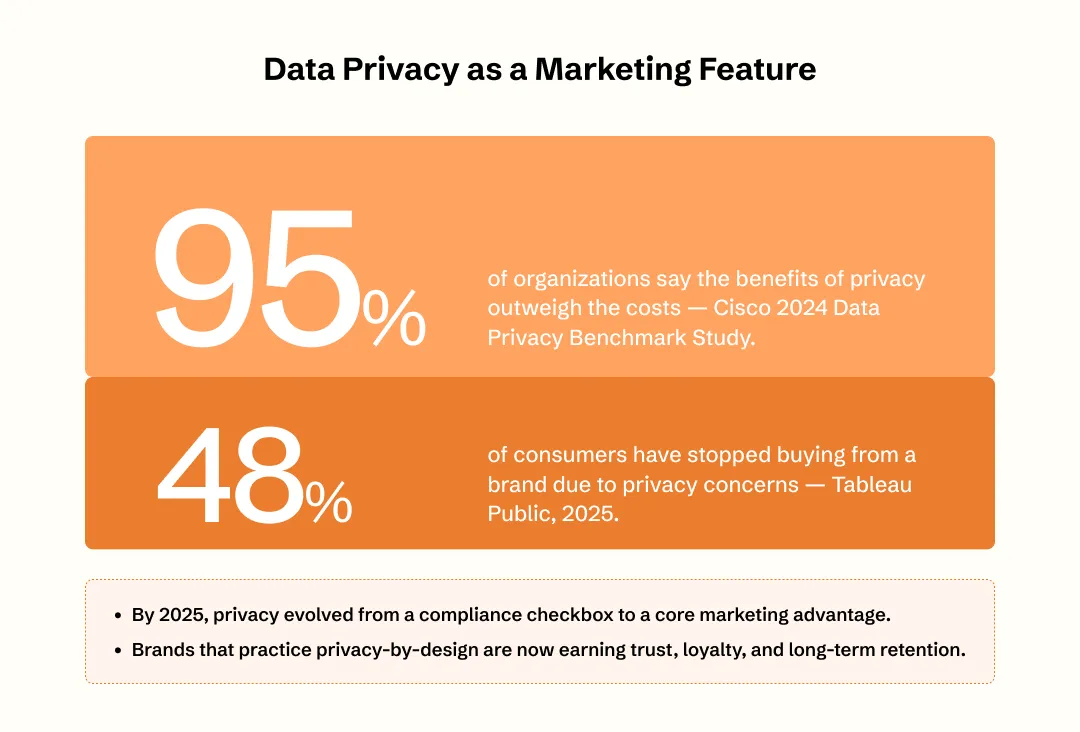
The financial incentive to do so was made crystal clear. The Cisco 2024 Data Privacy Benchmark Study confirmed that organizations were finally seeing a massive return on their privacy investments, with 95% of respondents stating that the benefits of privacy (like building trust and loyalty) outweighed the costs.
This was a direct response to consumer behavior. A 2026 "Data Privacy Statistics" report from Tableau Public (which aggregated 2024/2026 data) revealed a critical action point: 48% of consumers had actively stopped buying from a company or using a service specifically due to privacy concerns. This proved that privacy-by-design was no longer optional; it was a powerful competitive advantage to prevent churn.
23. Gamification as a Core Retention Engine
AI in gamification is no longer a gimmick; it's a core psychological framework for driving app user retention. Mordor Intelligence projects the global gamification market is set to grow to $92.51 billion by 2030. Why? Because it works.
The reason for this explosive investment was its proven, massive ROI. The foundational case study from Autodesk (analyzed by Yu-kai Chou) was a perfect example: by gamifying its 3ds Max software trial, Autodesk saw a 54% increase in trial usage and, most critically, a 15% increase in "buy clicks" (conversions).
This was where the benefits of AI became tangible. AI in marketing could personalize these game mechanics to prevent the churn that came from boredom or frustration.
24. The Technical Imperative: Performance is Marketing
This was a critical, non-negotiable trend that solidified in 2024-2026. All the slick AI in marketing in the world proved useless if the app was slow. Error rates, bounce rates, and app performance were no longer just an engineering problem; they were, unequivocally, core marketing KPIs. A high churn rate was rarely a failure of the marketing message, but a failure of the product's promise.
The financial stakes were staggering. Foundational research from Google had confirmed that 53% of mobile users abandoned a page if it took longer than 3 seconds to load.
The sensitivity was even more granular. A joint study by Deloitte and Google titled "Milliseconds Make Millions" proved that even a 0.1-second improvement in mobile site speed could boost retail conversions by 8.4% and increase the average order value by 9.2%. This was the "great filter" of app retention.
A 2024 benchmark report from OneSignal (a primary mobile engagement platform) confirmed the brutal reality: the average 30-day retention rate for mobile apps was just 7.88%, meaning an average churn rate of over 92%.
25. Composable Architecture for Marketing Agility
This was the "how" behind many of the most successful trends. To keep up with the breakneck pace of app marketing innovations in 2026, marketing and development teams abandoned monolithic app structures. A "composable" approach, championed by Gartner, involved building apps from interchangeable, best-in-class components (like AI APIs, headless CMS, and AI website builders for landing pages).
This was not a niche developer trend; it was a core business strategy. The MACH Alliance's "Global Research 2024" report provided concrete proof of its financial impact: 85% of IT leaders who had adopted a composable (MACH) approach reported "clear evidence" of achieving increased ROI.
The market itself reflected this mass adoption. A 2026 report from Precedence Research valued the global composable applications market at $6.44 billion in 2024. This investment was driven by one primary factor: speed.
This composable model was what allowed teams to add new features—like a conversational AI bot or an Automatic Lexicon Induction-powered search—in days, not months, creating a massive competitive advantage.
26. In-App Advertising Trends (IAA) Became the New Prime-Time TV
This was the trend that tied everything together. As users consolidated their 4.2 trillion hours inside a smaller set of apps (Trend 3) and privacy regulations made tracking outside of apps a minefield (Trend 2), ad budgets had no choice but to follow the audience. The "walled garden" of the app became the new, premium advertising real estate.
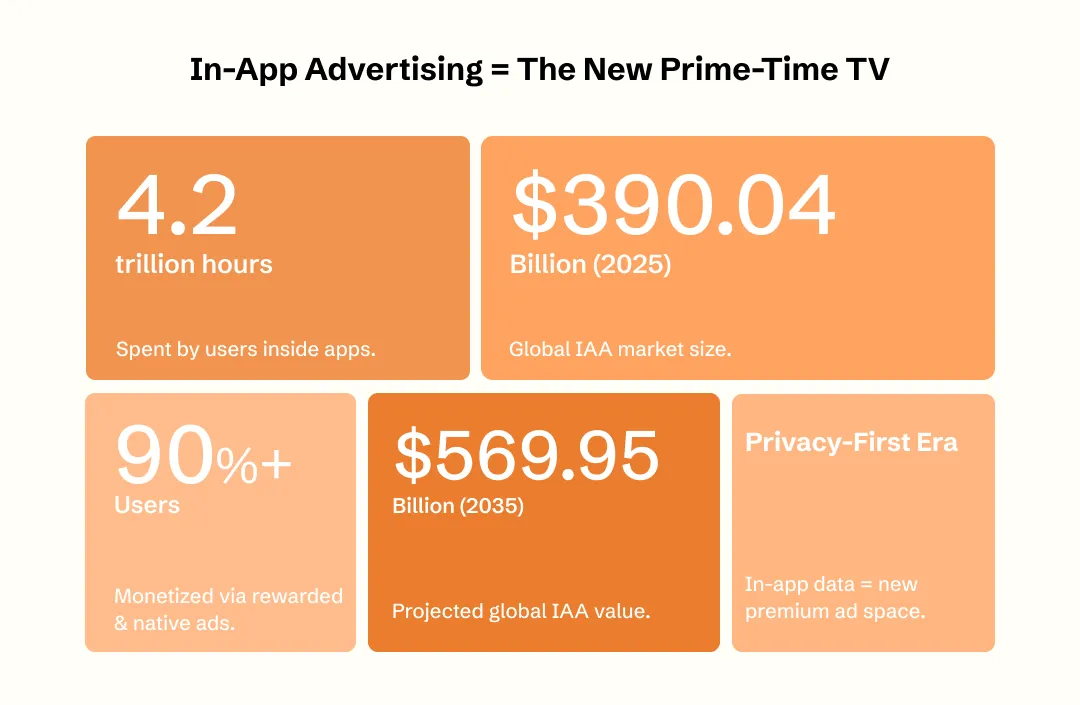
The in-app advertising trends were no longer just a "mobile strategy"; they became the central digital ad strategy. Statista's "In-App Advertising - Worldwide" outlook had quantified this stampede, showing the market had already hit approx $390.04 billion in 2026 and is projected to swell to $569.95 billion by 2026.
For app marketing professionals, this meant a massive shift in tactics. The focus moved to monetizing the 90%+ of users who would never subscribe, using sophisticated rewarded video and native ad placements. In the privacy-first world, the high-intent, contextual data inside an app's walls was the most valuable ad inventory on the market, effectively replacing the old third-party cookie.
To Conclude
These 26 trends aren't a buffet. You don't get to pick and choose. They are the interconnected components of a new machine.
Your composable architecture lets you deploy the generative AI that personalizes the experience. That personalization is what justifies the subscription model, which in turn pays for the creator partnerships that acquire high-LTV users. It all works together.
The market isn't just changing; it has changed. The $150 billion in revenue wasn't an anomaly; it was the new standard, rewarding those who mastered retention over acquisition. The age of brute-force marketing is dead. Welcome to the age of intelligent, technical marketing. Outthink, don't outspend.
Frequently Asked Questions
What's the single biggest app marketing trend I need to care about in 2026?
It's the "Great Decoupling." The game isn't about getting installs anymore—that metric is flat. The real action is in revenue, which exploded to $150B. The most important mobile app marketing trends for 2026 are all about getting more LTV from the users you already have, not just chasing new ones.
Is marketing a mobile app just about getting downloads anymore?
No, and that's a fatal mistake. Marketing a mobile app used to be a land grab for installs. Now? It's a battle for LTV. Your app's technical speed (a 3-second delay kills conversions) and your privacy policy are now core marketing features. It's a totally different ballgame.
What are the best app user acquisition strategies that actually work?
The old paid ad model is too expensive and inefficient. The best app user acquisition strategies now are built on trust. That means partnering with creators who have a real audience. It also means mastering cross-platform attribution, like proving a CTV ad (on a smart TV) led to an install on a phone.
What does the future of app marketing actually mean?
In one word: predictive. The future of app marketing isn't just reacting. It's using AI to know a user is at risk of churning before they do, then automatically sending them a personalized offer to keep them. It's also using generative AI to create thousands of ad variations, so you're not guessing what message works.
I'm not a gamer. What mobile app market trends matter for my business?
The biggest of all mobile app market trends for you is the "App-ocalypse" Reversal. For the first time ever (in Q2 2025), non-gaming apps—like yours—officially surpassed gaming in consumer spending. The subscription model is now the undisputed king, proving that users will pay for high-value services, not just in-game items.
Why are my app's downloads flat but I'm hearing revenue is up?
This is the "Great Decoupling." The market is mature. Users are done hoarding apps; they're now consolidating their time (all 4.2 trillion hours) and their money into a smaller list of apps they truly love. That $150B in revenue isn't from new users. It's from existing, loyal users paying for subscriptions and in-app value.
Are privacy rules killing app marketing?
They're not killing it, they're remaking it. Privacy rules killed the old way of tracking users across different apps. This is why trends in mobile marketing are all shifting "on-platform." In-app advertising ($390B+ market) and in-app retail media networks are exploding because the data is first-party and stays in one trusted, walled garden.
What's a hybrid-casual game and why should I care?
Hybrid-casual is the new, dominant model in mobile gaming. It's a genius move: it takes the simple, super-accessible gameplay of an old hyper-casual game but adds deeper monetization, like in-app purchases or battle passes. It’s a direct response to privacy changes (which hurt ad-only models), and its IAP revenue surged 37% in 2024 because it works.
Why is my dev team's "load speed" a marketing problem?
Because technical performance is your new conversion optimization. All the clever marketing in the world is useless if your app fails the "3-second rule." With a brutal 92% average 30-day churn rate, a slow or buggy app is the biggest, leakiest hole in your entire marketing funnel. Foundational Google data shows 53% of users will abandon a page that takes longer than 3 seconds to load. Speed is the new marketing KPI.
What's a super-app and does it change how I market my own app?
A super-app is an all-in-one application that bundles services like messaging, payments, and shopping. This trend, already a $95 billion market, fundamentally changes marketing a mobile app. Your goal is no longer to get an install.
Your new goal is to get your app included as a "mini-program" inside the super-app's ecosystem. It's a B2B partnership strategy, not a B2C download play.
How will Generative AI concretely change app marketing?
Generative AI is already revolutionizing app marketing in two key areas. First, creative optimization and content acceleration; teams can now test thousands of ad creatives, copy variations, and immersive ad formats mobile apps in minutes, not weeks. Second, it's the engine behind next-gen conversational AI and chatbots, making AI in customer service and in-app assistance predictive and human-like, directly addressing high-value Generative AI use cases.
How can I market an app with new privacy rules limiting tracking?
Your strategy must pivot from individual tracking to cohort analysis and first-party data.
- Invest in-app analytics to understand how groups of users behave.
- Build trust by offering a clear value exchange to encourage users to share data voluntarily.
- Master SKAN 4.0 and its postback models to get directional attribution data.
- Leverage contextual advertising (targeting based on the app's content, not user history). Many now rely on App Marketing Strategies from specialized agencies for this.

Uncover executable insights, extensive research, and expert opinions in one place.
Related Content