
FaceCheck.ID Review: Who It's For and Who Should Skip It?
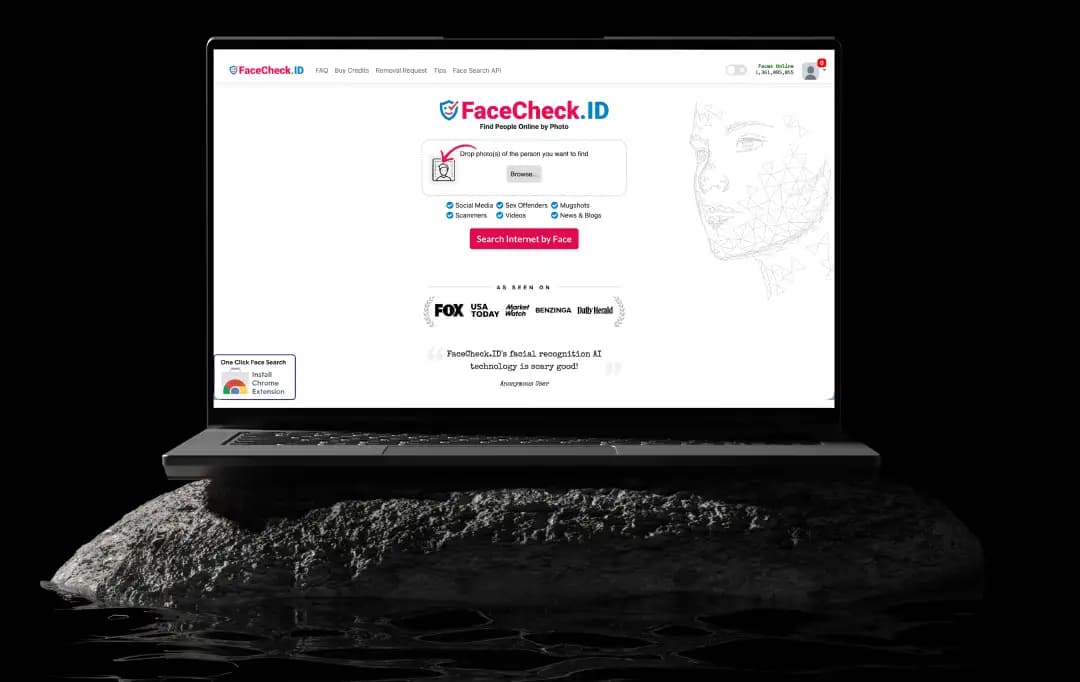
FaceCheck.ID is a reverse face search engine that does one thing well: you upload a photo of a person, and it shows you where else that face appears online, from social profiles and news articles to blogs and mugshot databases. You can think of it as Google reverse image search, except it's built specifically for faces.
Between 40,000 and 50,000 people use it every month, and most of them are online daters checking profiles, OSINT researchers, journalists confirming sources, or parents vetting strangers their kids are talking to. Sounds pretty standard, right? Here's where it gets different: the payment page asks for Bitcoin. FaceCheck stopped accepting credit cards in late 2024, and now it runs on crypto only.
So we put it through a controlled test, clear photos, low-light shots, side angles, masked faces, and even AI-generated ones, to find out where it actually delivers and where it falls apart. This FaceCheck.ID review highlights the results that surprised us in both directions. So, here’s what we found.
Pros and Cons of FaceCheck.ID
Pros
- Face-specific index pulls results that Google reverse image search misses entirely
- Strong performance on clear, front-facing photos with good lighting
- Match certainty scores (Certain, Confident, Uncertain, Weak) help calibrate trust in each result
- Red flag system surfaces matches against mugshots, sex offender registries, and scam profiles
- Each match links directly to its source, so verification is straightforward
- Free tier returns blurred previews and confidence scores before you commit credits
- Public API available for businesses integrating face search into their own workflows
- Users can request the removal of their own face from the index, which most face search tools don't offer
Cons
- Cryptocurrency-only payments (Bitcoin, Litecoin) create real friction for most users
- Not an identity verification tool, using it for compliance or KYC is a category mistake
- Accuracy drops sharply on low-light, side-angle, or partially obscured images
A Closer Look at FaceCheck.ID Features
FaceCheck.ID strips the feature list down to what a face search engine actually needs to do, and most of what's here is built around one job: finding a face and helping you decide whether to trust the match. Here are the Face Check ID features that stood out during our research-
1. AI-Powered Facial Recognition Across a Billion-Image Index
Face Check ID runs uploaded photos against an index it claims holds over a billion faces, scraped from publicly available web sources, social profiles, news sites, blogs, forums, and registry databases.
The matching itself is built on deep learning models that compare facial landmarks rather than pixel similarity. This is the reason why it can still surface matches across changes in lighting, angle, age, or hairstyle.
2. Match Certainty Levels for Every Result
Every match comes with a confidence score on a four-tier scale: Certain Match (90–100), Confident Match (83–89), Uncertain Match (70–82), and Weak Match (50–69).
This is the most useful feature on the platform, because facial recognition without calibration is just guessing. The platform’s scoring tells you exactly how seriously to take each result before clicking through.
3. Red Flag Alerts on High-Risk Matches
When an uploaded face matches images tied to mugshots, sex offender registries, scam profiles, adult content, or known catfishing patterns, FaceCheck.ID flags it. It also raises a flag if the uploaded image itself looks AI-generated.
For online daters and parents vetting strangers, this is the feature doing the heaviest lifting, though it's also the one that demands the most caution before acting on a result.
4. Direct Source Links on Every Match
Every result links straight to the page where the matching image lives, which means verification doesn't end inside FaceCheck.ID. You can open the source, check context, confirm the match independently, and move on. Most face search tools either hide sources or charge extra to reveal them. FaceCheck keeps this front-and-center, even on the free tier.
5. Continuous Monitoring with Telegram Alerts
On paid tiers, Face Check.ID can run the same face search automatically on a recurring basis and push new matches to your Telegram. This is built for OSINT researchers, journalists tracking a person of interest, or anyone who needs ongoing visibility rather than a one-shot check. It quietly turns the tool from a search engine into a monitoring system.
6. Public API for Custom Integrations
Businesses and developers can plug FaceCheck.ID into their own applications through a paid API, with credit usage billed separately from the consumer-facing tool. Real-world use sits mostly with OSINT platforms, fraud-detection workflows, and dating app safety layers, not with KYC or identity verification, which the API is not built for and shouldn't be used for.
Bonus Read: Best Authenticator Apps
Who is FaceCheck.ID For?
The original positioning of Face Check.ID as a tool for financial institutions and remote work verification misses what it actually does. This is a face search engine, not an identity verification system, and the people getting real value from it are using it for a much narrower set of jobs.
| Otter AI limitation | Why it becomes a problem | Alternative to consider |
|---|---|---|
| Free plan feels restrictive / meeting limits run out quickly | Frequent meetings can eat through minutes fast, especially for heavy users | Fathom |
| Summaries still need cleanup after meetings | If you spend time rewriting AI summaries anyway, structured meeting reports can feel more useful | Sembly AI |
| Visible meeting bot feels intrusive in calls | Some teams dislike a “note taker bot” joining sensitive or client-facing meetings. Bot-free options remove that friction | Jamie |
| Weak speaker separation in chaotic meetings | Multi-speaker conversations and overlapping voices can make transcripts messy | Fireflies.ai |
| Need stronger multilingual transcription | If your meetings involve global teams or multiple languages, broader language support matters. | Notta |
| Hard to revisit exact meeting moments | Sometimes you don’t need the whole transcript, you just need that one moment someone said something important | tl;dv |
| Pricing feels expensive for solo users | If you mainly need notes + summaries without enterprise complexity, better free value exists | Fathom |
| Too much background noise affects transcript quality | Audio quality can directly affect transcript accuracy during noisy calls | Krisp |
| Need better collaboration around meeting notes | Teams that turn meetings into tasks, agendas, and follow-ups may want stronger workflows | Fellow |
| Want cleaner highlights and searchable moments from calls | If you review interviews, customer calls, or demos, clipped highlights are easier to revisit than raw transcripts | Grain |
| Need more automation and meeting analytics | Teams wanting insights, automation, and searchable meeting intelligence often outgrow basic transcripts | MeetGeek |
Also Read: Best Parental Control Apps
Who FaceCheck.ID Is Not For?
This is where most businesses get into trouble. FaceCheckID AI facial recognition tool is not an identity verification platform, and treating it like one creates real compliance risk. Here’s a list of use cases for FaceCheck.ID should not be used for-
| User Type / Industry Type | Description |
|---|---|
| Financial institutions running KYC | FaceCheck.ID does not verify that a person is who they claim to be against a government-issued ID. KYC requires regulated biometric identity verification, which this is not |
| HR teams running employee background checks | Using public face search results to make hiring decisions opens up discrimination liability in most jurisdictions |
| Remote work identity verification | There are purpose-built tools for this. A reverse face search is not one of them |
| Law enforcement as a primary identification tool | Match certainty scores are not court-admissible evidence, and the company explicitly positions the tool for personal safety use, not investigative authority. |
| Anyone under jurisdictions that restrict facial recognition | Parts of the EU, Illinois (BIPA), and several other regions place legal restrictions on biometric processing and FaceCheck Id puts the legal responsibility entirely on the user. |
Understanding FaceCheck.ID Pricing
As of 2026, FaceCheck ID’s payment page accepts Bitcoin, Litecoin, and a handful of other major cryptocurrencies, and nothing else.
There is no monthly subscription. There is no annual plan. Everything is sold as a credit package, and credits are spent per search at a rate of three credits per query.
Unused credits expire on a fixed timeline that varies by package, which means stockpiling for occasional use is not the cost-saver it might look like.
Here’s an overview of FaceCheck ID pricing-
| Credit Package | Credits | Expiry | Approximate Cost (in BTC equivalent) |
|---|---|---|---|
| Rookie Sleuth | 150 | 14 days | $19 |
| Private Eye | 400 | 2 months | $47 |
| Deep Investigator | 2,000 | 6 months | $197 |
| Professional | 10,000 | 1 year | $597 |
*With higher tiers, you can unlock Telegram alerts, priority queue access, continuous recurring searches, and PDF and Excel exports
How To Use FaceCheck.ID?
Facecheck.ID is powered by advanced facial recognition technology to make the process of verification seamless and reliable. So, here’s how you can use FaceCheck ID to navigate the digital environment safely.
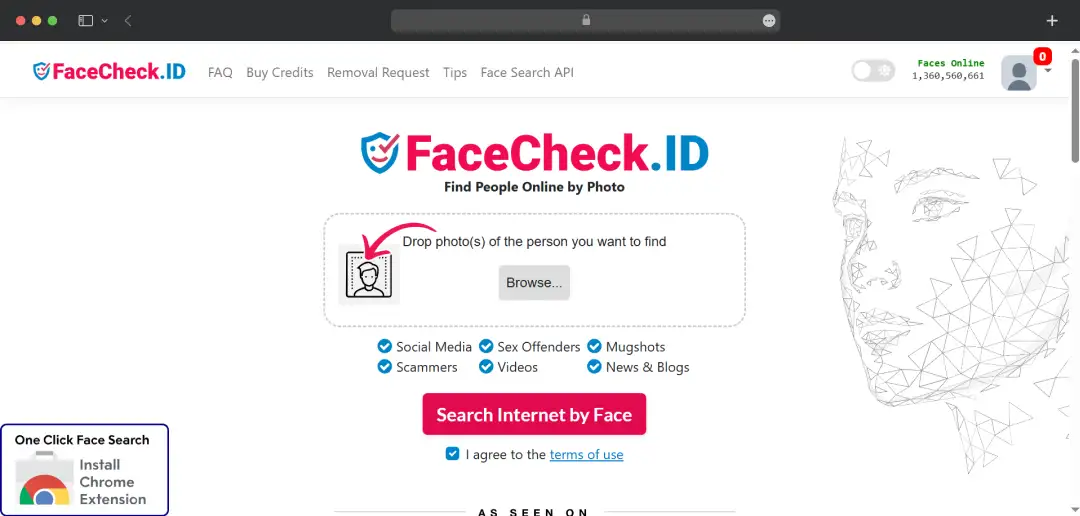
Step 1
Open Facecheck ID on your smartphone or computer. Locate the search box on the screen to drop the photos.
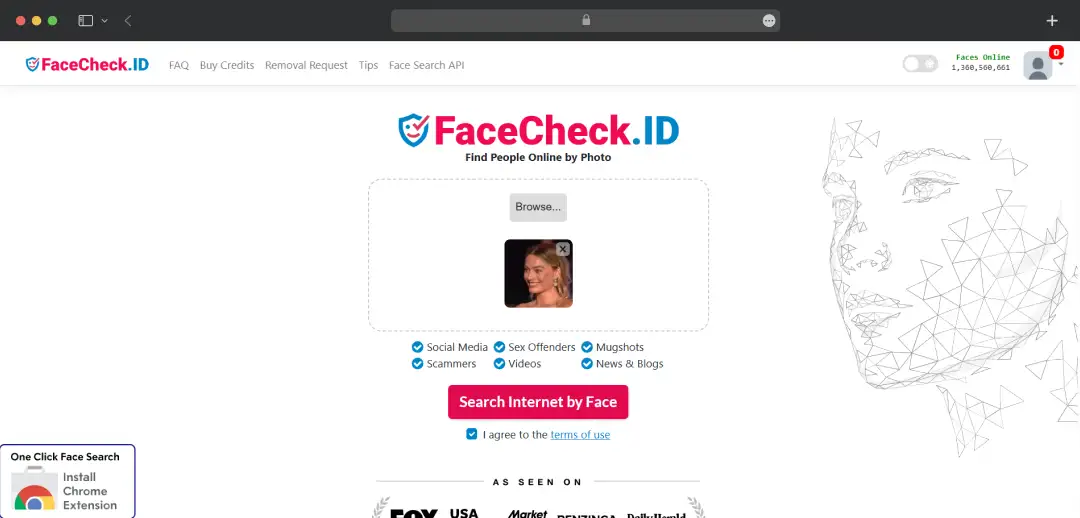
Step 2
Next, upload the photo from your device and ensure that it is in high resolution to ensure the best results.
Step 3
Click "Search the Internet by Face," accept the terms of use, and wait for the scan to complete. The tool will return a results page showing blurred previews, confidence scores, and the number of matches found.
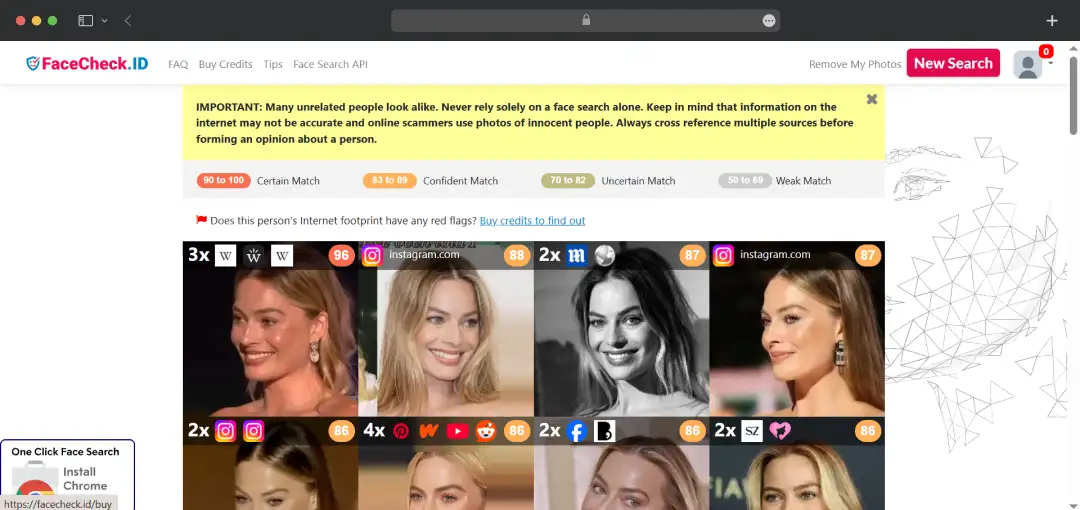
*To unlock the full images and source links, you'll need to spend credits, and at this point, if you haven't bought any, the tool will route you through the cryptocurrency payment flow.
Every search result on FaceCheck.ID comes with a similarity score ranging from 50 to 100, so you're never left guessing how confident the match is. Each result also shows the source platform, whether it's Instagram, Facebook, Pinterest, or Wikipedia, along with how many times that face appeared on that source.
Customer Reviews
How was your experience with the product?