- 1- Generative AI and Hyper-Personalization.
- 2- 6G Readiness
- 3 - Augmented Reality (AR) & Virtual Reality (VR)
- 4 - AIoT-Powered Intelligent Mobile Eco System
- 5 - Blockchain Decentralization and Security
- 6- Progressive Web Apps (PWAs)
- 7 - Voice and Conversational Interfaces
- 8- Domination of Mobile Commerce (m-Commerce)
- 9 - Foldable Devices Optimization
- 10 - Low-Code/No-Code Development
- 11- Mobile Applications Built in the Cloud
- 12- Predictive Analytics and Big Data
- 13 - mHealth and Telemedicine Development
- 14 - Improved Mobile App Protection (DevSecOps)
- 15- Brain-Computer Interfaces (BCI)
 Share It On:
 Retention, not downloads, now defines app success. Here are the 15 app development trends that will separate market leaders from laggards in 2026 and beyond.
Mobile market projected to grow fivefold by 2030 (Statista). But how do you become special in an overpopulated ecosystem?
The solution is to create mobile applications with the newest trends, such as GenAI, 5G infrastructure, and predictive personalization. This will lead to increased downloads, engagement with the users, and better business revenue.
In this blog, we'll look at the top mobile app development trends of 2026 and how these advances might be used to meet and exceed client expectations.
So, if you're an enterprise or a startup owner, this guide will help you with the right knowledge to stay competitive in the future.
Latest Mobile App Development Trends of 2026
Mobile app environments are becoming less feature-intensive and more intelligence-driven. By 2026, downloads will no longer be used to tell the success story, but retention, predictive functionality, and immersive utility. Let’s discuss the key mobile applications development trends in 2026 here:
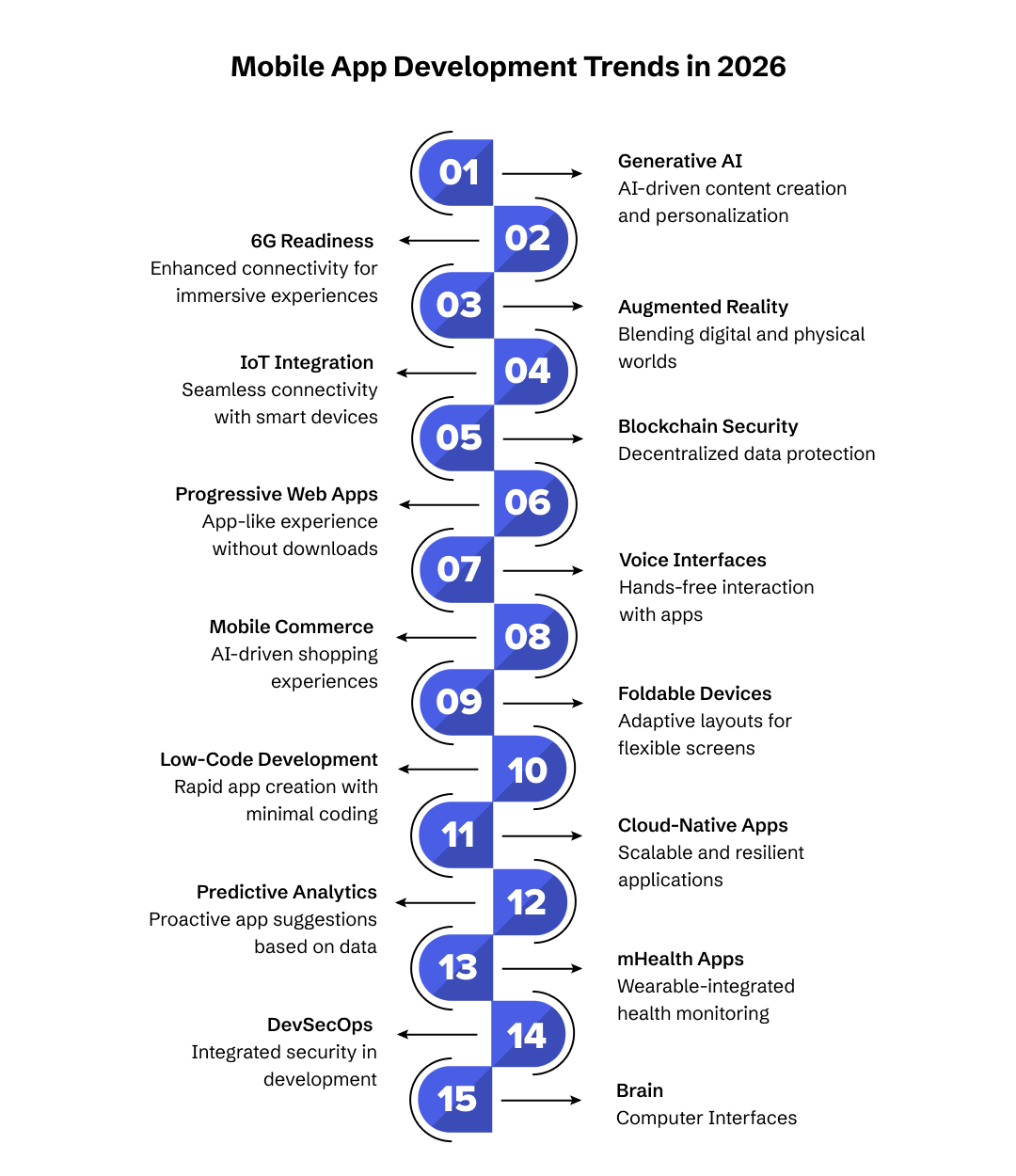
1- Generative AI and Hyper-Personalization.
Gradually, AI is becoming the driving force of mobile apps. Folks who didn’t adopt Generative AI earlier will be using it to generate content, predict user intent in real-time and provide hyper-personalized interfaces that adapt to user behavior.
The world market of generative AI is expected to hit about $55.5 billion in 2026 and $1005.07 billion by 2034. This clearly shows that in the future, users will compulsorily want apps to compose emails, build itineraries, and write code solutions automatically. Moreover, applications that do not have generative-powered features will be outdated.
For example, apps can have generative engines like Gemini, which acts as a conversational answer engine that cites sources in real-time, effectively replacing traditional search browsers on mobile.
2- 6G Readiness
As 6G networks emerge, they are unlocking features far beyond current consoles, such as holographic communication and real-time extended reality (XR). The 6G market is projected to reach $110.46 billion. Guessing what this means in the future?
This bandwidth will enable developers to push hard work to the cloud, which reduces the size of apps (small and downloadable) and makes them infinitely powerful. Further, this enables mid-range devices to run high-fidelity simulations and data-heavy applications without a hitch.
Consequently, app development companies in the USA, India, the UK, the Netherlands, or in other corners of the world will prioritize feature richness and user experience over storage constraints. This will open the door for a new wave of immersive, latency-free mobile platforms.
3 - Augmented Reality (AR) & Virtual Reality (VR)
Augmented Reality is boosting engagement in apps developed for manufacturing, gaming, retail, and more. Additionally, innovations presented by Apple Vision Pro and Quest by Meta are compelling mobile creators to develop a spatial experience.
Therefore, by 2026, mobile VR will offer spatial utility, using cloud streaming to render photorealistic virtual retail and immersive training environments on standard smartphones without the need for heavy local processing. Reports suggest that the market size of AR and VR will reach close to $1980 billion by 2035.
Moreover, AR-powered apps will continue to fill the existing gap between digital convenience and physical reality. It also significantly reduces return rates for retailers by offering tangible confidence in purchasing decisions.
Beyond e-commerce, this spatial computing revolution allows brands to create deeply immersive storytelling experiences that static screens simply cannot replicate. For example, IKEA Kreativ scans your actual room, deletes your existing furniture using AI, and lets you place new 3D furniture to see exactly how it fits.

4 - AIoT-Powered Intelligent Mobile Eco System
Mobile applications are turning into the remote controls through which you can easily plan your life. These apps not only perfectly fit with smart homes, smart wearables, smart cars, smart appliances, but also think for them.
By 2031, the world Artificial Intelligence of Things (AIoT) market is set to amount to about $81.04 billion, expanding to include an ecosystem of connected devices.
Therefore, mobile apps will increasingly be integrated with AIoT to help end users maintain a frictionless lifestyle where their environment adjusts automatically to their preferences without manual input. This cements the app's role as an indispensable daily utility.
For instance, SamsungSmartThings uses AI Energy Mode to monitor appliance usage patterns and automatically adjust settings to lower your electricity bill.
5 - Blockchain Decentralization and Security
The global market of blockchain technology is projected to increase to more than $393 billion in 2030. Hence, the adoption of blockchain technology in mobile security layers will continue to be in full swing in 2026 and even beyond.
As data privacy laws (GDPR, CCPA) become stricter, decentralized identity applications that allow users to have control over their data will have an enormous competitive edge. This shift not only mitigates the risk of catastrophic data breaches but also empowers users with true ownership of their digital footprint.
For example, World App uses a World ID to prove you are a human and not a bot online, without revealing your actual identity or personal data.
6- Progressive Web Apps (PWAs)
Progressive Web Apps provide an app-like experience with a Web Browser without the friction of downloading an app store. It is growing extremely popular, and hence, the PWAs market is expected to directly increase to about $7.6 million by 2026.
For startups and e-commerce brands, the PWAs will continue to provide quicker time-to-market and reduced development time. Also, PWAs democratize access, helping businesses to reach users in low-bandwidth regions or those with limited device storage who might otherwise abandon a heavy native download.
Furthermore, the unified codebase significantly slashes maintenance costs, enabling companies to push updates instantly across all platforms without waiting for app store approvals. For example, Starbucks PWA allows customers to browse the menu, customize orders, and add items to their cart even when offline, syncing instantly once connectivity returns.
7 - Voice and Conversational Interfaces
The voice and speech recognition market is expected to expand to more than $123 billion in 2034, and there will be a significant increase in mobile integration in 2026.
That’s because today, interaction is powered through voice search and voice command integration at a hands-free convenience. This matters because screen fatigue sets in. "Zero UI" (user interfaces that don't require looking at a screen) will differentiate top-tier utility and navigation apps.
8- Domination of Mobile Commerce (m-Commerce)
The desktop-to-mobile shopping transition is virtually complete, yet the year 2026 will continue to work on social commerce and livestream shopping right within apps, like Whatnot, where sellers host live video auctions, to bid on and buy collectibles instantly during the stream. This popularity has led global mobile commerce to reach $2,416 billion in 2026.
Therefore, it’s no longer just about having a cart; it’s about frictionless checkout and AI-driven product recommendations. Functionalities such as one-tap checkout and integrated video shopping can even convert passive scrollers to active customers in real time. Further, this can also lower cart abandonment rates and can instead capitalize on impulse shopping.
9 - Foldable Devices Optimization
Apps can no longer afford to assume screens are a rectangle, as the largest players such as Samsung and Google are redoubling their commitment to foldable technology. As per reports, in 2026, the shipment of foldable smartphones is expected to increase by an overwhelming 50 percent per annum.
Applications must now be capable of continuity, with the layout automatically changing as the device transforms from a tablet to a phone. This is where you have the opportunity to present a dual-experience application, i.e., an application that responds to quick, cover-screen interactions, and an all-work, productivity-oriented workflow to the inner display.
10 - Low-Code/No-Code Development
Gradually, most applications will be developed using these low-code/ no-code technologies. This implies that businesses can roll out operational applications in weeks instead of months, bridging the gap between a good idea and a product.
The agility enables companies to validate market feasibility through Minimum Viable Products (MVPs) at a fraction of the cost and risk. It liberates your senior developers to deal with complicated architectural issues, as the marketing and sales team can develop the tools they require on their own, which fast-tracks the general business innovation.
11- Mobile Applications Built in the Cloud
Cloud-native architectures, which use microservices and containers, are becoming the default for ensuring scalability. The market of cloud-native technologies will be $57.69 billion in 2026. driven by the need for apps that can handle massive traffic spikes without crashing.
Also, mobile app development companies are doing heavy lifting off your hands and in the cloud, you can offer console-quality performance even on mid-range phones, giving you a much bigger potential user base.
Moreover, the architecture can lower operational costs because you only pay for the resources of the servers that you actually utilize, and this makes the architecture a more financially prudent way to scale.
12- Predictive Analytics and Big Data
Apps are becoming proactive. Therefore, most apps are beginning to have Netflix-like suggestions for your finances, insurance, and healthcare. The global predictive analytics market is forecast to reach approximately $28.1 billion by 2026.
This popularity of predictive analytics is powered by a data-driven solution that guarantees the user sees precisely what they require, such as a prescription refill or a customized workout, even before they have to request it.
This level of personalization is the only retention strategy that will work in the present market, where there are abundant options. You are making your app a proactive problem solver, which will turn the app into an essential part of your life, into a sticky ecosystem that the users do not want to abandon. For example, Cleo is an AI financial assistant that analyzes your spending habits to predict when you might overdraft and help you save money.
13 - mHealth and Telemedicine Development
2026 will witness the mHealth apps evolve into not a mere fitness tracker but a complete medical device. The market size of mHealth apps is set to exceed $154.12 billion by 2034, owing to the potential to link wearables to track patients outside the hospital.
The trend allows having a so-called hospital-at-home model where vitals can be sent safely over a watch to the dashboard of a doctor in real-time. To the healthcare providers, this minimizes the number of hospital readmissions and operational burden, whereas to the patient, it eases the mind and provides access to care immediately without the physical travel.

14 - Improved Mobile App Protection (DevSecOps)
In emerging trends in mobile app development, security is no longer an afterthought but an integral development process. That’s because apps deal with more sensitive financial and health information. DevSecOps means that security is not added in as an afterthought to the code.
The application security market is estimated to be $15.62 billion in 2026 due to the growing cyber threats and regulations. With an average data breach cost increasing exponentially, prevention is more affordable than recovery. In addition to that, showing strong security badges and privacy assurances creates untold confidence in users who are usually the critical determinant of customers favoring you over a competitor.
15- Brain-Computer Interfaces (BCI)
By 2030, mobile interaction will transcend physical touch, enabling users to scroll, select, and type using only thought via non-invasive Brain-Computer Interfaces (BCI). This BCI market is expected to grow at 14.1% from 2024 to 2029.
The technology promises a hands-free future where intent translates directly into action without muscle movement. It envisions an interface where users can draft text messages or adjust smart home lighting purely by focusing their attention, effectively removing the barrier between the human mind and digital devices.
Looking Ahead
The mobile app technology trends in 2026 are obvious: Mobile is becoming faster, smarter and immersive. The gap between market leaders and laggards is widening. Those who embrace Generative AI, Low-Code agility, and immersive augmented reality are expected to experience success early.
The future of app development presented in this guide provides a roadmap that should be followed by implementation. Do not attempt to follow all the trends simultaneously. Rather, find out which technologies address the greatest pain points of your users.
If you are using AI to reduce support tickets or PWAs to reach new markets, the goal remains the same: delivering undeniable value at the speed of thought.
Frequently Asked Questions
What is the future of mobile apps by 2026?
The trends for mobile app development are moving towards a non-utility but intelligence-first ecosystem. In 2026, hyper-personalization with the help of Generative AI, immersive Extended Reality through AR, and seamless cross-device connections through IoT will determine success. Applications will not simply respond to user requests anymore; they will be proactive and predictive with analytics.
Which mobile app technology trends will dominate in 2026?
The top mobile app technology trends in 2026 include:
- Generative AI: To develop dynamic content and interfaces that are personalized.
- 5G Readiness: The unlock of real-time 4K streaming and cloud-based gaming.
- DevSecOps: Adding security on the first line of code to fight the emergent cyber threats.
- Foldable UI: Designing layouts to suit the expanding foldable devices market.
How will AI impact mobile app industry trends?
The AI mobile app trend is shifting out of simple chatbots. Eventually, generative AI will help apps to write emails, code, and create itineraries in real-time. Hyper-personalization with AI will become an obligatory requirement, allowing the apps to interact with the interface and suggestions dynamically in response to individual user behavior.
What are the key iOS app development trends for 2026?
The major trends in the development of iOS apps are related to privacy and integration into the ecosystem. Spatial computing and AR experiences are becoming the focus of developers with Apple Vision Pro. Also, the on-device machine learning (Core ML) optimization to keep the user data confidential and provide AI functionality is becoming a crucial element of the iOS market.
Why are Low-Code/No-Code platforms becoming a major trend for mobile app development?
The emergence of Low-code/No-Code platforms is a trend in mobile app development since it democratizes innovation. It enables companies to deploy Minimum Viable Products (MVPs) in weeks, not months, which costs little and time-to-market is shorter.

Uncover executable insights, extensive research, and expert opinions in one place.
Related Content