Google Launches Speaking Practice Powered By AI
Date: May 03, 2024
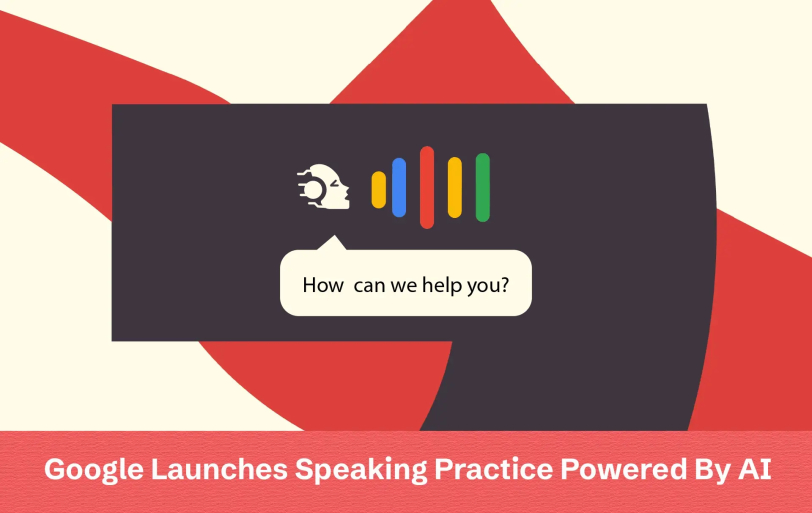
Google has introduced an AI-powered feature called Speaking Practice to aid English learners in select countries.
Google has been helping people find anything across the internet for over 25 years now. The platform has evolved over time from a basic search engine to a robust tech-offering giant. In recent updates, California-based Google launches Speaking practice feature to assist its users in honing their Engligh speaking abilities. The feature is powered by Google’s in-house AI engine to facilitate conversational prompts for comfortable practice sessions.
For now, the AI-powered feature is available to English learners in Argentina, Colombia, India, Indonesia, Mexico, and Venezuela. Google’s Speaking Practice feature is launched under the Google Search Labs Program, aimed at offering AI-driven interactive language exercises. To enable the feature, users must onboard themselves to the program. After enrolling to the programme, users can enable the feature from settings.
Google has clearly stated that the Speaking Practice is not a replacement for English learning and language courses. It is a support system for those who’ve learned something new in English language to find a comfortable practice partner. The AI tool conducts conversational English within Google search to help users familiarize themselves with the tool’s functionality.
By simulating real-life interactions, the AI system enables users to strengthen vocabulary, fluency, and conversational confidence. The AI is trained to create relevant natural conversational prompts like, ‘Whats Should I Do to get fit?’ to engage users. While the feature is still in QA testing phase, it can be a significant value addition to 4.9 billion users globally. Users will still require English speaking apps to learn language oriented knowledge.
Critics have already begun sharing their mixed opinion on Google’s latest AI offering. Majority of critiques are concerned about the efficacy of the Speaking Practice feature, whether it actually facilitates language learning or simply encourages dialog. Back in 2019, Google introduced the pronounciation tool which provided voice-based pronunciations for specific keywords.
The tool is extensively used during searches, but lacks many intricate details like slang and tone. The pronouncements are shared in robotic voices without much significance to real-world vocal usage. The Speaking Practice features looks like a build-up on the previous feature with major enhancement occurring from Artificial Intelligence. Whatever be the result, the new feature underscores Google’s commitment to eliminating language barriers and facilitating fluent English speaking.

By Arpit Dubey
Arpit is a dreamer, wanderer, and tech nerd who loves to jot down tech musings and updates. With a knack for crafting compelling narratives, Arpit has a sharp specialization in everything: from Predictive Analytics to Game Development, along with artificial intelligence (AI), Cloud Computing, IoT, and let’s not forget SaaS, healthcare, and more. Arpit crafts content that’s as strategic as it is compelling. With a Logician's mind, he is always chasing sunrises and tech advancements while secretly preparing for the robot uprising.
// Recommended
Pinterest Follows Amazon in Layoffs Trend, Shares Fall by 9%
AI-driven restructuring fuels Pinterest layoffs, mirroring Amazon’s strategy, as investors react sharply and question short-term growth and advertising momentum.

Clawdbot Rebrands to "Moltbot" After Anthropic Trademark Pressure: The Viral AI Agent That’s Selling Mac Minis
Clawdbot is now Moltbot. The open-source AI agent was renamed after Anthropic cited trademark concerns regarding its similarity to their Claude models.

Amazon Bungles 'Project Dawn' Layoff Launch With Premature Internal Email Leak
"Project Dawn" leaks trigger widespread panic as an accidental email leaves thousands of Amazon employees bracing for a corporate cull.

OpenAI Launches Prism, an AI-Native Workspace to Shake Up Scientific Research
Prism transforms the scientific workflow by automating LaTeX, citing literature, and turning raw research into publication-ready papers with GPT-5.2 precision.

Have newsworthy information in tech we can share with our community?

Related Content