Date: December 21, 2023
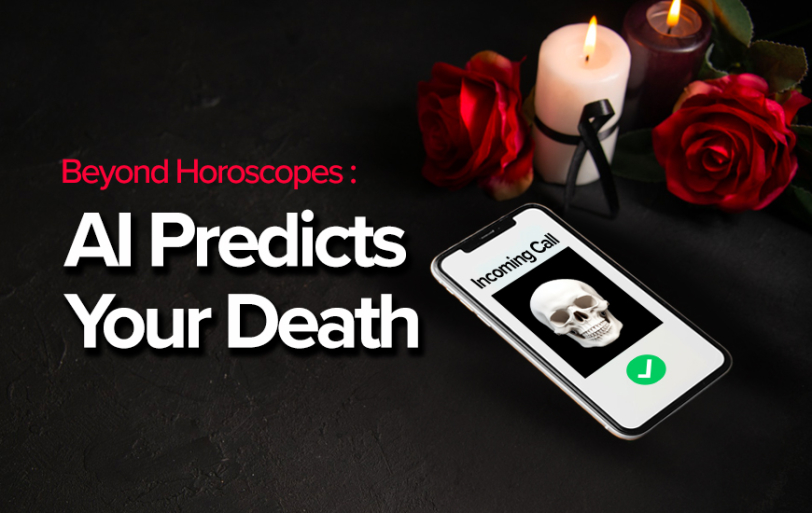
Life2Vec, an AI-powered death calculator, can predict a person’s death time with 78% accuracy. The tool is not publicly available but will be available soon.
Life is unpredictable, but knowing when you’ll die can be predicted now with 78% accuracy. The Technical University of Denmark has released an algorithm similar to ChatGPT to calculate when a person might die. The powerful AI tool is called life2sec and was developed by an industry veteran, Sune Lehmann.
We use the technology behind ChatGPT (something called transformer models) to analyze human lives by representing each person as the sequence of events that happens in their life.
- Sune Lehmann
The AI tool uses selected details of an individual’s life, including income, profession, residence, and health history, to predict a tentative death date and time with up to 78% accuracy. The research team behind the development of this tool believes that humans share a similarity with the language.
This model can predict almost anything.
- Lehmann
The research team also believes the AI death calculator can be used for many more tasks. Its capabilities can be used to predict people’s personalities, mass opinions, and decisions to analyze international movements. The purpose of this tool is not just to calculate death, as it is the initial step of the study. By discovering how and why people would die at a certain time, the tool can eliminate the sources of various causes, especially unnatural ones.
Lehmann’s troop examined nearly 6 million Danish people, who varied in age and sex. The lot was limited to an age bar between 2008 and 2020. The team at Life2Sec aimed to discover which of the study subjects would likely live past four years beyond January 1, 2016.
Based on the findings, the researchers assigned individual data points to a digital token. S52 represents forearm fracture, and working in a tobacco shop represents IND4726. These digital tokens accumulate an anomaly of why and how the person would have died. Using the information received, the tool almost perfectly predicted who had died by 2020, and it was successful more than three-quarters of the time. The death date and time are then used to predict future deaths of people.
Lehmann strictly declared that this tool would never be used to share death predictions with people. He also emphasized that none of the research study participants were told their death prediction time. The development of this powerful AI tool can result in an innovation in healthcare, suggest better lifestyle changes, and influence international public behavior.
By Arpit Dubey
Arpit is a dreamer, wanderer, and tech nerd who loves to jot down tech musings and updates. With a knack for crafting compelling narratives, Arpit has a sharp specialization in everything: from Predictive Analytics to Game Development, along with artificial intelligence (AI), Cloud Computing, IoT, and let’s not forget SaaS, healthcare, and more. Arpit crafts content that’s as strategic as it is compelling. With a Logician's mind, he is always chasing sunrises and tech advancements while secretly preparing for the robot uprising.
Pinterest Follows Amazon in Layoffs Trend, Shares Fall by 9%
AI-driven restructuring fuels Pinterest layoffs, mirroring Amazon’s strategy, as investors react sharply and question short-term growth and advertising momentum.
Clawdbot Rebrands to "Moltbot" After Anthropic Trademark Pressure: The Viral AI Agent That’s Selling Mac Minis
Clawdbot is now Moltbot. The open-source AI agent was renamed after Anthropic cited trademark concerns regarding its similarity to their Claude models.
Amazon Bungles 'Project Dawn' Layoff Launch With Premature Internal Email Leak
"Project Dawn" leaks trigger widespread panic as an accidental email leaves thousands of Amazon employees bracing for a corporate cull.
OpenAI Launches Prism, an AI-Native Workspace to Shake Up Scientific Research
Prism transforms the scientific workflow by automating LaTeX, citing literature, and turning raw research into publication-ready papers with GPT-5.2 precision.