Odoo Review: The ERP That Claims to Do Everything, Does It?
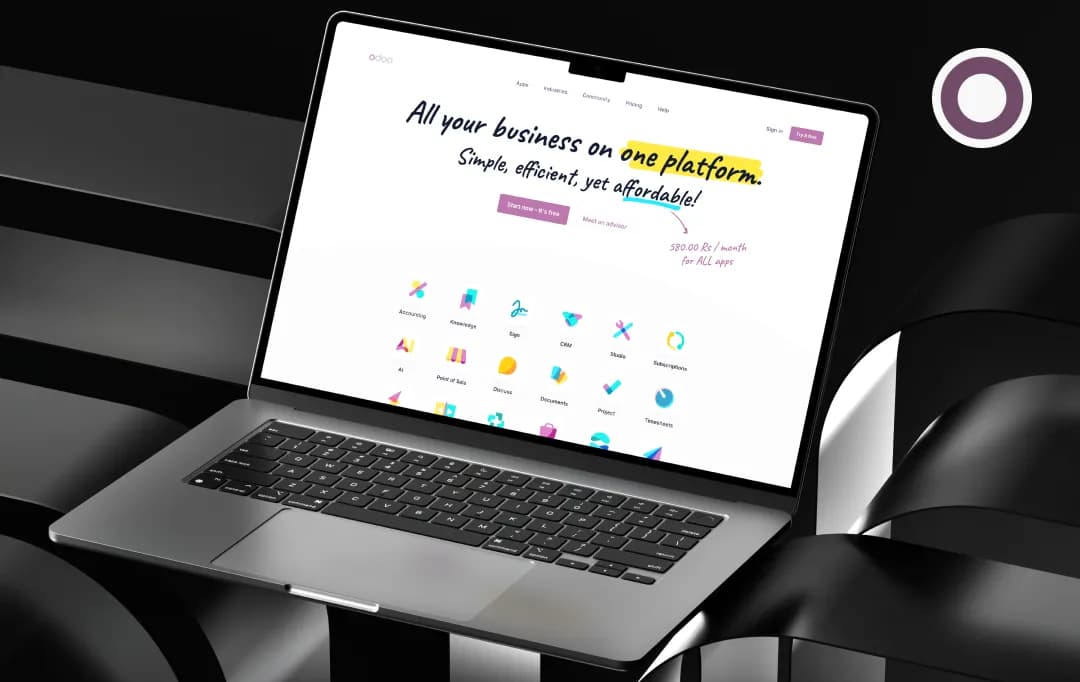
Running a business usually means juggling a different app for every function: one for sales, another for inventory, a third for accounting, and something entirely separate for HR. At some point, the stack becomes the problem. That is exactly the gap Odoo set out to close.
Odoo is an open-source business management software that brings CRM, accounting, inventory management, project tracking, manufacturing, and dozens of other functions under one roof. It has built a reputation as one of the best ERP software options for small businesses that need enterprise-level capability without enterprise-level pricing.
But Odoo software reviews paint a nuanced picture, enthusiastic users alongside frustrated ones, genuine praise for flexibility alongside consistent complaints about support and implementation complexity. So what is the honest answer?
I spent time going through Odoo's modules, its pricing structure, real user feedback across, and what the platform actually delivers day to day. This Odoo ERP review covers everything: features, pricing, usability, alternatives, and the verdict on whether it deserves a place in your business.
Pros and Cons of Odoo
Pros
- Modular architecture lets you activate only what you need, from Odoo accounting to manufacturing, without paying for the rest
- One of the most affordable full-suite ERP options available, the Standard plan covers all apps for a flat per-user fee
- Open-source codebase backed by a 100,000+ developer community and 40,000+ community apps in the marketplace
- Genuinely strong Odoo inventory management with real-time stock tracking, multi-warehouse support, barcode scanning, and lot tracing
- Native AI built across all apps for automation, smart suggestions, and reduced manual data entry
- No vendor lock-in, your data stays in PostgreSQL and the source code is accessible on GitHub
- Trusted by 28 million users worldwide, including KPMG Belgium, Toyota Material Handling, and Sodexo
Cons
- Implementation can be complex; most businesses benefit from experienced integrators or consulting partners to avoid stalled rollouts
- The free "One App" tier is more of a working demo than a real deployment; most businesses quickly outgrow it
- Version upgrades can be painful, especially with heavy customizations. Each major release may require significant rework
- Out-of-the-box depth in some areas (advanced manufacturing, complex EDI, multi-currency edge cases) lags behind enterprise-tier ERPs like SAP or NetSuite
- Customer support quality is inconsistent; direct support from Odoo is limited on the Community edition, and experiences with third-party partners vary widely
- Customization, while powerful, can make future upgrades more costly and time-consuming if not managed carefully
What Does Odoo Offer?
Most ERP software makes you choose between affordable and complete. Odoo's argument is that you do not have to. Its modular design means you can start with the apps your business actually needs today and expand as your operations grow, without switching platforms or migrating data.
Here is a closer look at the core Odoo features that make this possible.
1. Odoo Accounting (4.5/5)
Odoo accounting is the platform's most widely used module and one of its strongest. It handles invoicing, bank reconciliation, tax compliance, expense tracking, and financial reporting in a unified environment. Journal entries are automated wherever possible, the bank sync pulls in transactions directly, and the reporting dashboard gives finance teams a live view of cash flow, P&L, and balance sheets without needing to export anything.
The module integrates natively with Odoo Sales, Purchase, and Inventory, which means a confirmed sales order flows automatically into an invoice, and a vendor bill links directly to the purchase order it came from. For growing businesses that have outgrown other accounting apps like QuickBooks or Xero but are not ready for the cost and complexity of NetSuite, Odoo accounting sits in a strong middle ground.
2. Odoo Inventory Management (4.2/5)
Odoo inventory management is built for businesses that need more than a basic stock count. The module supports multi-warehouse configurations, real-time stock movement tracking, barcode scanning, lot and serial number tracing, and automated reorder rules. Delivery routes can be configured to push or pull inventory across locations, and the putaway rules let warehouse managers define exactly where products land when they arrive.
The module connects directly to the Purchase and Manufacturing apps, so a raw material shortfall triggers a purchase order without a manual step. For e-commerce businesses, inventory syncs with Odoo software’s own eCommerce module as well as external platforms.
One caveat noted consistently in user reviews: complex warehouse operations, particularly multi-step routing and barcode-heavy setups, often require implementation support and some initial configuration time beyond what out-of-the-box settings handle.
3. CRM & Sales (4.4/5)
Odoo's CRM gives sales teams a full-funnel view from lead capture to closed deal. Pipelines are visual and drag-and-drop, activities are logged automatically, and leads can be scored and assigned based on rules. The Sales module sits directly on top, so a won opportunity converts to a quotation in a single click, and that quotation becomes a sales order and then an invoice without any re-entry.
Email integration means every customer communication is logged in context, and the activity scheduler keeps follow-ups visible across the team. For smaller sales teams that do not need the full weight of Salesforce or HubSpot, Odoo CRM covers the core workflow cleanly.
Also Read: Invoice Automation Tools
4. Manufacturing & PLM (4.0/5)
Odoo's Manufacturing module handles bills of materials, work orders, and production scheduling. It integrates natively with the dedicated Quality app (a separate Supply Chain module) for quality checks and control workflows, keeping everything within a connected environment.
For small to mid-sized manufacturers, textile companies, food producers and custom furniture makers, the standard MRP functionality is genuinely useful.
Where it shows limits is in complex engineer-to-order environments: advanced routing, detailed scheduling across constrained resources, and sophisticated quality control workflows tend to require customization that goes beyond the standard module. This is a consistent theme across Odoo ERP system reviews for manufacturers with complex needs.
5. Human Resources Suite (4.0/5)
Odoo's HR suite covers recruitment, employee profiles, time-off tracking, performance appraisals, payroll (in supported countries), fleet management, and shift planning. The Recruitment module has a Kanban-style applicant pipeline and integrates with job boards. Employees can submit expense reports and timesheets directly from the portal, which feeds into payroll and project cost tracking automatically.
The suite is not as feature-dense as dedicated HR platforms like BambooHR, but for a business already running the Odoo ERP system for operations and finance, the built-in HR tools eliminate the need for a separate system entirely.
6. Marketing & eCommerce (4.3/5)
Odoo covers email marketing, SMS campaigns, social media scheduling, marketing automation workflows, event management, and surveys, all feeding data back into the CRM. The eCommerce module builds directly on the Website Builder and connects live to Inventory, so stock levels are always accurate and orders flow straight into fulfillment without integration middleware.
For businesses that run their online store and their back office on the same platform, the data continuity alone eliminates a significant class of operational errors.
7. Native AI Across All Apps (4.5/5)
Odoo has embedded AI across its product suite, not as a separate chatbot layer but as in-context assistance within the apps themselves. The AI helps with document scanning (auto-populating vendor bills from uploaded PDFs), smart content suggestions in email marketing, predictive lead scoring in CRM, and automated data entry reduction across workflows.
Operations across the platform are designed to complete in under 90 milliseconds, which the platform describes as faster than a blink, and in practice, the UI does feel noticeably responsive compared to heavier ERP competitors.
Odoo Pricing
One of the key things that stands out in this Odoo review is its transparent pricing model. Unlike many ERP platforms that charge separately for each module, Odoo follows a flat per-user monthly fee that unlocks access to all apps.
*Prices shown reflect an introductory discount valid for 12 months for initial users. Standard list prices are $31.10/user/month (annual) and $38.90/user/month (monthly); Custom list prices are $61.00/user/month (annual) and $76.20/user/month (monthly).
| Plan | Price | Free Trial | What's Included |
|---|---|---|---|
| One App Free | $0 / unlimited users | No trial needed | One app of your choice, unlimited users, hosted on Odoo Online. Dependencies included. Multi-company and Studio allowed. |
| Standard | $24.90 / user/month (annual) $31.10 / user/month (monthly) |
Yes, free trial available | All Odoo apps · Odoo Online hosting · Daily backups · Email support (24/5, Mon–Fri) · Unlimited upgrades |
| Custom | $49.00 / user/month (annual) $61.10 / user/month (monthly) |
Yes, free trial available | Everything in Standard · Odoo Studio (no-code customization) · Multi-company on single database · External API access · Choice of Odoo Online, Odoo.sh, or on-premise hosting |
What's not included in any plan: Odoo.sh hosting costs (for the Custom plan's development environment), implementation services, and in-app purchase credits for features like SMS, lead generation, and AI-assisted vendor bill scanning. Plus, maintenance of custom code developed outside standard Odoo modules.
For businesses with under 50 employees, the Odoo software offers Success Packs, bundled implementation hours, at fixed prices. Larger businesses typically work through certified Odoo integrators or official consulting partners.
What Is Odoo for Partners and Integrators?
Odoo's partner ecosystem is one of its defining structural advantages. Rather than relying solely on its own sales and implementation teams, Odoo has built a global network of certified integrators and Odoo consulting firms that handle everything from initial scoping and configuration to custom development and ongoing support.
This matters for buyers because most successful Odoo deployments, particularly for businesses beyond 20 employees or with complex operational requirements, go through a partner. Odoo's own direct support is strongest on the Enterprise paid tier; on Community, users depend primarily on the forum and community resources.
Odoo actively recruits and certifies partners across three categories:
| Partner Role | What It Involves |
|---|---|
| Certified Integrators | Accredited implementation firms that handle full ERP rollouts — needs analysis, configuration, data migration, custom development, and training |
| Accounting Firms | Registered accounting firms that deploy and manage Odoo for their client base, with access to the Odoo Accounting Firm portal |
| Software Resellers | Technology resellers who bundle Odoo licenses with local support, hosting, and value-added services |
Customer Reviews
How was your experience with the product?
Also Reviewed By Us